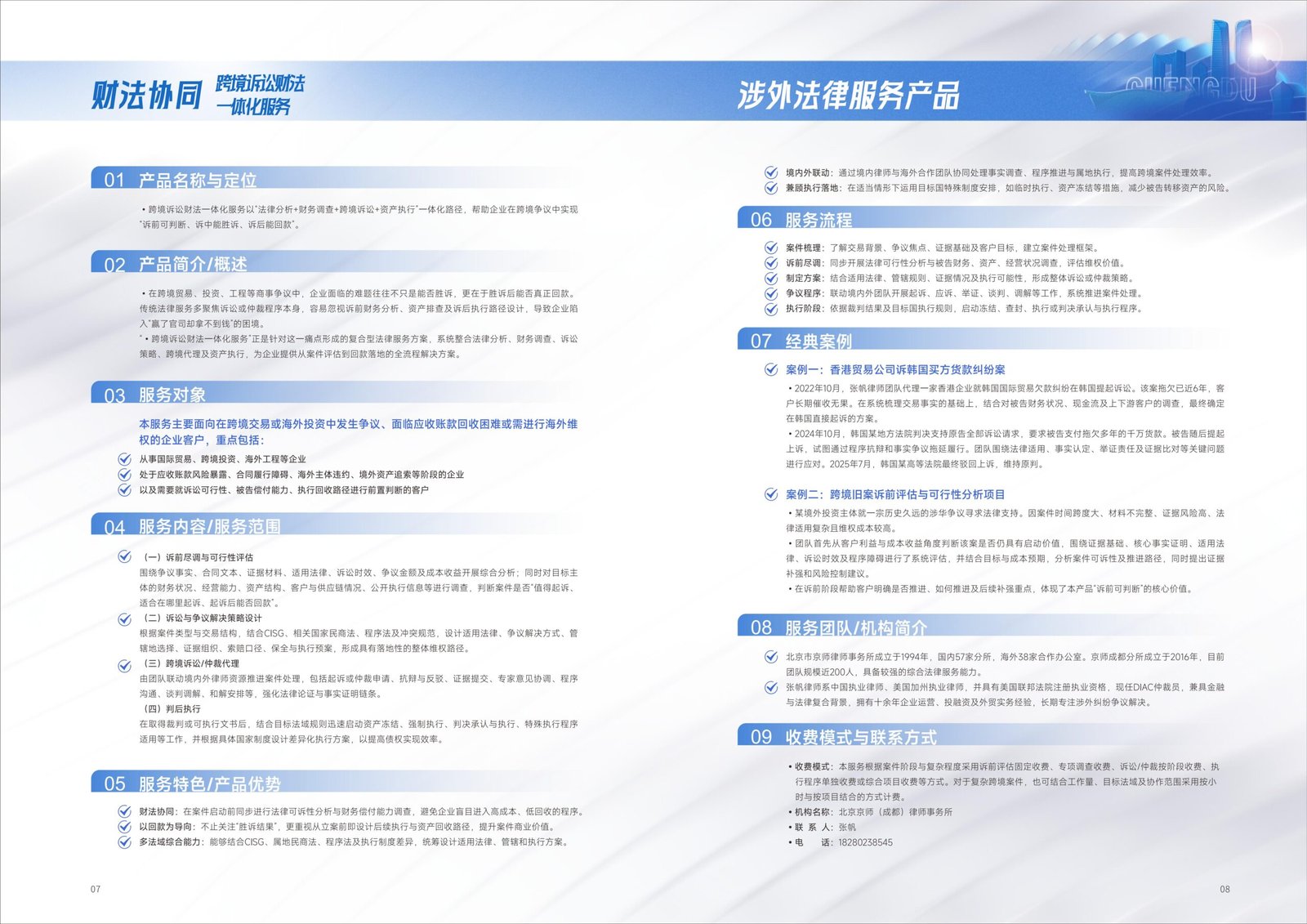
Integrated Finance-Law
Cross-Border Litigation Service
From obtaining judgments to recovering assets — a full-cycle approach that integrates financial strategy with legal expertise across multiple jurisdictions.
The Enforcement Gap
Winning your case is only half the battle. The other half — actually recovering your money — is where most cross-border disputes fail.
This is not a hypothetical scenario. It is the most common outcome in cross-border commercial disputes. Traditional legal services end at the courtroom door domestically. They focus on litigation and arbitration but neglect pre-suit financial plus asset analysis, litigation and post-judgment enforcement strategy. The result: a winning judgment and an empty recovery.
Legal Framework
Our service operates within — and leverages — the international legal instruments that govern cross-border trade disputes and judgment enforcement.
PRC Civil Procedure Law (2023)
Article 276 establishes foreign-related civil jurisdiction; Article 297 governs recognition and enforcement of foreign court judgments. The 2023 amendment significantly expanded China’s foreign-related procedural framework.
NPC Standing Committee →Hague Judgments Convention (2019)
The Convention on the Recognition and Enforcement of Foreign Judgments in Civil or Commercial Matters. China has signed but not yet ratified — creating the enforcement gap this service is designed to bridge.
HCCH Official Text →New York Convention (1958)
The Convention on the Recognition and Enforcement of Foreign Arbitral Awards — the most successful international dispute resolution instrument, with 172+ contracting states. Where a valid arbitration agreement exists, arbitration may offer a superior enforcement pathway.
UN Treaty Collection →Our Approach: Finance-Law Integration
We don’t just litigate. We design every legal strategy from the recovery perspective — working backwards from “how do we get the money back?”
Traditional Model
- Legal analysis only — no asset tracing
- Litigation/arbaitration-focused, enforcement is an afterthought
- Single-jurisdiction thinking
- Domestic and foreign counsel operate independently
- Reactive — responds to disputes after they arise
Finance-Law Integration
- Pre-suit financial due diligence + asset tracing
- Enforcement feasibility drives litigation strategy
- Multi-jurisdiction coordination (CISG + local law + procedure + enforcement)
- Domestic-international linkage with shared intelligence
- Proactive — strategy designed before filing
Service Structure
Two phases. Five steps. One goal: recovery.
Pre-Litigation Assessment & Strategy Design
Case Review
Transaction document audit (contracts, invoices, bills of lading, correspondence); dispute characterization; initial litigation/arbitration/negotiation pathway assessment.
Pre-Suit Due Diligence
Defendant asset tracing and financial analysis; operational status investigation; jurisdiction-specific enforcement regime assessment.
Strategy Formulation
Forum selection (court vs. arbitration, domestic vs. foreign — driven by asset location and enforceability); provisional measures strategy; cost-benefit analysis; litigation-enforcement timeline.
Dispute Resolution & Enforcement
Proceedings
Filing/lodging arbitration; asset preservation and provisional measures applications; evidence organization and hearing representation; obtaining judgment/award.
Enforcement & Recovery
Cross-border recognition and enforcement applications; asset pursuit and disposition; settlement negotiation leveraged by enforcement pressure; fund distribution and case closure.