
Fan Zhang Develops AI-Powered Cross-Border Trade & Regulatory Monitoring System
An intelligent automation platform harnessing NLP and AI to track anti-dumping, countervailing duty, and trade compliance regulations in real time
In the high-stakes world of international trade litigation, information is not just power — it is the decisive factor between winning and losing. On April 15, 2026, Fan Zhang registered a software copyright with the China National Copyright Administration for the Cross-Border Trade and Regulatory Information Continuous Monitoring System V1.0 — an AI-powered tool that combines natural language processing with intelligent automation to transform how law firms and enterprises track the torrent of regulatory changes governing global commerce. The system’s output is publicly accessible through the firm’s US Briefing Highlights page, where curated regulatory updates are published on an ongoing basis.
This registration marks a significant milestone: it is the rare convergence of deep legal expertise, independent software development, and AI technology, producing a proprietary intelligence asset purpose-built for the most demanding corner of cross-border legal practice — trade remedy proceedings, anti-dumping investigations, countervailing duty cases, and supply chain compliance. The system is not a theoretical concept: its curated outputs are already live at the US Briefing Highlights section, demonstrating real-world regulatory intelligence in action.
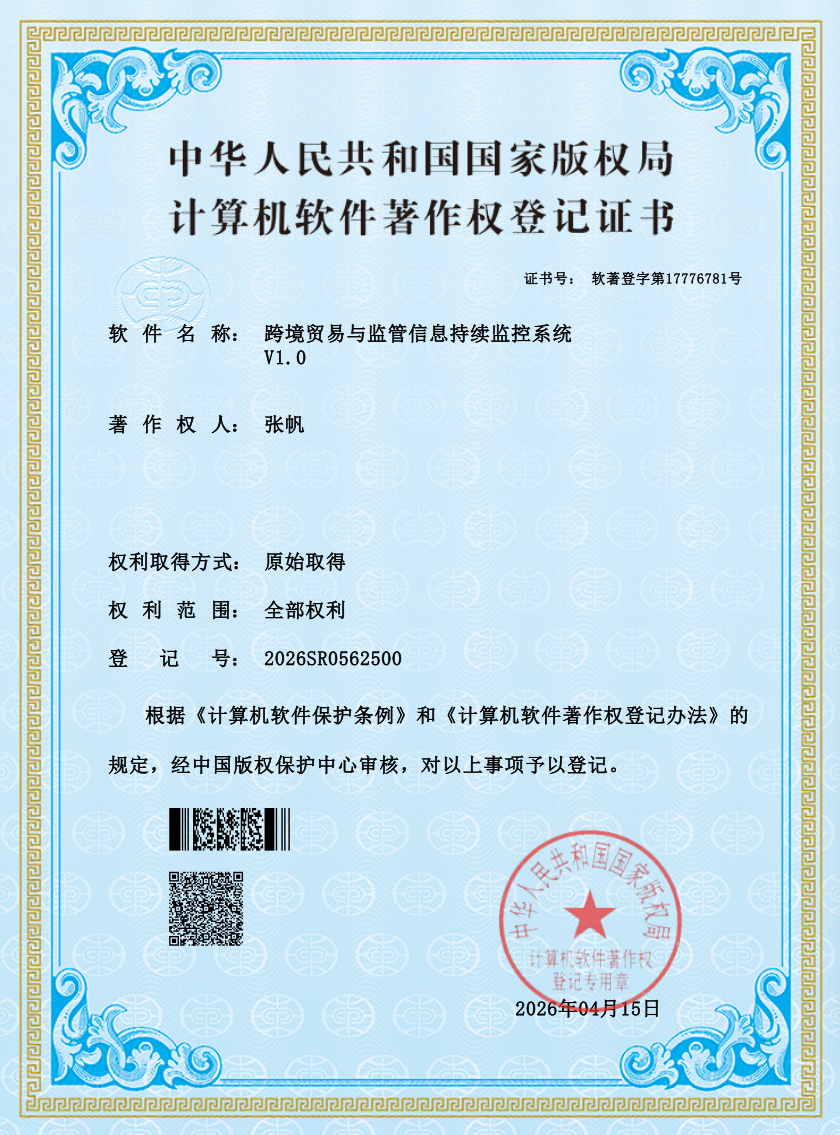
Software Copyright Registration Certificate — China National Copyright Administration (软著登字第17776781号)
Registration Details
The Problem: Why Traditional Trade Monitoring Fails
In an era of escalating trade tensions, shifting tariff regimes, and increasingly aggressive trade remedy enforcement, the volume of regulatory information governing cross-border commerce has grown exponentially. Government agencies — particularly the U.S. International Trade Commission (USITC), the U.S. Department of Commerce, and the U.S. Customs and Border Protection (CBP) — publish a constant stream of notices, determinations, and rule changes that directly impact importers, exporters, and their legal counsel.
Yet for most enterprises and even many law firms, the process of tracking these developments remains remarkably primitive. The consequences are severe — and in trade remedy cases, often irreversible.
Poor Timeliness — The Cost of a Single Day
Manual daily searches across fragmented government portals mean critical regulatory updates are discovered hours or days after publication. In anti-dumping and countervailing duty cases, a delayed response to a Commerce Department questionnaire can trigger adverse facts available (AFA) rates — effectively shutting a company out of the U.S. market.
Low Processing Efficiency — Drowning in Data
Official regulatory notices are dense, technical, and cross-referenced. Extracting the actionable core — a tariff rate change, a scope ruling, a sunset review schedule — requires skilled legal review. Manual processing consumes enormous human resources and introduces inconsistency.
Fragmented Management — No Institutional Memory
Without a unified archiving and classification system, monitoring insights exist only in individual inboxes or spreadsheets. When a team member departs, the knowledge departs with them. There is no systematic policy database, no historical trend analysis, and no institutional intelligence.
The Solution: An AI-Powered Full-Cycle Intelligence Platform
The Cross-Border Trade and Regulatory Information Continuous Monitoring System V1.0 was developed specifically to address these gaps. Built on an advanced automated workflow engine and integrated with an AI-powered natural language processing (NLP) module, the system achieves a full-process closed-loop from source monitoring to actionable intelligence — performing in seconds what would take a team of human analysts hours.
Real-Time Source Monitoring
Continuously scans authoritative regulatory sources including USITC, Commerce Department, CBP, Federal Register, and WTO dispute settlement bodies — capturing updates within minutes of publication.
Smart Classification & Archiving
Automatically categorizes updates by regulatory domain (anti-dumping, countervailing, tariff, customs, sanctions), department — building a searchable database.
Direct Application: Anti-Dumping & Countervailing Duty Cases
For enterprises facing or contemplating anti-dumping (AD) and countervailing duty (CVD) proceedings, the system’s value is immediate and measurable:
Early Warning on Petitions: The system detects new AD/CVD petition filings at the USITC after publication, giving respondents critical lead time to assemble defense teams, prepare factual evidence, and engage U.S. counsel before the initial investigation timeline compresses.
Scope Ruling Tracking: When CBP or Commerce issues a scope ruling affecting a product’s classification, the information immediately — preventing costly misclassifications that can result in retroactive duty liabilities or enforcement actions.
Tariff and Trade War Intelligence: From Section 301 tariffs to Section 232 national security measures, the system monitors the full spectrum of U.S. trade policy instruments affecting Chinese exporters — providing the strategic foresight needed to adjust pricing, supply chains, and market entry strategies.
In trade remedy litigation, the attorney who knows the regulation first usually wins. This system ensures we are always that attorney.
— Fan Zhang, Director of Foreign Legal Affairs, JINGSH ChengduWho Benefits from This Capability
The AI-powered system and the legal expertise behind it serve a diverse range of clients and stakeholders operating at the intersection of international trade and regulatory compliance:
Cross-Border Trade Enterprises
Manufacturers and exporters subject to AD/CVD investigations, tariff changes, or product standard modifications requiring real-time regulatory awareness and rapid legal response.
Legal & Compliance Service Providers
Law firms and compliance consultants representing clients in cross-border dispute resolution, trade remedy defense, and customs litigation who need first-source regulatory intelligence.
Industry Research & Consulting Firms
Analysts tracking long-term trade policy trends across specific jurisdictions, requiring systematic, automated collection of primary regulatory source material.
Supply Chain Management Teams
Operations managers monitoring logistics, customs clearance, and origin rule changes that affect sourcing decisions and inventory planning.
The AI Advantage: Why Technology Matters in Trade Law
The legal industry is undergoing a fundamental transformation — and AI is at the center of it. While many law firms are still exploring how to apply artificial intelligence to practice, this system represents an active deployment: an attorney-built AI tool that delivers measurable, immediate advantages in one of the most information-intensive areas of law.
This development complements Fan Zhang‘s existing credentials as a cross-border practitioner with director-level roles in three JINGSH national committees, three consecutive years of excellence awards, and extensive U.S. federal court admissions. She is admitted to practice before the U.S. Court of International Trade (CIT) — the forum where trade remedy cases are litigated — as well as the Federal Circuit (which hears appeals of CIT decisions), the Ninth Circuit, and two U.S. District Courts (CDCA and NDCA). She has also served as court-appointed counsel at the CIT, reflecting the judiciary’s recognition of her competence in trade matters.
For enterprises navigating the complex landscape of U.S.-China trade relations, EU regulatory compliance, or Middle East commercial arbitration, this integrated approach — combining AI-powered intelligence infrastructure with substantive federal court litigation credentials — offers a decisive advantage: legal strategy informed by real-time regulatory data, executed by a practitioner licensed to litigate in the very courts where those regulations are challenged and enforced.
Facing a Trade Remedy Investigation or Compliance Challenge?
Fan Zhang and the JINGSH Chengdu team combine deep legal expertise with AI-powered regulatory intelligence technology to deliver decisive results in cross-border trade matters.

