
U.S. Department of Commerce Lists Scope Ruling Applications for Antidumping and Countervailing Duty Orders Estimated reading time: 3–5 minutes The U.S. Department of Commerce has published a list of applications for scope rulings in antidumping (AD) and countervailing duty (CVD) proceedings. These applications were filed in August 2025. Scope rulings help decide if certain products are covered by existing AD or CVD orders. Details of Scope Ruling Applications Passenger Vehicle and Light Truck Tires From China Order Codes: A-570-016, C-570-017 Product: New pneumatic light truck tires made of rubber with a “LT” marking. Sizes are not listed in the 2023–2025 Tire and Rim Association Year Books. These tires have an outer diameter of 31 to 39 inches, section widths of 11.5 to 15.5 inches, radial construction, and inner diameters of 17 to 26 inches. They have ply ratings from 10 to 12, load indices from 100 to 128, and speed ratings of Q, P, or S. Producer/Exporter: China Applicant: Transamerica Tire Co., Ltd. (Transamerica) Date Filed: August 25, 2025 ACCESS Segment: “Transamerica” Common Alloy Aluminum Sheet From China Order Codes: A-570-073, C-570-074 Product: Aluminum composite panels (also called aluminum composite materials). These panels include a low-density polyethylene (LDPE) core, bonded between two aluminum sheets of the 3003-H24 series. Adhesive film coats both sides of the LDPE. The top and bottom aluminum sheets are painted different colors, and the top sheet has a protective film. The total thickness is 3mm. The top aluminum sheet is 0.5mm or 0.3mm thick, and the bottom sheet is 0.3mm thick. Producer/Exporter: China Applicant: Hong Kong Harbour Company Limited (HKH) Date Filed: August 28, 2025 ACCESS Segment: “HKH Aluminum Composite Panels” Process Information Commerce will accept a scope ruling application if it is not rejected or a scope inquiry is not started within 30 days after filing. If the 30th day is a non-business day, the next business day will be used. If the application is accepted, a scope inquiry will begin on day 31. If Commerce chooses to address the issue under a different process, it will let the applicant know. Scope inquiries will be conducted on the record of the AD proceeding if there are companion AD and CVD orders for the same product from the same country. Commerce can decide if the ruling will apply country-wide or only to specific companies. Public Access and Participation The full list of scope ruling applications is available at https://access.trade.gov. For more information on how to file or participate, visit https://access.trade.gov/help/Scope_Ruling_Guidance.pdf. Anyone wishing to take part in a scope inquiry must file an entry of appearance according to 19 CFR 351.103(d)(1) and 19 CFR 351.225(n)(4). Interested parties may ask to be on the annual inquiry service list during the anniversary month of the relevant order’s publication. This is in line with Commerce’s procedures under 19 CFR 351.225(n). Submitting Comments Comments about the completeness of this notice should be sent to Scot Fullerton, Acting Deputy Assistant Secretary for AD/CVD Operations, at the U.S. Department of Commerce. This notice, dated 2025-09-18, is published according to 19 CFR 351.225(d)(3). The public can check the current status of each scope ruling application on the ACCESS system. Legal Disclaimer This article includes content collected from the Federal Register (federalregister.gov). The content is not an official government publication. This article is for informational purposes only and does not constitute legal advice. For case-specific consultation, please contact us. Read our full Legal Disclaimer, which also includes information on translation accuracy.
Sol Gel Alumina-Based Ceramic Abrasive Grains From China; Determinations
USITC Finds Injury to U.S. Industry From Chinese Imports of Sol Gel Alumina-Based Ceramic Abrasive Grains Estimated reading time: 3–5 minutes On September 19, 2025, the United States International Trade Commission (USITC) made a final determination about imports from China. The USITC found that an industry in the United States is materially injured by imports of sol gel alumina-based ceramic abrasive grains from China. These grains are listed under subheading 2818.10.20 of the Harmonized Tariff Schedule of the United States. The Department of Commerce found that these imports from China are being sold in the U.S. at less than fair value and are subsidized by the Chinese government. The investigation was started on November 25, 2024. Petitions were filed by Saint-Gobain Ceramics & Plastics, Inc., of Malvern, Pennsylvania. The USITC decided to move forward with the final phase after Commerce made a preliminary ruling that the imports were subsidized as stated in section 703(b) of the Tariff Act of 1930 (19 U.S.C. 1671b(b)). A public notice was posted by the USITC about the final phase and a public hearing was scheduled. This information was made available in the Federal Register on June 2, 2025 (90 FR 23359). The hearing, which was planned for August 7, 2025, was later canceled, as announced in the Federal Register on August 8, 2025 (90 FR 38501). The USITC’s findings were finalized and filed on September 19, 2025. The views of the Commission are published in USITC Publication 5669, dated September 2025. The document is titled “Sol Gel Alumina-Based Ceramic Abrasive Grains from China: Investigation Nos. 701-TA-750 and 731-TA-1728 (Final).” Commissioner Johanson had a different view. He determined that the U.S. industry faces a threat of material injury from these imports, rather than current material injury. These actions were completed according to sections 705(b) and 735(b) of the Tariff Act of 1930 (19 U.S.C. 1671d(b) and 1673d(b)). The official order was issued by Sharon Bellamy, Supervisory Hearings and Information Officer of the USITC. Legal Disclaimer This article includes content collected from the Federal Register (federalregister.gov). The content is not an official government publication. This article is for informational purposes only and does not constitute legal advice. For case-specific consultation, please contact us. Read our full Legal Disclaimer, which also includes information on translation accuracy.
Carbon and Certain Alloy Steel Wire Rod From China; Scheduling of Expedited Five-Year Reviews
U.S. International Trade Commission Schedules Expedited Review of Steel Wire Rod Orders Estimated reading time: 3–5 minutes The United States International Trade Commission (USITC) has announced it will conduct expedited five-year reviews of antidumping and countervailing duty orders on carbon and certain alloy steel wire rod from China. The notice was issued on September 24, 2025, in the Federal Register (Volume 90, Number 183). The purpose of these reviews is to determine if removing the current duty orders would likely lead to a continuation or recurrence of material injury to the U.S. industry within a reasonably foreseeable time. The decision to proceed with expedited reviews comes after the USITC found that the group response from domestic interested parties was adequate. The response from the respondent interested party group was found to be inadequate. As a result, the Commission did not identify any reason to conduct full reviews. However, Commissioner Johanson voted to conduct full reviews. The reviews are being conducted according to the Tariff Act of 1930, section 751(c)(3), and under relevant sections of the Code of Federal Regulations (19 CFR parts 201 and 207). A staff report with details about the reviews has been placed in the nonpublic record. It will be made available on October 3, 2025, to those listed on the Administrative Protective Order service list. A public version will be issued later. Parties that have supplied individually adequate responses to the notice of institution, or parties other than interested parties, may submit written comments by October 9, 2025. These comments may not include new factual information. If the Department of Commerce extends the time limit for completing its final results, any comments regarding those results are due within three business days after Commerce issues its results. Only comments from Charter Steel, Commercial Metals Company (CMC), Liberty Steel USA, Nucor Steel, and Optimus Steel LLC will be accepted. These were found to be individually adequate responses. Comments from other interested parties will not be accepted. All documents submitted as part of the reviews must be served to all other parties and must include a certificate of service. Documents without the certificate will not be accepted. The Commission has determined that these reviews are extraordinarily complicated. Therefore, the review period may be extended by up to 90 days, following 19 U.S.C. 1675(c)(5)(B). These reviews are conducted under the authority of Title VII of the Tariff Act of 1930 and published according to Section 207.62 of the Commission’s rules. The notice was signed by Sharon Bellamy, Supervisory Hearings and Information Officer, and issued on September 22, 2025. Legal Disclaimer This article includes content collected from the Federal Register (federalregister.gov). The content is not an official government publication. This article is for informational purposes only and does not constitute legal advice. For case-specific consultation, please contact us. Read our full Legal Disclaimer, which also includes information on translation accuracy.
Multilayered Wood Flooring From the People’s Republic of China: Notice of Court Decision Not in Harmony With the Results of Countervailing Duty Administrative Review; Notice of Amended Final Results; Correction
Correction Issued on Multilayered Wood Flooring Countervailing Duty Review Estimated reading time: 3–5 minutes The U.S. Department of Commerce made a correction related to a recent court decision on multilayered wood flooring from the People’s Republic of China. On September 15, 2025, Commerce published a notice in the Federal Register. This notice was about the U.S. Court of International Trade’s (CIT) final judgment in Evolutions Flooring, Inc. et al. v. United States, Consol. Court no. 21-00591. The judgment covered the review of countervailing duties for wood flooring from China for the period January 1, 2018, through December 31, 2018. The original notice said the court’s judgment was not in harmony with Commerce’s final results of the administrative review. It also said Commerce would amend the final results for certain companies. However, Commerce found an error in the spelling of a company’s name. The company’s correct name is Dalian Shengyu Science and Technology Development Co., Ltd. This company is a producer/exporter without a superseding cash deposit rate. Commerce is also changing its cash deposit instruction for this company. The notice directs that, in the Federal Register of September 15, 2025 (FR Doc 2025-17777), on page 44371, the name should be corrected to “Dalian Shengyu Science and Technology Development Co., Ltd.” This correction applies to both the first column, where the company is named, and the second column, where it is listed in Appendix II. This correction is being shared as required by sections 516A(c) and (e) and 777(i)(1) of the Act. For more information, contact Jonathan Schueler or Laurel Smalley at the U.S. Department of Commerce, Enforcement and Compliance, AD/CVD Operations, Office VIII, Washington, DC 20230. Phone numbers are (202) 482-9175 or (202) 482-3456. This notice is signed by Christopher Abbott, Deputy Assistant Secretary for Policy and Negotiations, acting for the Assistant Secretary for Enforcement and Compliance. The official correction notice was filed on September 22, 2025. Legal Disclaimer This article includes content collected from the Federal Register (federalregister.gov). The content is not an official government publication. This article is for informational purposes only and does not constitute legal advice. For case-specific consultation, please contact us. Read our full Legal Disclaimer, which also includes information on translation accuracy.
Multilayered Wood Flooring From the People’s Republic of China: Notice of Court Decision Not in Harmony With the Results of Countervailing Duty Administrative Review; Notice of Amended Final Results
U.S. Amends Countervailing Duty Results for Multilayered Wood Flooring from China Estimated reading time: 3–5 minutes Background Commerce’s 2017 CVD review included important Chinese companies. The companies affected include Jiangsu Senmao Bamboo and Wood Industry Co., Ltd. (Jiangsu Senmao), Riverside Plywood Corporation and its cross-owned affiliates like Baroque Timber Industries (Zhongshan) Co., Ltd. (Baroque Timber), and non-selected companies under review. The case does not change the result for Jiangsu Guyu International Trading Co., Ltd. (Jiangsu Guyu). Commerce first published its 2017 review on November 27, 2020. It chose Baroque Timber and Jiangsu Guyu as mandatory respondents. Commerce did not select Jiangsu Senmao for individual review. Court Remands and Commerce Actions Jiangsu Senmao and other companies appealed Commerce’s results. On August 11, 2022, the CIT told Commerce to reconsider how it picked which companies to review and to recalculate the rate for companies not chosen for individual examination. After more court orders and remands, Commerce changed its methodology. The CIT then told Commerce to review Jiangsu Senmao as a main respondent and adjust its subsidy rate calculations for companies not chosen as main respondents. On August 8, 2025, Commerce issued new results. Commerce now based the rate for non-selected companies on both Baroque Timber and Jiangsu Senmao’s rates. The CIT accepted Commerce’s new final results on September 11, 2025. Subsidy Rates Assigned The amended rates for the 2017 period of review are: Producer/Exporter Subsidy Rate (percent ad valorem) Riverside Plywood Corporation and affiliates 13.18 Jiangsu Senmao Bamboo Wood Industry Co., Ltd. 2.45 Jiangsu Guyu International Trading Co., Ltd. 122.94 Non-selected companies under review 10.02 Cash Deposit Requirements Commerce will send new import duty collection (cash deposit) instructions to U.S. Customs and Border Protection (CBP) for some companies. If a company already has a newer deposit rate from a later review, Commerce will not issue new instructions. For Houzhou Chenchang Wood Co., Ltd., Shenzhenshi Huanwei Woods Co., Ltd., and Zhejiang Biyork Wood Co., Ltd., Commerce will issue new cash deposit instructions because they do not have newer rates. Liquidation of Entries At present, entries by Riverside Plywood Corporation, its affiliates, Jiangsu Senmao, and companies listed in Appendix II remain under court injunction and cannot be finalized. This applies to goods entered between January 1, 2017, and December 31, 2017. These entries will remain on hold until the appeals process is complete. If the CIT’s decision is not appealed, or after final court decisions, Commerce will instruct CBP to assess duties as per the amended rates, unless the rate is zero or de minimis. Companies Affected The companies impacted by these amended results are detailed in Appendices I and II of the official notice. Notice This action is required under U.S. law based on sections 516A(c) and (e) and 777(i)(1) of the Act. Dated: September 17, 2025 Christopher Abbott,Deputy Assistant Secretary for Policy and Negotiations For questions, contact:Jonathan Schueler (202-482-9175) or Laurel Smalley (202-482-3456),AD/CVD Operations, Office VIII, U.S. Department of Commerce. Legal Disclaimer This article includes content collected from the Federal Register (federalregister.gov). The content is not an official government publication. This article is for informational purposes only and does not constitute legal advice. For case-specific consultation, please contact us. Read our full Legal Disclaimer, which also includes information on translation accuracy.
Lightweight Thermal Paper From China; Scheduling of Expedited Five-Year Reviews
U.S. International Trade Commission Schedules Expedited Review for Lightweight Thermal Paper from China Estimated reading time: 7–10 minutes On September 23, 2025, the United States International Trade Commission (USITC) announced it is beginning expedited reviews of antidumping and countervailing duty orders for lightweight thermal paper from China. The reviews are being conducted under the Tariff Act of 1930. The Commission will decide if ending the current duties on lightweight thermal paper from China would likely cause harm to the U.S. paper industry in the future. The key date for this action is September 5, 2025. On this date, the USITC decided that the response from groups supporting U.S. industry was strong. The response from groups opposing the review was not strong. Because of this, the Commission chose an expedited review, following section 751(c)(3) of the Act (19 U.S.C. 1675(c)(3)). There are rules for how the review process happens. These rules can be found in the Commission’s Rules of Practice and Procedure—19 CFR part 201 and part 207. A staff report with information about this review is on the nonpublic record. The report will be shared with those on the Administrative Protective Order service list on October 17, 2025. A public version will come out later, as stated in the Commission’s rules. Written comments about these reviews can be submitted by interested parties who gave an individually adequate response to the notice of institution. Other people, who are not parties to the review, can also send a short written statement. Comments are due by 5:15 p.m. on October 23, 2025. Comments must not have new factual information. If the Department of Commerce extends its review, the deadline for comments will change to three business days after Commerce publishes its final results. Any comments with business proprietary information must meet the rules in 19 CFR 201.6, 207.3, and 207.7. Every document entered must be served to all others involved. Each document must have a certificate of service or it will not be accepted. The Commission has found Domtar Corporation’s response to be individually adequate. Other interested parties may not submit comments, according to 19 CFR 207.62(d)(2). The Commission has determined that these reviews are very complicated. Because of this, it is using its authority to add up to 90 days to the review period, following 19 U.S.C. 1675(c)(5)(B). This review is being done under the authority of title VII of the Tariff Act of 1930. The notice was published under section 207.62 of the Commission’s rules. For more information, contact Alexis Yim at the Office of Investigations (202-708-1446). Hearing-impaired persons can call 202-205-1810. Persons with mobility impairments should contact the Office of the Secretary at 202-205-2000. More information can also be found at the USITC website: usitc.gov or on the electronic docket at edis.usitc.gov. This notice was issued by Sharon Bellamy, Supervisory Hearings and Information Officer, on September 19, 2025. Legal Disclaimer This article includes content collected from the Federal Register (federalregister.gov). The content is not an official government publication. This article is for informational purposes only and does not constitute legal advice. For case-specific consultation, please contact us. Read our full Legal Disclaimer, which also includes information on translation accuracy.
Hot-Rolled Steel Products From China, India, Indonesia, Taiwan, Thailand, and Ukraine; Determinations
U.S. Keeps Tariffs on Hot-Rolled Steel From Six Countries Estimated reading time: 2–5 minutes On September 23, 2025, the United States International Trade Commission (USITC) announced its final decision in a major trade case. The USITC finished its fourth review of duties on hot-rolled steel products. The countries involved are China, India, Indonesia, Taiwan, Thailand, and Ukraine. The USITC decided not to revoke the current duties. This decision applies to two types of duties: countervailing duties and antidumping duties. The USITC found that removing these duties would probably cause harm again to the U.S. hot-rolled steel industry. This harm is called “material injury” in the law. Countries and Products Covered Countervailing duties stay on products from India, Indonesia, and Thailand. Antidumping duties remain on products from China, India, Indonesia, Taiwan, Thailand, and Ukraine. These duties will continue at current levels. They are meant to stop unfair foreign trade practices that hurt U.S. companies. About the Review The USITC began these reviews on July 1, 2024. The process followed all rules under the Tariff Act of 1930. A public hearing was held on July 24, 2025. Everyone who wanted to take part was given a chance. The official report is USITC Publication 5667. It is titled “Hot-Rolled Steel Products from China, India, Indonesia, Taiwan, Thailand, and Ukraine: Investigation Nos. 701-TA-405-406 and 408 and 731-TA-899-901 and 906-908 (Fourth Review).” Legal Reference The work was done as required by section 751(c) of the Tariff Act (19 U.S.C. 1675(c)). The determination was filed with the Secretary on September 19, 2025. Who Issued the Decision Sharon Bellamy, the Supervisory Hearings and Information Officer, issued the notice by order of the USITC. This decision means tariffs will stay in place to protect the U.S. steel industry from unfair trade for the next five years. Legal Disclaimer This article includes content collected from the Federal Register (federalregister.gov). The content is not an official government publication. This article is for informational purposes only and does not constitute legal advice. For case-specific consultation, please contact us. Read our full Legal Disclaimer, which also includes information on translation accuracy.
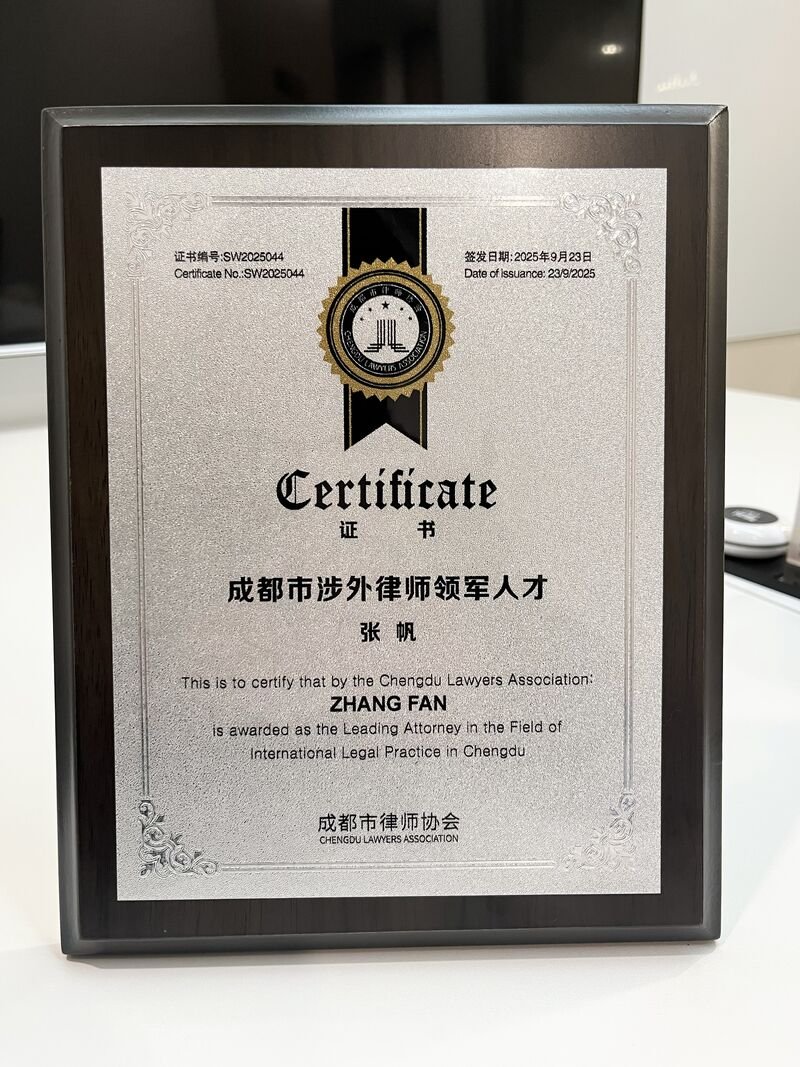
Leading Attorney in International Legal Practice | Cross-Border Legal Services
At the Tianfu Central Legal Zone Forum, Fan Zhang, Director at JINGSH Chengdu, accepts the award designating JINGSH Riyadh Office as an official Overseas Legal Service Station, strengthening global legal support for Chinese enterprises.
Agency Information Collection Activities; Proposed eCollection eComments Requested; Title-Revision of a Currently Approved Collection; Friction Ridge Cards: Arrest and Institution FD-249; Applicant FD-258; Identity History Summary Request FD-1164; FBI Standard Palm Print FD-884; Supplemental Finger and Palm Print FD-884a; Voluntary Appeal File Fingerprint FD-1212; Firearm-Related Challenge Fingerprint FD-1211 Restoration of Federal Firearm Rights Fingerprint FD-1222
FBI Releases Notice on Revised Friction Ridge Card Data Collection Estimated reading time: 3–5 minutes The Federal Bureau of Investigation (FBI) has announced a proposed change to its approved collection of friction ridge card data. This change was shared in the Federal Register on September 17, 2025. The public can comment on it for 60 days until November 17, 2025. The FBI collects and keeps fingerprint and palm print records using special forms. These records help law enforcement and government agencies identify people and keep records about criminal events. Details of the Collection The collection includes several forms: FD-249: Arrest and Institution FD-258: Applicant FD-1164: Identity History Summary Request FD-884: FBI Standard Palm Print FD-884a: Supplemental Finger and Palm Print FD-1212: Voluntary Appeal File Fingerprint FD-1211: Firearm-Related Challenge Fingerprint FD-1222: Restoration of Federal Firearm Rights These forms are for law enforcement groups and civil groups that need security checks or background checks. The record data is kept in the FBI’s Next Generation Identification System (NGI). Purpose of the Collection The FBI collects this information under Title 28, United States Code, Section 534. This law lets the FBI gather, keep, and share identification records, including for criminal and other investigations. The forms make sure the FBI can help other agencies across the country. Statistics and Burden The expected number of respondents each year is 459,238. Each response is estimated to take 10 minutes. The total yearly burden is about 12.4 million hours. The total annual cost for this collection is $0. Feedback and Questions People can send comments about: If collecting this information is needed. If the estimated time and process are correct. Ways to make the collection better or clearer. How to make it easier for people to submit information, including electronic ways. For more information or to give feedback, contact Brian A. Cain at the FBI’s Criminal History Information and Policy Unit in Clarksburg, West Virginia. You can call 304-625-5590 or email the office. For other details, contact Darwin Arceo at the U.S. Department of Justice in Washington, D.C. This notice was shared by Darwin Arceo, Department Clearance Officer for the Paperwork Reduction Act, U.S. Department of Justice, on September 15, 2025. Legal Disclaimer This article includes content collected from the Federal Register (federalregister.gov). The content is not an official government publication. This article is for informational purposes only and does not constitute legal advice. For case-specific consultation, please contact us. Read our full Legal Disclaimer, which also includes information on translation accuracy.
Agency Information Collection Activities; Proposed eCollection eComments; Requested; New Collection; Title-Optional Flexible Financial Assistance Survey
U.S. Justice Department Seeks Comments on New Financial Assistance Survey for Victims Estimated reading time: 3–5 minutes What Is the Survey About? The survey is called the Optional Flexible Financial Assistance Survey. It is part of the Financial Assistance Grants for Victims of Sexual Assault, Domestic Violence, Dating Violence, and Stalking Program (FAV Program). This program began in 2024. It helps victims by giving them quick and flexible financial help. The financial help is for things victims need to stay safe and stable. Sometimes, traditional services do not cover these things. This new survey will help the program learn if the help works well. How Will the Survey Be Used? The survey is short and optional. It will be given to people who get flexible financial help from FAV Program grantees. The survey will be sent online. Grantees will collect the answers and report them to OVW twice a year. The results will show Congress and others how the program is working. What Does the Survey Ask? The survey will ask survivors questions like: How and when they got financial help, How the help affected their safety and their families. The survey will not ask for a lot of information, just what is needed to see if the program is working. Who Will Take the Survey? About 2,600 people will take the survey each year. OVW expects 13 grantees to give financial help. Each grantee will ask about 200 people to take the survey per year. How Long Will the Survey Take? Each survey will take about 10 minutes. Altogether, this means about 433 hours are needed for everyone to finish the survey each year. How Can You Comment? The DOJ wants comments from the public. Comments should be about: If the survey is needed, If the estimate of how long it takes is correct, Ways to improve the survey, How to reduce the work for people taking the survey. Comments will be accepted until November 17, 2025. Contact Details If you want a copy of the survey or have questions, contact Tiffany Watson at the Office on Violence Against Women by phone at 202-514-5430 or by email. For more information, you can also contact Darwin Arceo, Department Clearance Officer, at the U.S. Department of Justice, Justice Management Division. Key Facts Table Activity Estimated Respondents Responses per Person Total Responses Time per Response (min) Total Hours Flexible Financial Assistance Survey 2,600 1 2,600 10 433 The Department of Justice is taking this step to help victims get better support and protection. The public’s ideas and comments will help make the program better. Legal Disclaimer This article includes content collected from the Federal Register (federalregister.gov). The content is not an official government publication. This article is for informational purposes only and does not constitute legal advice. For case-specific consultation, please contact us. Read our full Legal Disclaimer, which also includes information on translation accuracy.
Agency Information Collection Activities; Proposed eCollection eComments Requested; Revision of a Previously Approved Collection; Title-Voluntary Appeal File (VAF) Application Form
Justice Department Seeks Comments on Voluntary Appeal File Application Update Estimated reading time: 5 minutes The Department of Justice, Federal Bureau of Investigation (FBI), is asking for public comments on changes to the Voluntary Appeal File (VAF) Application Form. This is a notice from the Criminal Justice Information Services Division. People have 60 days to send comments, ending November 17, 2025. The FBI wants to hear more about: Whether the new information the form collects is useful. If the time it takes to fill out the form makes sense. Ways to make the form clearer. How to make the form easier to use, including online options. About the Voluntary Appeal File (VAF): If a person is delayed or told “no” when trying to buy a firearm, but they appeal and win, the FBI cannot keep a record of that decision or supporting documents. If the person tries to buy a firearm again, there can be more delays or denials. The person may need to submit documents again for each appeal. The VAF was created to help with this problem. People can ask the FBI to keep their information in the VAF. This can stop delays or wrong denials in the future. If accepted, the person gets a Unique Personal Identification Number (UPIN). They give their UPIN when buying a firearm, using the National Instant Criminal Background Check System (NICS). The VAF UPIN may help in other situations too, like for National Firearms Act gun checks or upcoming “firearm handler background checks.” People who have never been in a NICS check can also apply to the VAF to avoid problems later. Details of the Information Collection: Type of Collection: Revision of an approved collection. Form Title: Voluntary Appeal File (VAF) Application Form. Form Number: 1110-0043. Who Responds: Individuals. Response is voluntary. Time to Complete: About 30 minutes per person, not including travel for fingerprints or postage. Number of Respondents: About 11,073 people may apply each year. Total Time Spent Each Year: 5,536.5 hours total, based on all applicants. Some applications are resolved quickly. If fingerprints show the person is not restricted, it may take one day. If the person matches a possible restriction, the FBI might take up to 60 days, as they may need help from other agencies. Because of this, it is hard to estimate how long it will take to process all applications every year. For more information or to comment, contact Jill Montgomery at the FBI NICS Section, 1000 Custer Hollow Road, Clarksburg, WV 26306, or call 304-709-1476. Official contact at the Department of Justice: Darwin Arceo, Justice Management Division, Two Constitution Square, 145 N Street NE, 4W-218, Washington, DC. This notice was dated September 15, 2025. Legal Disclaimer This article includes content collected from the Federal Register (federalregister.gov). The content is not an official government publication. This article is for informational purposes only and does not constitute legal advice. For case-specific consultation, please contact us. Read our full Legal Disclaimer, which also includes information on translation accuracy.
Agency Information Collection Activities; Proposed eCollection eComments Requested; Revision of a Previously Approved Collection; ViCAP National Crime Database
Department of Justice Seeks Comments on ViCAP National Crime Database Collection Estimated reading time: 3–5 minutes The Department of Justice, through the Federal Bureau of Investigation (FBI), is asking for public comments on a revised information collection for the ViCAP National Crime Database. This request follows the rules set by the Paperwork Reduction Act of 1995. The Critical Incident Response Group (CIRG) of the FBI will submit this information collection request to the Office of Management and Budget (OMB) for review and approval. The public comment period is open for 60 days until November 17, 2025. Anyone with questions, suggestions, or requests for copies of the proposed collection instrument and instructions can contact Nathan Graham, Program Manager at the FBI’s Critical Incident Response Group. He can be reached at the FBI Academy, Quantico, VA 22135, by phone at (703) 632-4309. The Department encourages people to provide feedback on these points: Is the information collection needed for the FBI’s work, and does it have practical use? Is the FBI’s estimate of the public’s time and the number of responses correct? Can the quality, usefulness, or clarity of the information be improved? How can the burden on people who respond be reduced, for example, by using electronic or other technology? Details about the ViCAP National Crime Database: ViCAP is a unit within the FBI that studies serial violent and sexual crimes. The ViCAP National Crime Database is the largest U.S. collection of major violent crime case information. It collects and analyzes information about: Homicides (and attempted homicides) that are part of a series, appear random, or are sexually oriented Sexual assaults that are part of a series, or are committed by a stranger Missing persons, if foul play is likely and the victim is still missing Unidentified human remains when the cause of death may be homicide Overview of the Collection: Type of Information Collection: It is a revision of a collection already approved. Title of the Form/Collection: ViCAP National Crime Database. Agency Form Number: None. Affected Public: State, local, and tribal governments. Response is voluntary. Number of Respondents and Time: There are about 5,700 respondents each year. Each response takes about 20 minutes. Annual Burden: Total annual burden is about 1,900 hours (5,700 responses x 20 minutes each). Annual Cost Burden: There is no cost. Summary Table Activity Number of Respondents Frequency Total Annual Responses Time per Response (min) Total Annual Burden (hours) ViCAP National Crime Database 5,700 1 5,700 20 1,900 If more information is needed, readers can contact Darwin Arceo, Department Clearance Officer at the United States Department of Justice, 145 N Street NE, 4W-218, Washington, DC. This notice was signed by Darwin Arceo on September 15, 2025, as the Department Clearance Officer for the Paperwork Reduction Act at the U.S. Department of Justice. Legal Disclaimer This article includes content collected from the Federal Register (federalregister.gov). The content is not an official government publication. This article is for informational purposes only and does not constitute legal advice. For case-specific consultation, please contact us. Read our full Legal Disclaimer, which also includes information on translation accuracy.
Notice of Federal Advisory Committee Charter Renewal; Name of the Committee: NIC Advisory Board
NIC Advisory Board Charter Renewed Through 2027 Estimated reading time: 1–2 minutes The National Institute of Corrections (NIC) has renewed the charter for the NIC Advisory Board. The renewal is for two years, and it lasts through September 12, 2027. The NIC Advisory Board is a federal advisory committee. It was created by law under the Federal Advisory Committee Act, found at 5 U.S.C. 1001-1014 and 41 CFR 102-3.50(a). This law guides how advisory committees work in the government. The Advisory Board gives advice to the NIC on long-range plans and program development. It also recommends guidance to help NIC’s efforts. The Board also gives advice to the Attorney General about picking the Director of the NIC. The NIC helps corrections agencies at the federal, state, and local levels. It provides training, technical help, information, and development of policies and programs. It gives award funds to help start or run important correctional programs. The NIC tries to lead and guide how corrections work is done in the United States. Anyone can get a full copy of the NIC Advisory Board Charter. It can be downloaded as a PDF from the NIC website at https://nicic.gov. People can also ask for a paper copy by sending a mail request to the National Institute of Corrections, 320 1st Street NW, Washington, DC 20534. People who want to know more can contact Leslie LeMaster, who is the Designated Federal Officer. The phone number is (202) 305-5773, and the email is available on the NIC website. This notice is official and meets the rules of the Federal Advisory Committee Act, Public Law 92-463, as amended. The renewal was announced by Leslie LeMaster, Designated Federal Officer, National Institute of Corrections. Legal Disclaimer This article includes content collected from the Federal Register (federalregister.gov). The content is not an official government publication. This article is for informational purposes only and does not constitute legal advice. For case-specific consultation, please contact us. Read our full Legal Disclaimer, which also includes information on translation accuracy.
Notice of the Opening of the Inclusions Window for the Section 232 Steel and Aluminum Tariff Inclusions Process
Notice: September 2025 Section 232 Steel and Aluminum Tariff Inclusions Window Opens Estimated reading time: 2–4 minutes The Bureau of Industry and Security (BIS) has opened a new window for requests to include additional steel and aluminum products within Section 232 tariffs. This process is related to the President’s orders under Section 232 of the Trade Expansion Act of 1962. These orders are part of Proclamations 10895 and 10896, issued on February 10, 2025. The Proclamations made new tariff rates for steel and aluminum imports, including certain extra products made from steel and aluminum. The BIS has set up a process to let people request more products to be added under these duties. Window Dates and Submission Information The window is open from September 15, 2025, until 11:59 PM ET on September 29, 2025. Only submissions for inclusion requests will be accepted during this time. All submissions must be sent by email to the Defense Industrial Base Programs inbox at the BIS. Process Details After the window closes, accepted requests will be posted online for a two-week public comment period. This will be on Docket ID BIS-2025-0023 at Regulations.gov. The process follows the interim final rule published on May 2, 2025 (90 FR 18780). There are set submission periods each year in May, September, and January. Contact Information For questions or more information about the inclusions process, contact Stephen Astle at 202-482-4506. For steel, email [email addresses as listed in notice]. For aluminum, email [email addresses as listed in notice]. More information and details about the submission process can be found in the interim final rule. Robby S. Saunders Deputy Assistant Secretary for Technology Security Federal Register Notice 2025-18008, September 17, 2025 Bureau of Industry and Security U.S. Department of Commerce Legal Disclaimer This article includes content collected from the Federal Register (federalregister.gov). The content is not an official government publication. This article is for informational purposes only and does not constitute legal advice. For case-specific consultation, please contact us. Read our full Legal Disclaimer, which also includes information on translation accuracy.
Adoption and Procedures of the Section 232 Automobile Parts Tariff Inclusions Process
U.S. Sets New Process for Adding Auto Parts to Tariffs Estimated reading time: 3–5 minutes On September 17, 2025, the U.S. Department of Commerce announced a new process for including additional automobile parts in tariffs. This decision comes after President Biden issued Proclamation 10908 on March 26, 2025. This proclamation directs that more auto parts may be added to the scope of tariffs to protect national security. Key Points of the New Rule The rule became effective on September 17, 2025. The aim is to include more automobile parts under existing tariffs if imports of these parts threaten U.S. national security. The process is detailed under Section 232 of the Trade Expansion Act of 1962. Who Can Request Additions Any U.S. producer of automobiles or automobile parts may make a request. Industry associations representing these producers can also request inclusions. How and When to Apply Inclusion requests are accepted during two-week windows, four times a year. The windows open at the start of January, April, July, and October. The first submission window opens on October 1, 2025. Requests should be sent in PDF format to a dedicated email inbox. Each request must be no longer than 30 pages, including all attachments. Information Needed in Requests Requests must include: Clear identification of the requester. A detailed description of the specific auto part. The eight or ten-digit Harmonized Tariff Schedule of the United States (HTSUS) code. An explanation about why the article is an automobile part. Information about the domestic industry affected by the part. Import and domestic production statistics. A description of how increased imports threaten national security or the goals set by the Proclamation. If any information is missing or incorrect, requesters may get a 48-hour period to fix and resubmit the request. Public Comment Process Valid requests are posted for public review. There will be a 14-day public comment window after each submission period. Public comments must be submitted through regulations.gov using specific IDs for each quarterly window. Decision Timeline The Secretary of Commerce will make a decision on each request within 60 days. For each request, a memorandum stating approval or denial will be posted on regulations.gov. The rationale for the decision will be included. Any new parts added to the tariffs are effective the day after a Federal Register notice is published. Regulatory Details The rule is published as an interim final rule. The Office of Management and Budget has approved the information collection under emergency processing. The process is exempt from some federal rulemaking procedures due to its national security purpose. The rule does not affect state or local government authority. How to Comment on the Rule Itself Comments about the rule should be made separately from the inclusion requests. Rule comments must be submitted at regulations.gov under ID ITA-2025-0041 and by November 3, 2025. More Information For questions, contact Emily Davis, Director for Public Affairs at the International Trade Administration, U.S. Department of Commerce. The official rule appears in the Federal Register, Volume 90, No. 178, pages 44767-44772 (September 17, 2025), under Docket No. 250728-0130, RIN 0625-AB30. Legal Disclaimer This article includes content collected from the Federal Register (federalregister.gov). The content is not an official government publication. This article is for informational purposes only and does not constitute legal advice. For case-specific consultation, please contact us. Read our full Legal Disclaimer, which also includes information on translation accuracy.
Wooden Bedroom Furniture From the People’s Republic of China: Final Results of Antidumping Duty Administrative Review; 2023
U.S. Finds Eight Chinese Exporters Part of China-Wide Entity in Wooden Bedroom Furniture Case Estimated reading time: 3–5 minutes On September 17, 2025, the U.S. Department of Commerce announced the final results of its review of antidumping duties for wooden bedroom furniture from China. The review looked at exports made between January 1, 2023, and December 31, 2023. Commerce decided that eight exporters from China did not show that they qualify for a separate rate from the China-wide entity. These exporters are: Dorbest Ltd. Fine Furniture (Shanghai) Ltd. Rui Feng Lumber Development Co., Ltd. Rui Feng Woodwork Co., Ltd. Wanvog Furniture (Kunshan) Co., Ltd. Yeh Brothers World Trade Inc. Zhongshan Fookyik Furniture Co., Ltd. Shenzhen New Fudu Furniture Co., Ltd. These companies either did not file the required forms, did not respond to requests for information, or failed to show that they meet the rules for a separate rate. Because of this, they are treated as part of the China-wide entity. Commerce did not calculate any individual dumping margins for this review. There are no new calculations to share. For all entries of wooden bedroom furniture from these companies, the U.S. Customs and Border Protection (CBP) will collect antidumping duties at the China-wide entity rate. The current China-wide rate is 216.01 percent. The cash deposit requirements for shipments will be as follows: If an exporter already has a separate rate from a past review, that rate is still used. For exporters from China that do not have a separate rate, including those listed above, the cash deposit rate is 216.01 percent. For non-China exporters with no separate rate, the rate will match the Chinese supplier they used. Importers must file a certificate showing they did not get reimbursed for antidumping duties before their entries are finalized. If they do not do this, they may have to pay double duties. This notice also reminds anyone under an Administrative Protective Order to follow rules for handling confidential information. These results were published under the authority of the Tariff Act of 1930 and United States regulations. For more information, interested parties can find the full decision and related documents on the Enforcement and Compliance’s ACCESS website. Legal Disclaimer This article includes content collected from the Federal Register (federalregister.gov). The content is not an official government publication. This article is for informational purposes only and does not constitute legal advice. For case-specific consultation, please contact us. Read our full Legal Disclaimer, which also includes information on translation accuracy.
Wooden Cabinets and Vanities and Components Thereof From the People’s Republic of China: Continuation of Antidumping Duty Order and Countervailing Duty
U.S. Keeps Special Taxes on Wooden Cabinets and Vanities From China Estimated reading time: 4 minutes Why Are There Special Taxes? The U.S. Department of Commerce (Commerce) is keeping its special taxes, called antidumping and countervailing duties, on wooden cabinets and vanities from China. This decision was made because removing the taxes could lead to more unfair trading and hurt U.S. companies. Commerce and the U.S. International Trade Commission (ITC) looked at the trade rules about wooden cabinets and vanities from China. They found that if the special taxes were removed, more unfair trading, called dumping and subsidies, would happen. This would likely hurt companies in the United States. What Products Are Covered? The taxes apply to wooden cabinets and vanities and their parts from China. These products are usually used in kitchens and bathrooms. They can be floor mounted, wall mounted, or attached in other ways. The material can be real wood or wood made from particles, fibers, or bamboo. Wooden cabinets and vanities, with or without wooden or other coverings. Wooden component parts, such as frames, cabinet boxes, doors, drawers, shelves, and panels. “Ready to assemble” cabinets, also known as “flat packs.” Cabinets and vanities imported with sinks, faucets, plumbing, or countertops. Only the wooden part is taxed. Wooden cabinets and vanities processed in another country (such as cutting, painting, or assembly) are still included. What Is Not Included? Some products are not taxed. These include: Accessories added after making the cabinet, like drawer organizers or lazy Susans. Solid wooden decorations, like corbels and rosettes. Hardware made of metal, like hinges, handles, or screws. Medicine cabinets that are wall mounted, have mirrors, are assembled before shipping, are sold ready for retail, and are no deeper than seven inches. Wooden bedroom furniture. Hardwood plywood that is taxed under other rules. Trade Code Numbers These products are listed under special trade codes. The main codes are 9403.40.9060 and 9403.60.8081. Some parts may use codes 9403.90.7080 and 9403.91.0080. What Happens Next? Customs officers will keep collecting the special taxes on these products when they enter the United States. This rule began on September 9, 2025. The next check on these taxes will happen five years from the last ITC decision. Important Reminders Parties with special business information must keep following the rules on how to return or destroy the information. Breaking those rules could lead to punishment. This notice follows all U.S. trade law rules. It was officially signed by Christopher Abbott, Deputy Assistant Secretary for Policy and Negotiations, on September 12, 2025. Legal Disclaimer This article includes content collected from the Federal Register (federalregister.gov). The content is not an official government publication. This article is for informational purposes only and does not constitute legal advice. For case-specific consultation, please contact us. Read our full Legal Disclaimer, which also includes information on translation accuracy.
Methylene Diphenyl Diisocyanate From the People’s Republic of China: Preliminary Affirmative Determination of Sales at Less-Than-Fair-Value, Postponement of Final Determination, and Extension of Provisional Measures
U.S. Finds Chinese MDI Sold Below Fair Value in Preliminary Decision Estimated reading time: 3–5 minutes The U.S. Department of Commerce announced a preliminary finding on methylene diphenyl diisocyanate (MDI) from China. Commerce determined that MDI from the People’s Republic of China is being, or is likely to be, sold in the United States at less-than-fair-value (LTFV). What is MDI? MDI is a chemical used in making foams and plastics. It has two or more isocyanate groups connected to benzene rings with methylene bridges. MDI can be liquid or solid. Some of the common names for MDI include Polymeric MDI, Monomeric MDI, and Modified MDI. The investigation covers all types and grades of MDI from China, regardless of their physical form, additives, or packaging. Investigation Scope The investigation covers MDI and products containing more than 40% MDI by weight. Some products with less MDI or that are highly modified are not included. If MDI is processed in a third country or mixed with MDI from other sources, only the Chinese component is covered. Preliminary Dumping Margins Commerce found these estimated dumping margins for Chinese exporters and producers: Covestro Polymers (China) Co., Ltd.: 376.12% Shandong Mingko Co., Ltd.: 376.12% China-wide entity: 511.75% (based on facts available with adverse inferences) These margins show that MDI from China is being sold in the U.S. at much lower prices than normal value. Suspension of Liquidation U.S. Customs and Border Protection will suspend liquidation of MDI from China that is entered or withdrawn for consumption on or after the date of publication of the notice. Importers will need to provide a cash deposit equal to the dumping margin above for their specific supplier. How Did Commerce Make Its Decision? Commerce used information from the original petition and relied on facts available for the China-wide entity. For companies not individually examined, Commerce used the average margin alleged in the petition (376.12%). No Changes to Scope No parties commented on the scope of the products covered. Therefore, the scope remains unchanged from the initial notice. Public Comments and Hearing Requests Interested parties can submit written comments (case briefs) within 30 days of the notice’s publication. Parties may also request a hearing on the issues raised. If requested, the hearing date will be announced by Commerce. Postponement of Final Decision Wanhua Singapore and Wanhua Ningbo requested to postpone the final determination. Commerce agreed, extending the final decision deadline to 135 days after this notice. Provisional measures (such as cash deposits) may now last up to six months. Next Steps Commerce will send its findings to the U.S. International Trade Commission (ITC). If the final determination confirms the preliminary findings, the ITC will then decide if imports of MDI from China harm U.S. industry. Details and Contacts The full decision can be found online at https://access.trade.gov. For further information, contact Kayden Jenson or Christopher Maciuba at the International Trade Administration in Washington, DC. This finding was published in the Federal Register on September 16, 2025 (Volume 90, Number 177, Pages 44629-44632). Legal Disclaimer This article includes content collected from the Federal Register (federalregister.gov). The content is not an official government publication. This article is for informational purposes only and does not constitute legal advice. For case-specific consultation, please contact us. Read our full Legal Disclaimer, which also includes information on translation accuracy.
Certain Cameras, Camera Systems, and Accessories Used Therewith; Notice of Commission Determination To Review in Part a Final Initial Determination of Violation of Section 337; Schedule for Filing Written Submissions on Certain Issues Under Review and on Remedy, the Public Interest, and Bonding
U.S. International Trade Commission Reviews Patent Case Involving GoPro and Insta360 Estimated reading time: 6–10 minutes Background of the Case GoPro, a camera company based in California, filed a complaint on May 6, 2024. They claimed Insta360 imported cameras and accessories into the U.S. that violated six of GoPro’s patents. These patents included five “utility” patents for different camera technologies and one design patent known as D789,435. The ITC began an official investigation soon after the complaint. Insta360 is based in Shenzhen, China, with a U.S. branch in Irvine, California. Changes in Claims During the Case GoPro withdrew some of its claims during the investigation. By the end of the case, GoPro was only asserting certain claims for each of the six patents. ALJ’s Initial Findings The Administrative Law Judge (ALJ) held a hearing in January 2025. On July 11, 2025, the ALJ made a decision: Insta360 violated Section 337 with respect to GoPro’s design patent D789,435. Insta360 did not violate Section 337 with respect to the five utility patents. The ALJ also made several findings about patent infringement, invalidity, and whether GoPro’s products satisfied certain legal requirements. These included: Some GoPro patent claims were found invalid or not infringed. Some claims were satisfied for domestic industry needs. The design patent D’435 was found infringed and valid. Proposed Remedies from the ALJ If the ITC finds a violation, the ALJ recommended: A limited exclusion order to block certain Insta360 products from entering the U.S. A cease and desist order to stop Arashi Vision (U.S.) LLC from certain sales, since it had significant inventory. A bond set at zero percent of entered value, because GoPro’s products cost less than Insta360’s. Petitions for Review On July 25, 2025, both GoPro and Insta360 challenged parts of the decision and asked for review. They disagreed over both the final findings and specific issues related to the design and utility patents. They filed responses to each other’s petitions on August 4, 2025. Comments from Public and Government Officials The ITC asked for public comments about the case on July 15, 2025. Several U.S. Representatives and the involved companies submitted opinions. Issues Under ITC Review The ITC will review parts of the decision involving: Certain limits in the ‘840 patent. Some language in the ‘052 patent. The ALJ’s finding that certain Insta360 products infringe the design patent D’435. The ITC does not plan to review the rest of the ALJ’s findings. Questions and Next Steps The ITC is asking the parties to explain whether Insta360 products infringe GoPro’s D’435 design patent. They especially want to know about Insta360’s rear screen, which can be in many positions. The ITC also requests written answers on potential remedies, the public interest, and whether warranty and repair parts should be exempt from any orders. The public interest includes concerns for health, the U.S. economy, competition, U.S. production, and consumers. If the ITC orders a remedy, the U.S. Trade Representative will have 60 days to review. During that review, products can enter the U.S. under bond. Deadline for Written Submissions All main written submissions must be filed by September 25, 2025. Reply submissions are due by October 2, 2025. There are page limits for all submissions, and parties must follow all ITC rules. Contact Information People can find documents online at https://edis.usitc.gov or get general details at https://www.usitc.gov. For filing questions, call (202) 205-2000. By order of the Commission.Issued: September 11, 2025.Supervisory Attorney: Susan Orndoff. Legal Disclaimer This article includes content collected from the Federal Register (federalregister.gov). The content is not an official government publication. This article is for informational purposes only and does not constitute legal advice. For case-specific consultation, please contact us. Read our full Legal Disclaimer, which also includes information on translation accuracy.
Multilayered Wood Flooring From the People’s Republic of China: Notice of Court Decision Not in Harmony With the Results of Countervailing Duty Administrative Review; Notice of Amended Final Results
Court Orders Amended Results in Chinese Wood Flooring Duty Review Estimated reading time: 3 minutes Court Orders Amended Results in Chinese Wood Flooring Duty Review On August 29, 2025, the U.S. Court of International Trade (CIT) gave its final judgment in the case of Evolutions Flooring, Inc. et al. v. United States, Consol. Court No. 21-00591. The CIT agreed with the U.S. Department of Commerce’s revised findings about the countervailing duty on multilayered wood flooring from China for goods imported between January 1, 2018, and December 31, 2018. Changes to Subsidy Rates Riverside Plywood Corporation and its cross-owned affiliates: 9.02% Jiangsu Senmao Bamboo Wood Industry Co., Ltd.: 5.29% Non-selected companies under review: 7.91% Background of the Decision In its earlier decision on October 27, 2021, Commerce used certain facts to say that the Government of China’s Export Buyer’s Credit Program (EBCP) applied to companies under review. This contributed to their subsidy rates. Later, the Department fixed errors in its calculations. Evolutions Flooring, Inc. and others appealed the results. On March 27, 2025, the CIT sent the decision back for corrections. The Commerce Department then found that Jiangsu Senmao did not use the EBCP during the review period. It also corrected calculation mistakes for Baroque Timber. Cash Deposit Rules The Commerce Department will update instructions for U.S. Customs and Border Protection (CBP). However, companies listed in Appendix I already have newer cash deposit rates, so their current rates will not change. For Dailan Shengyu Science and Technology Development Co., Ltd., which does not have a newer rate, new instructions will be sent to CBP. Liquidation of Entries Certain entries remain on hold by order of the CIT while any appeals are pending. These are imports by Riverside Plywood Corporation, Jiangsu Senmao Bamboo Wood Industry Co., Ltd., and companies listed in Appendix II from January 1, 2018, through December 31, 2018. If the CIT ruling is not appealed, or if higher courts agree with CIT, Commerce will order CBP to collect duties at the new rates for these companies. Lists of Companies *Appendix I lists companies with superseding cash deposit requirements. Appendix II lists non-selected companies now subject to the new amended final results.* The news is official as of September 8, 2025, and is signed by Christopher Abbott, Deputy Assistant Secretary for Policy and Negotiations. Legal Disclaimer This article includes content collected from the Federal Register (federalregister.gov). The content is not an official government publication. This article is for informational purposes only and does not constitute legal advice. For case-specific consultation, please contact us. Read our full Legal Disclaimer, which also includes information on translation accuracy.

CIT Court Appointed Counsel
At the Tianfu Central Legal Zone Forum, Fan Zhang, Director at JINGSH Chengdu, accepts the award designating JINGSH Riyadh Office as an official Overseas Legal Service Station, strengthening global legal support for Chinese enterprises.
Certain Vaporizer Devices, Cartridges Used Therewith, and Components Thereof (II); Notice of Institution of Investigation
U.S. International Trade Commission Starts Investigation on Vaporizer Devices and Components Estimated reading time: 5–10 minutes On August 8, 2025, JUUL Labs, Inc. from Washington, DC, filed a complaint with the U.S. International Trade Commission. The complaint is under section 337 of the Tariff Act of 1930, as amended. The case is about certain vaporizer devices, cartridges used with these devices, and their parts. The complaint says these products are being imported, sold for importation, or sold in the U.S. after being imported. JUUL Labs claims these products infringe certain claims of U.S. Patent No. 12,156,533. The complaint also says that there is an industry in the United States involved in this matter, as the law requires. JUUL Labs has asked the Commission to investigate and, after the investigation, issue a limited exclusion order and cease and desist orders. On September 9, 2025, the U.S. International Trade Commission agreed to begin an investigation. The investigation will check if section 337(a)(1)(B) of the Tariff Act has been violated. It will focus on the importation, sale for importation, or sale in the U.S. after importation of the following products: Vaporizer devices (also known as electronic nicotine delivery systems or ENDS) Cartridges used with these devices Components of these devices and cartridges, including cartridge housings, e-liquid nicotine salt formulations, heater components (also called atomizers), chargers, batteries, and subassemblies of these items The investigation will also check if an industry in the U.S. exists in this area, as required by section 337(a)(2). The named parties in this investigation are: Complainant: JUUL Labs, Inc., 1000 F Street NW, Washington, DC 20004 Respondents: NJOY, LLC, 9449 N 90th Street, Suite 201, Scottsdale, AZ 85258 NJOY Holdings, Inc., 9449 N 90th Street, Suite 201, Scottsdale, AZ 85258 Altria Group, Inc., 6601 W Broad Street, Richmond, VA 23230 Altria Group Distribution Company, 6601 W Broad Street, Richmond, VA 23230 Altria Client Services LLC, 6601 W Broad Street, Richmond, VA 23230 The Chief Administrative Law Judge at the U.S. International Trade Commission will choose the presiding Administrative Law Judge for the investigation. The Office of Unfair Import Investigations will not join as a party in this case. Respondents must send their replies to the complaint and the investigation notice, following section 210.13 of the Commission’s Rules of Practice and Procedure. The deadline is no later than 20 days after the Commission sends the complaint and notice of investigation. Extensions for the deadline will only be allowed if there is good reason. If a respondent does not reply on time, they may lose their right to contest the complaint. The Commission and the judge may take the facts as given in the complaint and notice. This can result in an exclusion order, a cease and desist order, or both, against the respondent. For more information or to see the complaint (without confidential information), visit the Commission’s electronic docket at https://edis.usitc.gov. The notice was issued by Sharon Bellamy, Supervisory Hearings and Information Officer, on September 9, 2025. Legal Disclaimer This article includes content collected from the Federal Register (federalregister.gov). The content is not an official government publication. This article is for informational purposes only and does not constitute legal advice. For case-specific consultation, please contact us. Read our full Legal Disclaimer, which also includes information on translation accuracy.
Certain Vehicle Telematics, Fleet Management, and Video-Based Safety Systems, Devices, and Components Thereof; Notice of Request for Submissions on the Public Interest
U.S. International Trade Commission Requests Public Comments on Vehicle Telematics Investigation Estimated reading time: 3–4 minutes On September 12, 2025, the U.S. International Trade Commission (ITC) announced a request for public comments as part of Investigation No. 337-TA-1393. This investigation involves certain vehicle telematics, fleet management, and video-based safety systems and devices. A Final Initial Determination on Violation was issued by the presiding administrative law judge on September 8, 2025. The determination included recommendations on possible remedies and bonding if a violation is found. The ITC is now asking for comments on public interest issues related to these recommendations. The recommended remedies are a limited exclusion order and a cease and desist order. These would apply to certain vehicle telematics, fleet management, and video-based safety systems, devices, and components imported, sold for importation, or sold after importation by Motive Technologies Inc. The ITC is seeking public comments covering the following topics: How the products that might be excluded are used in the United States. Any concerns about public health, safety, or welfare in the United States related to the recommended orders. Other similar products made in the United States that could replace the products that might be excluded. Whether the complainant or others can supply enough replacement products within a reasonable time. The potential impact on U.S. consumers if the recommended orders are issued. Submissions can be up to five pages long, including attachments. The deadline for submissions is the close of business on October 9, 2025. All documents must be filed electronically. They should clearly refer to “Inv. No. 337-TA-1393” on the cover or first page. For details on how to file, the ITC’s Handbook for Electronic Filing Procedures is available online. Those with questions about filing can contact the Secretary at (202) 205-2000. Persons submitting confidential documents must mark them properly and may also need to file non-confidential versions for public inspection. Confidential material will be handled as outlined in ITC rules. All non-confidential documents will be available to the public. For further information, contact Paul Lall at the Office of the General Counsel, U.S. International Trade Commission, 500 E Street SW, Washington, DC 20436, telephone (202) 205-2043. Publicly available documents can also be viewed via the Commission’s electronic docket at https://edis.usitc.gov. This process follows Section 337 of the Tariff Act of 1930 and part 210 of the Commission’s rules. The ITC will consider the public interest before making final decisions about the exclusion or limitation of these products. Issued by Sharon Bellamy, Supervisory Hearings and Information Officer, on September 9, 2025. Legal Disclaimer This article includes content collected from the Federal Register (federalregister.gov). The content is not an official government publication. This article is for informational purposes only and does not constitute legal advice. For case-specific consultation, please contact us. Read our full Legal Disclaimer, which also includes information on translation accuracy.
Hexamethylenetetramine From the People’s Republic of China: Antidumping Order and Countervailing Duty Order
United States Sets Antidumping and Countervailing Duties on Hexamethylenetetramine From China Estimated reading time: 8 minutes What Happened Commerce and the ITC made final decisions that Chinese hexamine sold in the U.S. was both dumped at less than fair value and subsidized by the Chinese government. This was found to hurt U.S. manufacturers. Important Dates These orders apply starting September 11, 2025. Antidumping duties apply to service entries from May 6, 2025. Countervailing duties apply to entries from March 7, 2025. Duty Rates Antidumping Duties: The cash deposit rate for all Chinese exporters is set at 394.65%, based on a dumping margin of 405.19%. This applies to the “China-wide Entity.” Countervailing Duties: The cash deposit rate is 420.73% for all named Chinese companies and for all others. The companies include Changzhou Highassay Chemical Co., China Bluestar International Chemical Co., Ltd, Fengchen Group Co., Ltd, Hutubi Ruiyuantong Chemicals Co., Ltd, Jiangsu Guotai Guomian Trading, Jiaozuo Runhua Chemical Industry Co., and Qingdao Sun Chemical Corp. Ltd. How It Works U.S. Customs and Border Protection (CBP) will collect duties on imports of hexamine from China, based on these rates. For antidumping duties, CBP will collect the difference between the normal value and the exported price. Rates apply to entries after May 6, 2025, except some entries after provisional measures expired before the final ITC injury determination. For countervailing duties, CBP will collect duties equal to the subsidy rate. This applies to entries from March 7, 2025, except for entries during certain periods when provisional measures expired. Product Scope The orders cover granular hexamine from China, which has a particle size of 5 millimeters or less. It does not matter if the hexamine is stabilized or unstabilized. The orders apply whether it is blended, mixed, or ground with other products, as long as it contains at least 50% hexamine by weight. Hexamine may also be called: Hexamethylene tetramine HMT HMTA 1,3,5,7-tetraazaadamantanemethenamine 1,3,5,7-tetraazatricyclo{3.3.1.13,7}decane It is classified under HTSUS code 2933.69.5000. The written description decides if a product is covered, not just the HTS code. Suspension of Liquidation CBP will continue to suspend the processing (liquidation) of all affected entries until further instructions. The AD and CVD orders are effective as of the Federal Register publication date. Annual Inquiry Service Lists Commerce will maintain an annual service list for each order or investigation. Law firms, petitioners, foreign governments, and interested parties must enter appearances on Commerce’s online system, ACCESS. This ensures they are notified of any new scope applications or rulings related to these orders. What It Means Any U.S. importer of hexamine from China must now pay very high cash deposits. These new trade orders are designed to protect U.S. industry from unfairly traded imports. Contact Information For questions about antidumping, contact Thomas Cloyd at (202) 482-1246. For countervailing duties, contact Eliza DeLong at (202) 482-3878, both at the U.S. Department of Commerce. Reference This order was signed by Christopher Abbott, Deputy Assistant Secretary for Policy and Negotiations, on September 8, 2025. For more details and a list of all ongoing AD and CVD orders, visit https://enforcement.trade.gov/stats/iastats1.html. Legal Disclaimer This article includes content collected from the Federal Register (federalregister.gov). The content is not an official government publication. This article is for informational purposes only and does not constitute legal advice. For case-specific consultation, please contact us. Read our full Legal Disclaimer, which also includes information on translation accuracy.
Citric Acid and Certain Citrate Salts From the People’s Republic of China: Preliminary Results of the Antidumping Duty Administrative Review; 2023-2024
U.S. Department of Commerce: Preliminary Results of Antidumping Review on Citric Acid from China Estimated reading time: 1–7 minutes On September 11, 2025, the U.S. Department of Commerce announced its preliminary results for the antidumping duty administrative review of citric acid and certain citrate salts from China. The review covers sales made between May 1, 2023, and April 30, 2024. The companies under review are RZBC Group Co., Ltd., RZBC Co., Ltd., RZBC Import & Export Co., Ltd., and RZBC (Juxian) Co., Ltd. (together, RZBC). The Department determined that RZBC did not sell citric acid in the United States at less than its normal value during this period. Key Details of the Review The Department of Commerce began this review after a request was submitted following the publication of the original antidumping order on May 29, 2009. The current review only covers RZBC, which was selected as the mandatory respondent. On December 9, 2024, Commerce extended some deadlines in this review by 90 days. The preliminary results deadline was then extended to September 5, 2025. All detailed events and analysis are available in the Preliminary Decision Memorandum, available to the public through the ACCESS system. Product Scope The product covered by this review is citric acid and certain citrate salts from China. The full product description can be found in the Preliminary Decision Memorandum. China-Wide Entity The China-wide entity, which has an assessment rate of 156.87 percent, is not under review because no party requested its review. Its rate is not subject to change. Methodology Commerce used the methods set by the Tariff Act of 1930. Export price was calculated using section 772(a), and normal value was calculated using section 773. More detail is in the Preliminary Decision Memorandum. Preliminary Results For the review period, the following preliminary dumping margin was found: Exporter Weighted-Average Dumping Margin (percent) RZBC Group Co., Ltd., RZBC Co., Ltd., RZBC Import & Export Co., Ltd., and RZBC (Juxian) Co., Ltd. 0.00 Next Steps and Public Comment Commerce will release its calculations within five days of this notice. Interested parties have 21 days from publication to submit case briefs. Rebuttal briefs are due five days after case briefs. Briefs must include a table of contents and table of authorities. Executive summaries should be provided for each issue and be no more than 450 words per issue. Anyone who wants a hearing must submit a request through the ACCESS system within 30 days of publication. The hearing can only cover issues raised in the written briefs. Final Results The final results of the review are expected within 120 days from publication unless extended. These will include analysis of all comments. Assessment Rates After the final results, the Department will set antidumping duties as follows: If a company’s margin is zero or less than 0.5 percent (de minimis), Customs will liquidate entries with no additional duties. If an importer-specific rate is not de minimis, duties will be collected. Instructions to Customs (CBP) will be issued not less than 35 days after publication of the final results. Cash Deposit Requirements After the final results, the following will apply: For RZBC, the new cash deposit rate will be based on the final results (zero if the margin is zero or de minimis). For other exporters with past separate rates, their previous rate will continue. For Chinese exporters without a separate rate, the China-wide entity rate applies. For non-Chinese exporters without their own rate, the rate of their Chinese supplier applies. These requirements stay in effect until further notice. Reminder to Importers Importers must file a certificate about reimbursement of antidumping or countervailing duties before liquidation. Failing to do so may result in double duties being assessed. Publication This notice is issued and published in accordance with U.S. law. The review was signed on September 5, 2025, by Christopher Abbott, Deputy Assistant Secretary for Policy and Negotiations, performing the duties of the Assistant Secretary for Enforcement and Compliance. Appendix The Preliminary Decision Memorandum discusses: Summary Background Scope of the Order Methodology Adjustment Under Section 777A(f) Currency Conversion Recommendation For full documents and more information, refer to the Federal Register notice and the ACCESS portal. Legal Disclaimer This article includes content collected from the Federal Register (federalregister.gov). The content is not an official government publication. This article is for informational purposes only and does not constitute legal advice. For case-specific consultation, please contact us. Read our full Legal Disclaimer, which also includes information on translation accuracy.
Temporary Steel Fencing From China; Scheduling of the Final Phase of Countervailing Duty and Antidumping Duty Investigations
U.S. Schedules Final Phase of Trade Investigation on Temporary Steel Fencing From China Estimated reading time: 7–10 minutes The United States International Trade Commission (USITC) has announced the scheduling of the final phase for investigations No. 701-TA-754 and 731-TA-1732. These are countervailing duty and antidumping duty investigations. The investigations seek to find out if an industry in the U.S. is being hurt by imports of temporary steel fencing from China. The temporary steel fencing is covered under subheading 7308.90.95 of the Harmonized Tariff Schedule. The Department of Commerce (Commerce) found that these products are subsidized and sold at prices lower than fair value. Definition and Scope Commerce defines the merchandise under investigation as temporary steel fencing. This includes both temporary steel fence panels and stands. The panels are held together by stands or other kinds of supports to make a fence. The panels are included in the scope whether or not they are attached to a stand. Temporary steel fence panels have welded steel tube frames and an inside made of chain link, steel wire mesh, or other steel materials. The inside materials are not more than ten millimeters wide. The panels can have steel tubing all around or just on two sides. All panels with two framed sides are included, no matter the number of edges framed. Most panels are between 10 and 12 feet long and 6 to 8 feet high. All panels are included, regardless of size or weight, if they have: More than 7.5 square feet of surface area A weight above 4 pounds A weight below 1.92 pounds per square foot Panels can be square, rectangular, or rounded and may have gates, wheels, doors, or other features. All are covered. The panels may also have extra reinforcing tubes, extensions, pins, tubes, or holes at the bottom. All are included no matter these features. Steel fence stands are flat pieces with one or two tubes or pins for holding panels up. Stands are covered no matter how they are made or shaped. Panels and stands are covered regardless of coating, painting, or finish. All panels and stands are covered if imported together or separately, assembled or unassembled. Inclusions and Exclusions Material that matches the description but has been finished, packed, or put together in other countries is included. This includes painting, coating, or assembly in other places. Temporary steel fencing is included even if attached to other parts like hooks, brackets, or latches. Only the fencing itself is part of this investigation. Excluded are decorative steel fence panels. These are panels where: the long side is 48 inches or less; the short side is 38 inches or less; the panel weighs 7 pounds or less; all sides have steel tubing no wider than 10 mm; the inside is a decorative pattern (not square, diamond, or hexagonal mesh) covering at least 5% of the surface. Background The investigation was started because Commerce found that Chinese companies get subsidies for temporary steel fencing and are selling these products in the U.S. for less than fair value. ZND US Inc., based in Statesville, North Carolina, started this process with a petition on January 15, 2025. Procedures and Participation Anyone who wants to take part in the final phase as a party must file an entry of appearance no later than 21 days before the hearing. Those who already appeared in the preliminary phase do not need to file again. All filings must be made electronically using the Electronic Document Information System (EDIS) at https://edis.usitc.gov. Business proprietary information (BPI) will only be shared with authorized parties under the administrative protective order (APO). Applications for BPI access must be submitted at least 21 days before the hearing. Schedule and Hearings The prehearing staff report will be on the nonpublic record by December 1, 2025. A public version will follow. The hearing starts at 9:30 a.m. on December 18, 2025. Requests to appear must be filed by December 11, 2025. Requests to testify via videoconference must include a reason. Remote witness requests are accepted for illness or a positive COVID-19 test up until 3:00 p.m. the day before the hearing. A prehearing conference, if needed, will be on December 16, 2025. Written testimony and presentation slides are due by noon on December 17, 2025. Written Submissions Prehearing briefs are due December 8, 2025. Posthearing briefs and written statements from the public are due January 5, 2026. Parties will get access to all information not previously shared on January 22, 2026. Final comments are due by January 26, 2026. All documents must follow the Commission’s rules. A certificate of service is required for every filing. The investigations are conducted under the authority of Title VII of the Tariff Act of 1930. This notice was issued by Sharon Bellamy, Supervisory Hearings and Information Officer, and published on September 11, 2025. Legal Disclaimer This article includes content collected from the Federal Register (federalregister.gov). The content is not an official government publication. This article is for informational purposes only and does not constitute legal advice. For case-specific consultation, please contact us. Read our full Legal Disclaimer, which also includes information on translation accuracy.
Wooden Cabinets and Vanities From China; Determinations
U.S. International Trade Commission Makes Determination on Wooden Cabinets and Vanities From China Estimated reading time: 1–7 minutes On September 5, 2025, the United States International Trade Commission (“Commission”) released an important decision. The ruling concerns wooden cabinets and vanities imported from China. The case was reviewed under Investigation Nos. 701-TA-620 and 731-TA-1445 (Review). The review is required by law, including section 751(c) of the Tariff Act of 1930. The Commission had to decide if cancelling duties on these products would hurt U.S. industry. The Commission looked at a detailed record. Reviews were started in March 2025 and announced under Federal Register 90 FR 11059. By June 6, 2025, the Commission decided to use an expedited review process. This was announced in the Federal Register at 90 FR 36070. After completing its analysis, the Commission ruled that ending the countervailing and antidumping duty orders on wooden cabinets and vanities from China would probably lead to material injury again for U.S. industry in the near future. The findings and legal views are in USITC Publication 5661, dated September 2025. This decision means that the current duties on wooden cabinets and vanities from China will remain in place. The official notice was issued by Susan D. Orndoff, Supervisory Attorney, on September 5, 2025. Reference: Federal Register Volume 90, Number 172, page 43474, document number 2025-17301. Legal Disclaimer This article includes content collected from the Federal Register (federalregister.gov). The content is not an official government publication. This article is for informational purposes only and does not constitute legal advice. For case-specific consultation, please contact us. Read our full Legal Disclaimer, which also includes information on translation accuracy.
Notice of OFAC Sanctions Action
OFAC Adds New Names to Specially Designated Nationals List Estimated reading time: 2–3 minutes The U.S. Department of the Treasury’s Office of Foreign Assets Control (OFAC) has published an official notice in the Federal Register. This notice announces that new persons have been added to the Specially Designated Nationals and Blocked Persons List (SDN List). This action was issued on August 27, 2025. It is based on OFAC’s determination that the legal requirements for sanctions were met. These sanctions mean that all property and interests in property under U.S. jurisdiction belonging to the listed persons are now blocked. U.S. persons are generally not allowed to do business or any transactions with these blocked persons. All affected property remains blocked. The full SDN List and more details about OFAC sanctions programs are available on the OFAC website at OFAC website. If you need more information, you can contact the Associate Director for Global Targeting at 202-622-2420 or the Assistant Director for Sanctions Compliance at 202-622-2490. The notice is signed by Bradley T. Smith, Director of the Office of Foreign Assets Control. The full legal notice can be found in the Federal Register, Volume 90, Number 169, Thursday, September 4, 2025, on pages 42790-42792. The action blocks the property and interests in property of the named persons under the relevant sanctions authority. All persons and organizations should review the updated SDN List to ensure compliance with sanctions laws. Legal Disclaimer This article includes content collected from the Federal Register (federalregister.gov). The content is not an official government publication. This article is for informational purposes only and does not constitute legal advice. For case-specific consultation, please contact us. Read our full Legal Disclaimer, which also includes information on translation accuracy.
Small Diameter Graphite Electrodes From the People’s Republic of China: Continuation of Antidumping Duty Order
U.S. Keeps Antidumping Duties on Chinese Small Diameter Graphite Electrodes Estimated reading time: 3–5 minutes The United States Department of Commerce has announced that the antidumping duty order on small diameter graphite electrodes from the People’s Republic of China will continue. This decision comes after the Department of Commerce and the U.S. International Trade Commission (ITC) decided that ending the order would likely result in continued dumping and harm to U.S. industry. The antidumping order was first put in place on February 26, 2009. On March 3, 2025, the ITC and Commerce began the third five-year review of this order, as required by law. In July 2025, the Department of Commerce found that getting rid of the order would likely lead to more dumping of these products into the U.S. market by Chinese companies. The ITC agreed, saying that the ending of the order would likely cause further harm to American businesses. The order covers small diameter graphite electrodes of any length, with diameters of 400 millimeters (16 inches) or less. These electrodes are used in furnaces and include those attached or not attached to a joining system. The order also covers graphite pin joining systems for these electrodes, whether sold attached or separately. These products are mainly used in metal melting, steel refining, and special furnace industries like foundries and smelters. The products fall under several subheadings of the U.S. Harmonized Tariff Schedule (HTSUS), including 8545.11.0010, 3801.10, and 8545.11.0020. Some products under these codes were included due to earlier decisions to stop companies from using extra processing in other countries to get around the order. U.S. Customs and Border Protection will continue to collect cash deposits at current rates for these Chinese imports. The effective date for this continuation is August 29, 2025. The Commerce Department plans to begin its next five-year review of the order no later than 30 days before the fifth anniversary of the last ITC determination. This notice also reminds involved parties about their duty to return or destroy any confidential business information in line with the law and regulations. For more information, contact Elizabeth Whiteman at the Department of Commerce. This news is published according to sections 751(c), 751(d)(2), and 777(i) of the Tariff Act of 1930, and the related federal regulations. Dated: August 29, 2025. Abdelali Elouaradia, Deputy Assistant Secretary for Enforcement and Compliance. Legal Disclaimer This article includes content collected from the Federal Register (federalregister.gov). The content is not an official government publication. This article is for informational purposes only and does not constitute legal advice. For case-specific consultation, please contact us. Read our full Legal Disclaimer, which also includes information on translation accuracy.
Certain Hydrodermabrasion Systems and Components Thereof; Notice of Request for Submission on the Public Interest
U.S. International Trade Commission Requests Public Input on Hydrodermabrasion Systems Investigation Estimated reading time: 4–6 minutes The U.S. International Trade Commission (ITC) has announced a request for public comments related to an ongoing investigation about certain hydrodermabrasion systems and their parts. The investigation is officially known as Investigation No. 337-TA-1408. On August 26, 2025, the Administrative Law Judge (ALJ) working on the case issued an Initial Determination that a violation of Section 337 has occurred. The ALJ also made a Recommended Determination about possible remedies and bonding if a violation is found. The ITC is now asking the public and interested government agencies to share comments about the possible impact of the recommended remedial actions. This includes a limited exclusion order and a cease and desist order against Cartessa Aesthetics, LLC. These actions would affect the importation, sale for importation, or sales after importation of the hydrodermabrasion systems and their components by Cartessa. The Commission wishes to understand how these orders could affect: Public health and welfare in the United States Competitive conditions within the U.S. economy The production of similar or directly competitive products in the U.S. Consumers in the United States The Commission is especially looking for comments that: Explain how the affected hydrodermabrasion systems and their parts are used in the United States. Identify any public health, safety, or welfare concerns about the recommended orders. Point out similar or directly competing products made in the U.S. by the complainant, its licensees, or third parties that could replace the imported items. Indicate whether there is enough capacity among the complainant, licensees, or third-party suppliers to replace the imported products quickly. Explain how the recommended orders might impact U.S. consumers. Public submissions must be five pages or less, including any attachments. The deadline for submitting these comments is the close of business on October 2, 2025. Those making submissions must file documents electronically by the deadline under 19 CFR 210.4(f). The investigation number “Inv. No. 337-TA-1408” should be clear on the cover or first page. Questions about filing can be directed to the Secretary of the Commission at (202) 205-2000. Documents with confidential information must be clearly marked as such. Non-parties submitting confidential information must also serve these documents to the investigation parties following the guidelines in the Administrative Protective Order and file a redacted public version of the document at the same time. Non-confidential submissions will be available for public viewing via the Commission’s electronic docket (EDIS) at https://edis.usitc.gov. This notice was issued by Lisa Barton, Secretary to the Commission, on September 2, 2025. The action is authorized under Section 337 of the Tariff Act of 1930 and the Commission’s rules (19 CFR part 210). For more information, contact Jonathan D. Link, Esq., at the Office of the General Counsel, U.S. International Trade Commission, 500 E Street SW, Washington, DC 20436, telephone (202) 205-3103. General information is also available at https://www.usitc.gov. Legal Disclaimer This article includes content collected from the Federal Register (federalregister.gov). The content is not an official government publication. This article is for informational purposes only and does not constitute legal advice. For case-specific consultation, please contact us. Read our full Legal Disclaimer, which also includes information on translation accuracy.
Notice of Receipt of Complaint; Solicitation of Comments Relating to the Public Interest
U.S. International Trade Commission Receives Complaint on Liquid Crystal Devices Estimated reading time: 4–6 minutes The U.S. International Trade Commission (USITC) announced that it has received a new complaint. The complaint is titled “Certain Liquid Crystal Devices, Components Thereof, and Products Containing the Same” (Docket Number 3845). The USITC is asking for comments from the public. They want to know about any public interest issues related to the complaint or the complainant’s filing. Who Filed the Complaint? The complaint was filed by BH Innovations LLC on August 29, 2025. It claims that certain companies have violated section 337 of the Tariff Act of 1930 (19 U.S.C. 1337). The violations involve importing, selling for importation, or selling in the United States after importation certain liquid crystal devices and related products. Who Are the Respondents? The complaint lists several companies as respondents. They include: HKC Corporation Ltd. (China) Chongqing HKC Optoelectronics Technology Co., Ltd. (China) HKC Overseas Ltd. (Hong Kong) HiSense Co., Ltd. (China) HiSense International Co., Ltd. (China) HiSense Visual Technology Co. Ltd. (China) HiSense US Corporation (Suwanee, GA) VIZIO Holding Corp. (Irvine, CA) TCL Electronics Holdings Ltd. (Hong Kong) Shenzhen TCL New Technology Co. Ltd. (China) TCL King Electrical Appliances Co. Ltd. (China) TTE Technology Inc. (Irvine, CA) TCL Technology Group Corp. (China) TCL Moka International Ltd. (Hong Kong) TCL Overseas Marketing Ltd. (Hong Kong) TCL Industries Holdings Co., Ltd. (China) TCL Smart Device (Vietnam) Co. Ltd. (Vietnam) LG Electronics, Inc. (South Korea) LG Electronics USA, Inc. (Englewood Cliffs, NJ) Westinghouse Electric Corporation (Canonsburg, PA) What Does the Complaint Request? BH Innovations LLC is asking the USITC to: Issue a limited exclusion order. Issue cease and desist orders. Impose a bond on the alleged infringing items during the 60-day Presidential review period, according to law. What Comments Does the USITC Want? The USITC wants comments from: Respondents Other interested parties Members of the public Government agencies Comments should discuss if the requested actions by BH Innovations LLC would: Affect public health or welfare in the U.S. Affect competition in the U.S. economy. Impact the production of similar products in the U.S. Influence U.S. consumers. The USITC is especially interested in comments that: Explain how the liquid crystal devices are used in the U.S. Identify any public health, safety, or welfare concerns in the U.S. about these products. Name similar products made in the U.S. that could replace the imported ones. Show if BH Innovations LLC or its licensees can replace the volume of products if the order is made. Explain how the orders would impact U.S. consumers. How to File Comments Written submissions must be filed electronically within eight calendar days after publication in the Federal Register. Replies to submissions must be filed within three days after the original due date. Submissions are limited to five pages. All filings must use the EDIS online system at https://edis.usitc.gov. Only electronic filings are accepted. Confidential Information Any person wanting to keep their filing confidential must request confidential treatment and state the reasons. Information may be shared with USITC staff and U.S. government workers for official purposes. Non-confidential information will be public. Legal Authority This notice is issued under the authority of section 337 of the Tariff Act of 1930, as well as the USITC’s regulations. The notice is signed by Lisa Barton, Secretary to the Commission, and was issued on September 2, 2025. Legal Disclaimer This article includes content collected from the Federal Register (federalregister.gov). The content is not an official government publication. This article is for informational purposes only and does not constitute legal advice. For case-specific consultation, please contact us. Read our full Legal Disclaimer, which also includes information on translation accuracy.
Revocation of Validated End-User Authorizations in the People’s Republic of China
U.S. Removes Major Chipmakers from Export List in China Estimated reading time: 5 minutes On September 2, 2025, the Bureau of Industry and Security (BIS), part of the U.S. Department of Commerce, released a final rule about exports to China. This rule changes the Export Administration Regulations (EAR). The main change is the removal of three companies from the Validated End-User (VEU) list in China. The companies are Intel Semiconductor (Dalian) Ltd, Samsung China Semiconductor Co. Ltd, and SK hynix Semiconductor (China) Ltd. The VEU program allowed approved companies in certain countries to receive U.S. goods, software, and technology with less paperwork. They did not need an export license for eligible items. These three companies will no longer have this special status after December 31, 2025. Suppliers will now need to submit license applications to export, reexport, or transfer certain U.S.-controlled items to them in China. The VEU program is explained in 15 CFR 748.15 of the EAR. It helps companies in eligible countries get specific U.S. items more easily. The U.S. government checks and approves VEUs, making sure they follow U.S. export rules. The End-User Review Committee (ERC) administers the VEU program. It includes people from the Departments of State, Defense, Energy, Commerce, and other agencies. The change is allowed by the Export Control Reform Act of 2018 (ECRA), part of the John S. McCain National Defense Authorization Act for Fiscal Year 2019. ECRA allows the BIS to regulate exports from the U.S. and to make changes through final rules without needing public comments before approval. The rule is not a significant regulatory action. It does not have federalism implications and is exempt from several administrative rulemaking requirements. These include the need for proposed rulemaking, public participation, and a regulatory flexibility analysis. BIS estimates that removing these companies will create about 1,000 more license applications each year. This will add about 495 hours of paperwork, which fits within current estimates for federal collections of information. The final rule removes entries for Intel Semiconductor (Dalian) Ltd, Samsung China Semiconductor Co. Ltd, and SK hynix Semiconductor (China) Ltd from Supplement No. 7 to Part 748 of the EAR. This rule was signed by Julia A. Khersonsky, Deputy Assistant Secretary for Strategic Trade. The rule takes effect on December 31, 2025. Legal Disclaimer This article includes content collected from the Federal Register (federalregister.gov). The content is not an official government publication. This article is for informational purposes only and does not constitute legal advice. For case-specific consultation, please contact us. Read our full Legal Disclaimer, which also includes information on translation accuracy.
Temporary Steel Fencing From the People’s Republic of China: Preliminary Affirmative Determination of Sales at Less Than Fair Value, Preliminary Affirmative Determination of Critical Circumstances, in Part, Postponement of Final Determination and Extension of Provisional Measures; Correction
U.S. Department of Commerce Issues Correction in Steel Fencing Dumping Case Estimated reading time: 3–5 minutes On September 2, 2025, the U.S. Department of Commerce released a correction notice in the Federal Register for its investigation on temporary steel fencing from the People’s Republic of China. The notice updates the preliminary determination of sales at less than fair value (LTFV), preliminary affirmative determination of critical circumstances, postponement of the final determination, extension of provisional measures, and corrects errors made in a previous publication from August 19, 2025. Background The Department of Commerce had earlier announced that some Chinese firms sold temporary steel fencing in the United States at prices below fair market value. This is considered dumping under U.S. trade laws. The August 19 notice had mistakenly stated that critical circumstances exist for some companies, which affects how tariffs are applied. The department also recognized errors in how some company names were listed. Correction of Critical Circumstances The new notice clarifies that critical circumstances did not exist for the following exporters and their related producers: Hebei Minmetals Co., Ltd. and several specific producers including Huanghua Wangang Hardware Co., Ltd., Huanghua Taiyue Hardware Co., Ltd., among others. Tianjin Linkwel International Trading Co., Ltd. and producers like Tianjin Lianhao Metal Products Co., Ltd. Shantou Jiayu Trading Co., Ltd. and Huanghua Juntai Hardware Products Co., Ltd. Shijiazhuang Shuangming Trade Co., Ltd. with different producers. Metaltec Group Co., Limited with several listed producers. Hebei Yelang Imp. & Exp. Trade Co., Ltd. and Huanghua Pengxiang Hardware Products Co., Ltd. Joint Force Int’l Co., Limited and several listed producers. Hebei Jinshi Industrial Metal Co., Ltd. with four producers. Hebei Haiao Wire Mesh Products Co., Ltd. and Raoyang Shengshi Metal Products Co., Ltd. Anping Chengxin Metal Mesh Co., Ltd. Hebei Houtuo Co., Ltd. and Huanghua Aiyuan Hardware Products Co., Ltd. Hebei Neweast Yilong Trading Co., Ltd. and Huanghua City Deyue Hardware Co., Ltd. Hebei Giant Metal Technology Co., Ltd. Correction in Producer Names The Department corrected the spelling of producers’ names for certain companies in the rate table of the August 19, 2025 notice. This table lists the dumping margins and the adjusted cash deposit rates for each exporter-producer pair. Dumping Margins and Cash Deposit Rates For Shenzhou Yongao Metal Products Co., Ltd. and Shenzhou Yuelei Metal Products Co., Ltd., the weighted-average dumping margin is 187.69%, with a subsidy-adjusted cash deposit rate of 177.15%. Most other exporter-producer combinations have a margin and cash deposit rate of 136.57%. An exception is Anping Chengxin Metal Mesh Co., Ltd., which has a margin of 136.57% and a cash deposit rate of 126.03%. The China-wide entity margin is 187.69%, with the same rate for cash deposit. Legal Notification This notice is made as required by sections 733(f) and 777(i) of the Tariff Act of 1930, as amended, and 19 CFR 351.205(c). The correction was signed by Abdelali Elouaradia, Deputy Assistant Secretary for Enforcement and Compliance, on August 27, 2025. For more details, contact Dennis McClure at (202) 482-5973 or Noah Wetzel at (202) 482-7466, U.S. Department of Commerce, Enforcement and Compliance, Office VIII, Washington, DC. Legal Disclaimer This article includes content collected from the Federal Register (federalregister.gov). The content is not an official government publication. This article is for informational purposes only and does not constitute legal advice. For case-specific consultation, please contact us. Read our full Legal Disclaimer, which also includes information on translation accuracy.
Kitchen Appliance Shelving and Racks From China; Institution of a Five-Year Review
U.S. Trade Commission Starts Third Review of Kitchen Appliance Shelving and Racks from China Estimated reading time: 4–6 minutes On September 2, 2025, the United States International Trade Commission (USITC) announced it is starting new reviews to decide if removing current trade duties on kitchen appliance shelving and racks from China would hurt American companies again. The USITC is reviewing two orders: antidumping and countervailing duties. These orders have been in place since September 14, 2009. They were reviewed and continued in 2015 and again in 2020. The Commission is now doing its third review under the Tariff Act of 1930. Key Dates and Participation Reviews started: September 2, 2025 Responses due: October 2, 2025 Comments on responses due: November 14, 2025 Anyone interested in this issue, including producers, importers, and consumer groups, can take part by submitting information. Parties must file an entry of appearance within 21 days of this notice to be on the service list. What Products Are Involved? The review is about two main products made for kitchen appliances, both produced in the U.S. and imported from China: Refrigeration shelving and baskets for refrigerators, freezers, and other cooling equipment. Oven racks, side racks, and subframes for cooking ovens and stoves. Request for Information The Commission wants information about: Names and addresses of involved companies and officials. Whether the company is a U.S. producer, importer, worker union, trade group, or foreign producer or exporter. The party’s willingness to provide information. The expected effect of removing duties on U.S. companies. Lists of all U.S. producers, importers, and foreign exporters of these products. Leading buyers of these products in the U.S. How much of these products companies produced, imported, or exported in 2024. Details on prices, production levels, and changes in supply or demand since 2019. How to Respond Those replying are encouraged to use the Commission’s NOI worksheet on its website. Responses must be submitted electronically using the Commission’s EDIS system. Paper filings are not being accepted now. All information provided must be complete and accurate. If a party cannot give the requested information, they must explain why. Incomplete responses may be used against the responding party. Definitions “Subject Merchandise” means the shelving and racks being reviewed. “Subject Country” refers to China. “Domestic Like Product” means similar products made in the U.S. “Domestic Industry” includes all U.S. makers of these products. Further Details The USITC will decide if it will do a full review or an expedited one based on the responses. Review rules are found in 19 CFR parts 201 and 207. For help, contact Juan Carlos Pena-Flores at 202-205-3169 or visit the Commission’s website. Authority This review is conducted under Title VII of the Tariff Act of 1930. The notice is published as required by USITC Rule 207.61. Issued: August 27, 2025 By order of the Commission Lisa Barton, Secretary to the Commission Legal Disclaimer This article includes content collected from the Federal Register (federalregister.gov). The content is not an official government publication. This article is for informational purposes only and does not constitute legal advice. For case-specific consultation, please contact us. Read our full Legal Disclaimer, which also includes information on translation accuracy.
Revocation of Validated End-User Authorizations in the People’s Republic of China
U.S. Removes Three Semiconductor Companies in China from Special Export List Estimated reading time: 5–7 minutes On September 2, 2025, the U.S. Department of Commerce made new changes to export rules for companies in China. These changes were published in the Federal Register. The Bureau of Industry and Security (BIS) has removed Intel Semiconductor (Dalian) Ltd, Samsung China Semiconductor Co. Ltd, and SK hynix Semiconductor (China) Ltd from the Validated End-User (VEU) authorizations list. This new rule will take effect on December 31, 2025. What Is the VEU List? The VEU list lets approved companies in certain countries get some U.S. items without needing extra export licenses. These companies are checked and approved by a group of U.S. government agencies. A company on the VEU list can receive certain items, like hardware, software, and technology, more easily. Items tied to missile technology or crime control are not included. What Changed? The End-User Review Committee (ERC), which checks and approves VEUs, has decided to remove the three semiconductor companies from China from the VEU program. This means these companies will no longer have the special permission to receive certain U.S.-controlled exports without extra review. Legal Background These changes are made based on the Export Control Reform Act of 2018. This law allows the U.S. government to control exports for reasons related to national security and foreign policy. Section 1753 and Section 1754 of the law allow the government to control which items can be sent overseas and to which companies. The government can do this without public notice before the rule is final. Impact Starting December 31, 2025, Intel Semiconductor (Dalian) Ltd, Samsung China Semiconductor Co. Ltd, and SK hynix Semiconductor (China) Ltd will need to apply for export licenses like other companies, without the easier process from the VEU program. BIS expects this rule to create about 1,000 more export license applications each year. This would add about 495 hours of extra work, but this is within normal expectations. Other Details The rule is not considered major under Executive Order 12866 and does not have federalism impacts. It is also not subject to the regulatory steps that usually let the public comment first. Next Steps The official removal appears in 15 CFR Part 748. The names of the three companies will be taken off the VEU list in the regulations. This change was announced by Julia A. Khersonsky, Deputy Assistant Secretary for Strategic Trade at the Department of Commerce. Legal Disclaimer This article includes content collected from the Federal Register (federalregister.gov). The content is not an official government publication. This article is for informational purposes only and does not constitute legal advice. For case-specific consultation, please contact us. Read our full Legal Disclaimer, which also includes information on translation accuracy.
Temporary Steel Fencing From the People’s Republic of China: Preliminary Affirmative Determination of Sales at Less Than Fair Value, Preliminary Affirmative Determination of Critical Circumstances, in Part, Postponement of Final Determination and Extension of Provisional Measures; Correction
U.S. Commerce Department Corrects Ruling on Chinese Steel Fencing Estimated reading time: 5–10 minutes The U.S. Department of Commerce has issued a correction for its August 19, 2025, preliminary determination in an investigation about temporary steel fencing from China. This update was released on September 2, 2025. Background The Commerce Department had found that certain steel fencing from China is being sold in the United States at less than fair value. This means the products are being sold for less than they cost in China. The investigation is a response to concerns from U.S. companies about unfair trade. Correction of Critical Circumstances In the August notice, Commerce said “critical circumstances” existed for some exporters. “Critical circumstances” means extra duties could be charged on products brought to the U.S. before the investigation started. The latest correction says this was a mistake for some companies. The corrected notice states that critical circumstances do NOT exist for these separate rate companies regarding temporary steel fencing: Exported by Hebei Minmetals Co., Ltd. and produced or supplied by the following companies: Huanghua Wangang Hardware Co., Ltd. Huanghua Taiyue Hardware Co., Ltd. Hebei Wuxin Garden Products Co., Ltd. Huanghua Qingxin Metal Products Co., Ltd. Huanghua Xingyu Hardware Products Co., Ltd. Huanghua Deyue Hardware Co., Ltd. Cangzhou Hualing Metal Products Co., Ltd. Huanghua Huanyu Hardware Factory Exported by Tianjin Linkwel International Trading Co., Ltd. and produced by: Tianjin Lianhao Metal Products Co., Ltd. Chanzhou Lianrui Metal Products Co., Ltd. Exported by Shantou Jiayu Trading Co., Ltd. and supplied by: Huanghua Juntai Hardware Products Co., Ltd. Exported by Shijiazhuang Shuangming Trade Co., Ltd. and produced by: Huanghua Wangang Hardware Co., Ltd. Huanghua Taiyue Hardware Co., Ltd. Hebei Wuxin Garden Products Co., Ltd. Huanghua Qingxin Metal Products Co., Ltd. Huanghua Xingyu Hardware Products Co., Ltd. Exported by Metaltec Group Co., Limited and produced by: Shijiazhuang Shuangming Trade Co., Ltd. Huanghua Wangang Hardware Co., Ltd. Huanghua Taiyue Hardware Co., Ltd. Hebei Wuxin Garden Products Co., Ltd. Huanghua Qingxin Metal Products Co., Ltd. Huanghua Xingyu Hardware Products Co., Ltd. Exported by Hebei Yelang Imp. & Exp. Trade Co., Ltd. and produced by: Huanghua Pengxiang Hardware Products Co., Ltd. Exported by Joint Force Int’l Co., Limited and produced by: Hebei Minmetals Co., Ltd. Huanghua Wangang Hardware Co., Ltd. Huanghua Taiyue Hardware Co., Ltd. Hebei Wuxin Garden Products Co., Ltd. Huanghua Qingxin Metal Products Co., Ltd. Huanghua Xingyu Hardware Products Co., Ltd. Huanghua Deyue Hardware Co., Ltd. Huanghua Huanyu Hardware Factory Exported by Hebei Jinshi Industrial Metal Co., Ltd. and produced and supplied by: Tangshan ZhongRui Industrial Co., Ltd. Huanghua Tianhang Hardware Products Co., Ltd. Hebei Tinlin Metal Products Co., Ltd. Huanghua Xindarui Hardware Products Co., Ltd. Exported by Hebei Haiao Wire Mesh Products Co., Ltd. and produced by: Raoyang Shengshi Metal Products Co., Ltd. Exported and produced by: Anping Chengxin Metal Mesh Co., Ltd. Exported by Hebei Houtuo Co., Ltd. and produced by: Huanghua Aiyuan Hardware Products Co., Ltd. Exported by Hebei Neweast Yilong Trading Co., Ltd. and produced by: Huanghua City Deyue Hardware Co., Ltd. Exported and produced by: Hebei Giant Metal Technology Co., Ltd. Names of Producers Corrected There were also errors in some producer names in the earlier table showing dumping and deposit rates for certain exporters. The Commerce Department corrected the producer names for rows 16, 19, 20, and 22 in its rate table. Dumping Margins and Deposit Rates The table lists each exporter and producer, with weighted-average dumping margins and adjusted cash deposit rates. Most companies received a dumping rate of 136.57 percent. Some, like Shenzhou Yongao Metal Products Co., Ltd. and Shenzhou Yuelei Metal Products Co., Ltd., received a higher dumping rate of 187.69 percent. The China-wide rate is 187.69 percent. Legal Notice and Next Steps This notice is issued under the Tariff Act of 1930 and related regulations. The final determination in the investigation has been postponed. Provisional measures and possible duties remain in place for certain companies and products. The full correction can be found in the Federal Register, Volume 90, Number 167, dated September 2, 2025. Contact Information For questions, contact Dennis McClure at (202) 482-5973 or Noah Wetzel at (202) 482-7466 at the U.S. Department of Commerce. Legal Disclaimer This article includes content collected from the Federal Register (federalregister.gov). The content is not an official government publication. This article is for informational purposes only and does not constitute legal advice. For case-specific consultation, please contact us. Read our full Legal Disclaimer, which also includes information on translation accuracy.
In the Matter of Maxim Marchenko, Inmate Number: 78093-510, FCI Allenwood Low, Federal Correctional Institution, P.O. Box 1000, White Deer, PA 17887; Order Denying Export Privileges
Export Privileges Denied for Maxim Marchenko After Conviction Estimated reading time: 3–5 minutes Date: 2024-07-17 On July 17, 2024, Maxim Marchenko was convicted in the U.S. District Court for the Southern District of New York. He was found guilty of smuggling goods from the United States in violation of 18 U.S.C. 554 and for conspiracy to commit money laundering. Marchenko unlawfully caused companies in the United States to export OLED micro-displays to Russia. The court sentenced him to 36 months in prison and three years of supervised release. According to Section 1760(e) of the Export Control Reform Act (ECRA), a person convicted of certain offenses, like smuggling, can have their export privileges denied for up to ten years. Any licenses from the Bureau of Industry and Security (BIS) that the person had at the time of conviction may also be revoked. The Bureau of Industry and Security (BIS) received notice of Marchenko’s conviction. BIS gave Marchenko a chance to submit a written statement. He did not provide any written response. After reviewing the case, BIS decided to deny Marchenko’s export privileges for ten years from his conviction date. This ban lasts until July 17, 2034. Details of the Export Ban: Maxim Marchenko cannot take part in any business involving any item (commodity, software, or technology) subject to the Export Administration Regulations, whether directly or indirectly. He cannot apply for, obtain, or use any export license, or be involved in negotiations, buying, selling, or any transaction related to exported items covered by the regulations. Marchenko cannot benefit from any transaction involving items exported from the U.S. Restrictions for Others: No person may export or help export any item subject to the regulations to Marchenko. Nobody can help Marchenko get ownership, possession, or control of regulated items. No one can acquire regulated items from Marchenko with knowledge that such items will be exported from the United States. No person can service any regulated item owned or controlled by Marchenko if it involves use of items exported from the United States. Extension of the Order: Any person, firm, corporation, or business linked to Marchenko by ownership, control, position, affiliation, or business connection may also be subject to the order to prevent evasion. Appeal Process: Marchenko may appeal the order to the Under Secretary of Commerce for Industry and Security. The appeal must be filed within 45 days and follow the rules in Part 756 of the Regulations. Public Notice: A copy of the order will be delivered to Marchenko and published in the Federal Register. The order is effective immediately and will remain so until July 17, 2034. Issued by: Steven Fisher, Acting Director, Office of Export Enforcement. Legal Disclaimer This article includes content collected from the Federal Register (federalregister.gov). The content is not an official government publication. This article is for informational purposes only and does not constitute legal advice. For case-specific consultation, please contact us. Read our full Legal Disclaimer, which also includes information on translation accuracy.
In the Matter of Vladimir Kuznetsov, Inmate Number: 91806-053, FCI Allenwood Low, Federal Correctional Institution, P.O. Box 1000, White Deer, PA 17887; Order Denying Export Privileges
Vladimir Kuznetsov Denied Export Privileges by U.S. Government Until 2034 Estimated reading time: 4-6 minutes On April 30, 2024, Vladimir Kuznetsov was convicted in the U.S. District Court for the Eastern District of New York. He was found guilty of violating Section 38 of the Arms Export Control Act. This law can be found at 22 U.S.C. 2778. Kuznetsov was found to have exported and tried to export rifle parts and accessories from the United States to Russia. He did this without the needed U.S. government license. The items included one Accuracy International AICS AX MK II rifle chassis, an H-S Precision aluminum rifle stock, a Kinetic Research Group savage 180-Alpha rifle chassis, a Dakota bolt shroud, a Timney Sportsman trigger assembly, many firearm magazines, and other firearms accessories. These are all listed as defense articles on the United States Munitions List. Because of his conviction, Kuznetsov was sentenced to 46 months in prison. He will also have two years of supervised release after prison. Under the Export Control Reform Act (ECRA), the Bureau of Industry and Security (BIS) can deny a person’s export privileges for up to 10 years if they are convicted of crimes like violating Section 38 of the AECA. This is found at 50 U.S.C. 4819(e). The BIS also has the power to cancel any export licenses that the convicted person held. BIS learned of Kuznetsov’s conviction and gave him a chance to send a written statement. As allowed by the Export Administration Regulations, found at 15 CFR 766.25, Kuznetsov could have replied. But he did not send any response to BIS. After reviewing the case, the Acting Director of the Office of Export Enforcement, Steven Fisher, decided to deny Kuznetsov’s export privileges for 10 years from the date of his conviction. The Office of Exporter Services also decided to cancel any export licenses linked to Kuznetsov. The order means that Vladimir Kuznetsov cannot participate in any export activities under U.S. regulations until April 30, 2034. This ban applies to him directly or through anyone acting for him. He cannot apply for export licenses, buy, sell, transport, or use any U.S. export items. He also cannot benefit from any activity involving items regulated by U.S. export laws. No person may export, reexport, or transfer items controlled under these rules to or for Kuznetsov. No one can help Kuznetsov get control or ownership of those items. No one may take any action to get items from Kuznetsov that are subject to U.S. export laws, or help him get those items. Any person, firm, or company related to Kuznetsov by ownership, control, or business ties may also be subject to this order, if needed, to stop any plan to avoid the order. Kuznetsov can appeal this order. He must file his appeal with the Under Secretary of Commerce for Industry and Security within 45 days. He must follow the rules in Part 756 of the Export Administration Regulations. A copy of the order will be given to Kuznetsov and published in the Federal Register. The order is effective immediately and will last until April 30, 2034. Steven Fisher, Acting Director of the Office of Export Enforcement, signed the order. Legal Disclaimer This article includes content collected from the Federal Register (federalregister.gov). The content is not an official government publication. This article is for informational purposes only and does not constitute legal advice. For case-specific consultation, please contact us. Read our full Legal Disclaimer, which also includes information on translation accuracy.
Slag Pots From the People’s Republic of China: Final Affirmative Determination of Sales at Less Than Fair Value
U.S. Commerce Department Finds Chinese Slag Pots Sold Below Fair Value Estimated reading time: 5 minutes Washington, D.C., August 28, 2025 — The U.S. Department of Commerce has made its final decision in the antidumping duty investigation of slag pots from the People’s Republic of China. The Department determined that these products are being, or are likely to be, sold in the United States at less than fair value (LTFV). Period of Investigation The period looked at was from April 1, 2024, through September 30, 2024. No Comments or Changes The Department published its preliminary decision on June 17, 2025. No parties sent comments, so the Department adopted its preliminary findings as final. There is no decision memorandum for this action. Scope of the Investigation The investigation covers slag pots from China. The Department received no comments on what products should be included. The scope, as described in the appendix of the notice, was not changed. Facts Available and Adverse Inferences No companies were found eligible for separate rates. The Department treated all companies as part of the “China-wide entity.” No verification was done. Based on sections 776(a) and (b) of the Tariff Act of 1930, the Department used facts available with adverse inferences. The Department set the dumping rate at 294.43 percent for the China-wide entity. This is the highest rate claimed in the original petition. The China-wide entity includes these companies: Chaeng Great Wall Casting Co., Ltd. Chaugzhou Jinyuan Machinery Equipment Ltd. Co. China Minmetals Corporation Dawang Metals Co. Ltd. Dehua Protech Innovation Co., Ltd. Liaoning Mineral and Metallurgy Group Co. Ltd. MCC Baosteel Technology Services Co., Ltd. Shantou Huaxing Metallurgical Equipment Co. Ltd. Shaoguan Germany China Metal Group, Ltd. Shenyang Minmetal Import & Export Co., Ltd. UMECC Beijing Equipment Co., Ltd. No Separate or Combination Rates The Department did not offer individual “separate rates” or “producer/exporter combination rates” because no company qualified for a separate rate. Final Dumping Margin The weighted-average dumping margin for the China-wide entity is 294.43 percent. The cash deposit rate, adjusted for export subsidy offset, is 278.81 percent. No Disclosure Calculations Because the rate is based on adverse facts available and the petition, there are no calculations to disclose. Continuation of Suspension of Liquidation The Department will tell U.S. Customs and Border Protection (CBP) to continue suspending liquidation of all related entries entered or withdrawn for consumption on or after June 17, 2025. This includes all merchandise covered under the investigation. CBP will require cash deposits based on the rates above. The cash deposit rate may be changed in the future if the U.S. International Trade Commission (ITC) finds both dumping and subsidies, at which point it will be adjusted for export subsidies. For now, CBP will not collect deposits adjusted for provisional measures in the companion countervailing duty (CVD) case, because they have expired. Next Steps by the U.S. International Trade Commission The Department will notify the ITC about its findings. The ITC must decide if U.S. industry is being injured or threatened with injury by these imports within 45 days. If the ITC rules there is no injury, the case ends and deposits are returned. If the ITC finds injury, the Department will order AD duties on all entries made on or after the effective date for suspension of liquidation. Administrative Protective Orders If the ITC finds no injury, this notice will serve to remind all parties with access to business-sensitive information under Administrative Protective Orders (APOs) to return or destroy relevant documents. Scope: What Is Covered The products covered are slag pots with capacities from 65 cubic feet to 1200 cubic feet, regardless of shape, finish, or whether finished or unfinished. These are load-bearing goods typically made by casting or fabrication, such as welding. They may have legs, stands, or lifting hooks. The country where the slag pot was cast or forged determines its origin. The products are classified under HTSUS codes 7309.00.0090 and 8454.20.0080, though scope and definitions are controlled by the written description. Contact Information For more information, contact George McMahon at the International Trade Administration, (202) 482-1167. This final determination is official as of August 28, 2025. Legal Disclaimer This article includes content collected from the Federal Register (federalregister.gov). The content is not an official government publication. This article is for informational purposes only and does not constitute legal advice. For case-specific consultation, please contact us. Read our full Legal Disclaimer, which also includes information on translation accuracy.
Slag Pots From the People’s Republic of China: Final Affirmative Countervailing Duty Determination
U.S. Finds Countervailable Subsidies on Slag Pots from China Estimated reading time: 3–5 minutes Investigation Period and Background The U.S. Department of Commerce has made a final decision on imports of slag pots from the People’s Republic of China. The agency determined that Chinese producers and exporters of slag pots receive countervailable subsidies. The period of investigation was from January 1, 2023, to December 31, 2023. On April 3, 2025, the Department published its preliminary findings. No comments were received, and the results remain unchanged in the final determination. Companies Involved and Subsidy Rate The following companies from China were assigned a countervailing duty rate: Chaeng Great Wall Steel Casting Co. Ltd. UMECC Beijing Equipment Inc. Ltd. Cast-Con Engineering GmbH & Co. KG Changzhou Jinyuan Machinery Equipment Ltd. Co. Dawang Metals Co. Ltd. GVA Krefeld GmbH Liaoning Mineral and Metallurgy Group Co. Ltd. Luoyang Zhongtai Industries Co., Ltd. Shantou Huaxing Metallurgical Equipment Co. Ltd. Tangshan Sinya International Trade Co., Ltd. All other companies Each company received an estimated countervailable subsidy rate of 226.16 percent ad valorem. This rate was based on facts available because the mandatory respondents did not provide requested information and were considered uncooperative. Product Scope The investigation covers slag pots with a nominal capacity of 65 to 1,200 cubic feet. These items are used in metal processing and can be made by casting or fabrication, with or without finishes like coating or heat treatment. They may come with parts such as legs and lifting hooks. Both finished and unfinished slag pots, even those further processed in other countries, are covered. Relevant U.S. import tariff codes for these products include: 7309.00.0090 8454.20.0080 Possible attachments could also enter under codes like 7316.00.0000, 7325.10.0080, 7325.99.1000, 7325.99.5000, and 7326.19.0080. Suspension of Liquidation Following the preliminary decision, U.S. Customs was told to suspend liquidation of slag pot imports from China that arrived on or after April 3, 2025. Customs will not suspend entries made on or after August 1, 2025, but will keep suspending those entered on or before July 31, 2025. Next Steps The U.S. International Trade Commission (ITC) will now decide if these imports hurt the U.S. industry. The ITC must issue its decision within 45 days. If the ITC finds injury, a countervailing duty order will be issued and cash deposits for duties will be required. If no injury is found, the case will end and all deposits will be refunded. Legal Reference This action was published in the Federal Register on August 28, 2025, under the authority of the Deputy Assistant Secretary for Enforcement and Compliance. For more information, the full legal text can be found in the Federal Register, Volume 90, Number 165, pages 41986-41988. Legal Disclaimer This article includes content collected from the Federal Register (federalregister.gov). The content is not an official government publication. This article is for informational purposes only and does not constitute legal advice. For case-specific consultation, please contact us. Read our full Legal Disclaimer, which also includes information on translation accuracy.
Certain Magnesia Carbon Bricks From the People’s Republic of China: Rescission of Antidumping Duty Administrative Review; 2023-2024
U.S. Rescinds Administrative Review of Chinese Magnesia Carbon Bricks Estimated reading time: 1–4 minutes On August 28, 2025, the U.S. Department of Commerce announced it is rescinding the administrative review of the antidumping duty order on certain magnesia carbon bricks from the People’s Republic of China. The review was meant to cover imports made between September 1, 2023, and August 31, 2024. The rescission took place because there were no reviewable entries of magnesia carbon bricks from the companies involved during the period of review. This means that no imports of these bricks entered the United States in a way that would be affected by the review during that time. The review process started after the Magnesia Carbon Bricks Fair Trade Committee requested it on September 30, 2024. U.S. Customs and Border Protection data later showed that there were no relevant entries to review. No parties provided comments about this data, and no comments were received after the notice of intent to rescind the review was issued on July 8, 2025. This decision follows Commerce’s usual practice. When there are no entries to review because none were imported during the set period, Commerce rescinds the review according to its regulations. No antidumping cash deposit rates will change because of this rescission. The current cash deposit requirements for these imports will stay in effect until further notice. Commerce will instruct Customs to assess antidumping duties at the same rates that were in place at the time the entries were made. Instructions about assessment will be sent to Customs no earlier than 35 days after this notice is published. Parties involved in this review are reminded of their duties under the administrative protective order. They must return or destroy any proprietary information given under this order according to the rules. This notice was signed by Scot Fullerton, Acting Deputy Assistant Secretary for Antidumping and Countervailing Duty Operations, on August 26, 2025. Legal Disclaimer This article includes content collected from the Federal Register (federalregister.gov). The content is not an official government publication. This article is for informational purposes only and does not constitute legal advice. For case-specific consultation, please contact us. Read our full Legal Disclaimer, which also includes information on translation accuracy.
Polypropylene Corrugated Boxes From the People’s Republic of China: Preliminary Affirmative Determination of Sales at Less Than Fair Value
U.S. Finds Chinese Polypropylene Corrugated Boxes Sold at Less Than Fair Value Estimated reading time: 5–7 minutes The U.S. Department of Commerce says that polypropylene corrugated boxes from China are being sold in the United States at less than fair value. This is called an “affirmative preliminary determination” in an antidumping investigation. Time Period Investigated The time period studied was July 1, 2024, through December 31, 2024. What is Being Investigated The investigation is about boxes made from corrugated sheets of polypropylene. These boxes are used to hold or carry goods. The boxes can be any size, shape, or style. They can have handles, lids, tops, or be made in one piece, two pieces, or more. The investigation also covers lids or tops by themselves. How the Boxes are Made The boxes are made from plastic sheets that have air channels inside. These make the boxes strong but still light. The plastic used is at least 50% polypropylene. Where the Boxes are Classified These boxes are classified in U.S. customs under number 3923.10.9000. The written description is most important for determining what is covered. Results of the Investigation No companies from China responded to the government’s requests for information. Because of this, Commerce used facts available “with adverse inferences” to set the dumping rate for all exporters from China. Dumping Margins The Commerce Department says the “China-wide entity” has a weighted-average dumping margin of 83.64 percent. The cash deposit rate, after adjusting for subsidies, is 73.10 percent. What Happens Next U.S. Customs must suspend liquidation of these products brought into the U.S. on or after August 28, 2025. Importers must pay cash deposits based on the dumping margin. If changes happen in a related countervailing duty case, the deposit rates could change. These rules stay in effect until more notice is given. Public Comment Period Interested parties have 30 days to send in written comments, called “case briefs.” They can send in rebuttal briefs 5 days after that. Everyone who sends briefs must include a table of contents and a list of legal sources. Summaries of each argument (about 450 words) should be put at the start of each brief. Anyone wanting a hearing must request one in writing within 30 days of the notice. Hearings will be only about issues in these briefs. What Happens Later Commerce will make its final decision within 75 days of this preliminary determination. The U.S. International Trade Commission (ITC) will be told about this preliminary decision. If Commerce says in its final decision that dumping has happened, the ITC will decide if this has hurt the U.S. industry. Scope of the Investigation The full description of the products and steps of the investigation are posted on the U.S. Department of Commerce’s Enforcement and Compliance website. More Information The official notice and more details are published in the Federal Register Volume 90, Number 165, on August 28, 2025. For questions, contact Dan Alexander at the U.S. Department of Commerce. Legal Disclaimer This article includes content collected from the Federal Register (federalregister.gov). The content is not an official government publication. This article is for informational purposes only and does not constitute legal advice. For case-specific consultation, please contact us. Read our full Legal Disclaimer, which also includes information on translation accuracy.
Certain Tungsten Shot From the People’s Republic of China: Antidumping Duty and Countervailing Duty Orders
U.S. Sets Antidumping and Countervailing Duties on Tungsten Shot from China Estimated reading time: 1–7 minutes On August 27, 2025, the U.S. Department of Commerce issued final antidumping (AD) and countervailing duty (CVD) orders on certain tungsten shot imported from the People’s Republic of China. This action follows affirmative final determinations by both the U.S. Department of Commerce and the U.S. International Trade Commission (ITC). Background Commerce determined on July 11, 2025, that Chinese producers and exporters of tungsten shot are selling their products in the United States at less than fair value and are receiving countervailable subsidies. The ITC confirmed, on August 20, 2025, that U.S. industry is being materially retarded by these imports. Product Scope The orders cover tungsten spheres or balls, also known as shot, that are 92.6 percent or greater tungsten by weight. The size ranges from 1.5 mm to 10.0 mm in diameter. The product may be called “Tungsten Super Shot” and may include coatings, such as copper, nickel, iron, or metallic alloys. These products are generally classified under U.S. Harmonized Tariff Schedule (HTSUS) subheading 9306.29.0000, and may also enter under 8101.99.8000. The written description in the order determines the scope. Antidumping Order Details Commerce will instruct U.S. Customs and Border Protection (CBP) to impose antidumping duties equal to the amount by which the normal value of the merchandise exceeds its export price. Because the ITC’s injury determination is based on material retardation, AD duties will only be collected on entries made on or after the date the ITC’s final injury determination is published. CBP will also refund any cash deposits from entries before this date, specifically for entries made on or after February 19, 2025 (the date of the AD Preliminary Determination). Commerce will reinstitute the suspension of liquidation and require a cash deposit for all future imports of subject tungsten shot from China. The estimated weighted-average dumping margin for all Chinese producers and exporters is 201.32 percent. Countervailing Duty Order Details Under the CVD order, CBP will collect duties on imports of tungsten shot from China beginning with entries made on or after the publication date of the ITC’s final injury determination. CBP will refund any cash deposits for entries before this date, specifically those made on or after December 20, 2024 (the date of the CVD Preliminary Determination). Estimated subsidy rates by company: Luoyang Combat Tungsten & Molybdenum Materials Co., Ltd.: 292.84% Luoyang Hypersolid Metal Tech Co., Ltd.: 292.84% Mudanjiang North Alloy Tools Co., Ltd.: 292.84% Shaanxi Xinheng Rare Metal Co., Ltd.: 292.84% Xi’an Refractory & Precise Metals Co., Ltd.: 292.84% Zhuzhou KJ Super Materials Co., Ltd.: 55.64% Zhuzhou Oston Carbide Co., Ltd.: 292.84% Zhuzhou Tungsten Man Materials Co., Ltd.: 292.84% All Others: 55.64% Administrative Procedures Commerce will maintain an annual inquiry service list for these orders. Interested parties must submit an entry of appearance to be added to this list within 30 days of the order’s publication. Law firms are asked to designate a lead attorney. This list will be updated as needed. The petitioner and the Government of China must submit their initial entries of appearance to be included on the first annual list. They do not need to resubmit each year but must update their entries if there are changes. Conclusion These orders are effective as of August 27, 2025. Detailed information is available online at: https://enforcement.trade.gov/stats/iastats1.html. These actions were signed by Abdelali Elouaradia, Deputy Assistant Secretary for Enforcement and Compliance. Legal Disclaimer This article includes content collected from the Federal Register (federalregister.gov). The content is not an official government publication. This article is for informational purposes only and does not constitute legal advice. For case-specific consultation, please contact us. Read our full Legal Disclaimer, which also includes information on translation accuracy.
Ceramic Tile From the People’s Republic of China: Final Results of the Expedited First Sunset Review of the Antidumping Duty Order
U.S. Commerce Department Finds Dumping of Ceramic Tile from China Likely to Continue Estimated reading time: 3–5 minutes Background The antidumping duty order on ceramic tile from China was first published on June 1, 2020. In May 2025, the Commerce Department began its first sunset review of this order as required by law. The Coalition for Fair Trade in Ceramic Tile, a group of U.S. manufacturers, producers, or wholesalers, submitted a notice to participate in this review before the deadline. The group also provided a full response with information and arguments. No responses came from any Chinese companies. Review Process Because there were no responses from the other side, the Commerce Department ran an expedited review, which takes 120 days. The review considered whether removing the antidumping duty order would lead to more dumping of ceramic tiles from China. Scope of the Order The order covers ceramic tile from China. More details on what is covered are in the full decision memo, which is available online. Findings The Commerce Department found that canceling the order would likely lead to the continuation or recurrence of dumping. Dumping means selling products in the U.S. at prices below fair value. The Department determined that if the order is revoked, weighted average dumping margins could be as high as 356.02 percent. Other Information Parties who got special access to information in this review must follow rules for returning, destroying, or converting protected information. These results were issued in line with the law and regulations. For more information and for access to the full Issues and Decision Memorandum, visit https://access.trade.gov or contact Juliana Kogan at the U.S. Department of Commerce, telephone: 202-482-0966. Dated: August 22, 2025 Abdelali Elouaradia, Deputy Assistant Secretary for Enforcement and Compliance. Legal Disclaimer This article includes content collected from the Federal Register (federalregister.gov). The content is not an official government publication. This article is for informational purposes only and does not constitute legal advice. For case-specific consultation, please contact us. Read our full Legal Disclaimer, which also includes information on translation accuracy.
Notice of OFAC Sanctions Actions
United States Imposes Sanctions on Four Costa Rican Nationals and Two Entities Estimated reading time: 1–7 minutes On August 18, 2025, the U.S. Department of the Treasury’s Office of Foreign Assets Control (OFAC) took new sanctions actions. OFAC has added four individuals and two companies to its Specially Designated Nationals and Blocked Persons List (SDN List). These actions are based on Executive Order 14059, “Imposing Sanctions on Foreign Persons Involved in the Global Illicit Drug Trade.” All property and interests in property in the United States, belonging to these persons and companies, are now blocked. U.S. persons may not do business with them. Individuals Added to SDN List: Edwin Danney Lopez Vega – Also known as “Pecho de Rata” – Location: Limon, Costa Rica – Date of Birth: January 2, 1977 – Place of Birth: Centro Central, Limon, Costa Rica – Nationality: Costa Rica – Cedula Number: 701210791 – Gender: Male Celso Manuel Gamboa Sanchez – Location: Cartago, Costa Rica – Date of Birth: April 21, 1976 – Place of Birth: Carmen Central, San Jose, Costa Rica – Nationality: Costa Rica – Cedula Number: 109380563 – Gender: Male Alejandro Antonio James Wilson – Also known as “Turesky” – Location: San Jose, Costa Rica – Date of Birth: October 5, 1972 – Place of Birth: Centro Central, Limon, Costa Rica – Nationality: Costa Rica – Cedula Number: 701040769 – Gender: Male Alejandro Arias Monge – Also known as “Diablo” – Location: Limon, Costa Rica – Date of Birth: September 19, 1984 – Place of Birth: Guapiles Pococi, Limon, Costa Rica – Nationality: Costa Rica – Cedula Number: 701600166 – Gender: Male These four individuals are designated for activities or transactions that have contributed, or pose a significant risk of contributing, to the international spread of illicit drugs or drug production tools. Entities Added to SDN List: Limon Black Star FC – Location: Limon, Costa Rica – Established: 2022 – Organization Type: Activities of sports clubs – Linked to: Celso Manuel Gamboa Sanchez Bufete Celso Gamboa and Asociados – Location: San Jose, Costa Rica – Established: 1945 – Organization Type: Legal activities – Linked to: Celso Manuel Gamboa Sanchez Both companies are designated for being owned, controlled by, or acting for or on behalf of Celso Manuel Gamboa Sanchez. Further Information The official list and further details about OFAC’s sanctions programs are available on the OFAC website at https://ofac.treasury.gov. The information in this article is based entirely on the official notice published in the Federal Register, Volume 90, Number 163, on August 26, 2025. Legal Disclaimer This article includes content collected from the Federal Register (federalregister.gov). The content is not an official government publication. This article is for informational purposes only and does not constitute legal advice. For case-specific consultation, please contact us. Read our full Legal Disclaimer, which also includes information on translation accuracy.
Carbon and Certain Alloy Steel Wire Rod From the People’s Republic of China: Final Results of the Expedited Second Sunset Review of the Countervailing Duty Order
U.S. Keeps Countervailing Duties on Steel Wire Rod from China Estimated reading time: 3–5 minutes Background On January 8, 2015, the Department of Commerce published the CVD order on steel wire rod from China. On May 1, 2025, Commerce began the second sunset review of this order. U.S. producers—Charter Steel, Commercial Metals Company, Liberty Steel USA, Nucor Corporation, and Optimus Steel LLC—showed intent to participate as domestic interested parties. These companies are producers of the same type of product in the U.S. On June 2, 2025, Commerce received a response from the domestic interested parties. The Government of China and companies from China did not respond. Expedited Review Because only domestic interested parties responded, and the Chinese side did not, Commerce held an expedited review as allowed by law. This was done under section 751(c)(3)(B) of the Tariff Act of 1930 and related rules. Product Scope The order covers carbon and certain alloy steel wire rod from China. A full description of the products and issues discussed appears in the “Issues and Decision Memorandum,” which is available electronically on the Department of Commerce’s official system ACCESS. Findings Commerce found that ending the CVD order would likely lead to more countervailable subsidies from China. Here are the countervailable subsidy rates that are most likely to apply if the order were removed: Benxi Steel (which includes several related companies): 193.31% ad valorem Hebei Iron & Steel Co., Ltd. Tangshan Branch: 178.46% ad valorem All Others: 185.89% ad valorem Administrative Details Parties subject to an Administrative Protective Order (APO) are reminded to return or destroy confidential information according to the rules. Failure to do this can result in sanctions. Publication The Department of Commerce is publishing these final results as required by law, including sections 751(c), 752(b), and 777(i)(1) of the Act, and 19 CFR 351.221(c)(5)(ii). Official Contact For more information, contact Emily Eshoo of the Enforcement and Compliance office at the U.S. Department of Commerce, by phone at 202-482-6296. Signed Dated: August 22, 2025. Abdelali Elouaradia Deputy Assistant Secretary for Enforcement and Compliance — Reference: Federal Register Volume 90, Number 163 (Tuesday, August 26, 2025), Pages 41547-41548, Notice C-570-013. Legal Disclaimer This article includes content collected from the Federal Register (federalregister.gov). The content is not an official government publication. This article is for informational purposes only and does not constitute legal advice. For case-specific consultation, please contact us. Read our full Legal Disclaimer, which also includes information on translation accuracy.
Polypropylene Corrugated Boxes From China and Vietnam; Scheduling of the Final Phase of Countervailing Duty and Antidumping Duty Investigation
U.S. Moves Forward in Trade Case on Polypropylene Corrugated Boxes from China and Vietnam Estimated reading time: 2–5 minutes The United States International Trade Commission (ITC) is moving ahead with the final step of an investigation into polypropylene corrugated boxes (“PC boxes”) from China and Vietnam. This notice came after a finding from the U.S. Department of Commerce that these boxes from China are being subsidized. What Are Polypropylene Corrugated Boxes? These are boxes, bins, totes, or other containers made from special sheets of plastic called polypropylene. The inside of these sheets have channels or pockets of air. This makes the boxes lightweight but strong. They can come in one piece, two pieces, or several pieces, with or without handles, lids, or reinforcing wire. They may also be printed with ink or digital designs. Even lids or tops shipped alone are included. Why Is There an Investigation? The investigation looks at imports from China and Vietnam. The goal is to decide if the influx of these boxes hurts U.S. companies or slows down new businesses. Four U.S. companies asked for this review: CoolSeal USA Inc., Inteplast Group Corporation, SeaCa Plastic Packaging, and Technology Container Corp. Next Steps of the Investigation The final part of the investigation started on August 20, 2025. The U.S. Department of Commerce already made a first decision that boxes from China may be getting help from the Chinese government. Decisions about “antidumping”—selling the boxes for less than they cost to make—are still pending. The ITC will decide if the imports hurt or threaten to hurt U.S. industry. Key Dates and Deadlines October 22, 2025: A staff report will be made in the nonpublic record. A public version will follow. October 28, 2025: Final prehearing briefs must be turned in. October 29, 2025: People must request to appear at the hearing. November 4, 2025: A prehearing conference may be held, and written testimony and slides for the hearing are due by noon. November 5, 2025: The main hearing will start at 9:30 a.m. November 12, 2025: Deadline for post-hearing briefs and for others to send in written statements. November 25, 2025: All new information will be shared with the parties. December 1, 2025: Final comments must be submitted. How to Get Involved People who want to take part in the hearing must file an “entry of appearance” at least 21 days before the hearing. Industrial users, consumers, and others can send written statements. All filings must be made online through the Commission’s electronic filing system. Rules and Security Business secrets collected during the investigation can only be seen by allowed people under a special order. Paper filings are not accepted at this time. Only electronic filings will be used. Contact and More Information For questions, contact Camille Bryan at (202) 205-2811. More information is available on the ITC’s website (https://www.usitc.gov) and on the electronic docket (https://edis.usitc.gov). Legal Authority This investigation is being conducted under Title VII of the Tariff Act of 1930. Issued by: Lisa Barton,Secretary to the CommissionDate: 2025-08-22
Notice of Request for Public Comments on Section 232 National Security Investigation of Imports of Wind Turbines and Their Parts and Components
U.S. Department of Commerce Starts Investigation Into Wind Turbine Imports Estimated reading time: 3–5 minutes The U.S. Department of Commerce has begun an investigation about wind turbines and their parts coming into the United States. The purpose is to find out how these imports may affect national security. The investigation started on August 13, 2025. It is being managed by the Bureau of Industry and Security (BIS). How the Public Can Comment The Department of Commerce wants to hear from the public. People and companies can send in comments, facts, or studies related to the investigation. Comments are due by September 9, 2025. You must submit comments through the Federal rulemaking website, www.regulations.gov. Use the ID BIS-2025-0191 and refer to XRIN 0694-XC133 when you comment. If you want to keep information private, you must clearly mark which parts are confidential. You should also provide a public version without the secret details. This information will be made public unless you follow the correct steps for business confidentiality. What Topics Should Comments Cover? How much wind turbines and their parts the United States needs now and will need in the future. If companies in the United States can make enough of these items. How much the United States depends on other countries to supply these items. If many wind turbines or parts come from just a few countries or suppliers, which could be risky. Whether foreign governments help their companies with unfair subsidies or trade practices. If foreign companies make prices too low because of unfair actions or because their governments make too many wind turbines. If other countries might limit exports or use their control over wind turbines as a weapon. How possible it is to make more wind turbines in the United States and buy fewer from other countries. If current trade policies are helping or hurting U.S. companies. If new measures, like tariffs or limits on imports, are needed for national security. Risks that come from letting foreign companies or countries control parts of the supply chain. If foreign wind turbines or parts can be used in ways that could harm the United States. How to Protect Confidential Information If your comments have confidential business information: Mark those pages “BUSINESS CONFIDENTIAL.” Give a public version for sharing. Make sure the confidential file name starts with “BC,” and the public file starts with “P.” If you submit comments without using “BC” or “P,” the information may become public on regulations.gov. More Information If you have questions, you can contact Stephen Astle, Director at the Defense Industrial Base Division of BIS, at (202) 482-4506 or by email (provided in the original notice). Details about the investigation and regulations are at www.bis.doc.gov/232. For FOIA requests and to see related records, visit https://efoia.bis.doc.gov/. The notice was signed by Robby S. Saunders, Deputy Assistant Secretary for Technology Security. Legal Disclaimer This article includes content collected from the Federal Register (federalregister.gov). The content is not an official government publication. This article is for informational purposes only and does not constitute legal advice. For case-specific consultation, please contact us. Read our full Legal Disclaimer, which also includes information on translation accuracy.
Carbon and Certain Alloy Steel Wire Rod From the People’s Republic of China: Final Results of the Expedited Second Sunset Review of the Antidumping Duty Order
U.S. Department of Commerce Announces Results of Second Sunset Review on Chinese Steel Wire Rod Estimated reading time: 4–5 minutes On August 25, 2025, the U.S. Department of Commerce released the final results of the expedited second sunset review of the antidumping duty order on carbon and certain alloy steel wire rod from China. The Department found that removing the antidumping duties on steel wire rod from China would likely lead to continued or repeated dumping. The likely dumping margins would be up to 110.25 percent. Background of the Order The original antidumping duty order on steel wire rod from China was published on January 8, 2015. The purpose of this order is to prevent unfair dumping of steel wire rod into the United States at prices lower than fair value, which can harm U.S. producers. On May 1, 2025, the Department of Commerce started the second sunset review of this order. This review is required under the Tariff Act of 1930. A sunset review occurs every five years to decide if ending the duties would lead to continued dumping. Participation in the Review On May 16, 2025, Domestic Interested Parties, which include Charter Steel, Commercial Metals Company (CMC), Liberty Steel USA, Nucor Corporation, and Optimus Steel LLC, filed their notice of intent to participate in the review. These parties said they are U.S. manufacturers, producers, or wholesalers of the steel wire rod covered by the order. The Department of Commerce notified the U.S. International Trade Commission (ITC) of this intent to participate on May 22, 2025. On June 2, 2025, these same parties submitted their full response, which was on time and in full detail. No parties from China responded to the Department’s request for comments. Because there was no response from China, the Department carried out an expedited (120-day) review. Scope of the Order The order covers carbon and certain alloy steel wire rod from China. The full details are in the Issues and Decision Memorandum, which the Department has made public. This document is available online at the Enforcement and Compliance’s ACCESS system. Final Results The Department concluded that ending the antidumping duty order would probably result in the continued or repeated dumping of steel wire rod from China. The likely margins are up to 110.25 percent. This means that, according to the Department, if the duties are revoked, Chinese companies might continue or resume selling steel wire rod in the U.S. at unfairly low prices, at levels up to 110.25 percent below fair value. Administrative Protective Orders The notice also reminds parties who have access to proprietary information under administrative protective order (APO) of their responsibility to return or destroy this information as required by law. Further Information All related documents, including the full Issues and Decision Memorandum, are available to the public on the ACCESS system at https://access.trade.gov. This announcement is in accordance with sections 751(c), 752(c), and 777(i)(1) of the Tariff Act, and corresponding regulations. Contact For more information, contact Morgan Jefferies at the Department of Commerce, Enforcement and Compliance, telephone 202-482-6302. Legal Disclaimer This article includes content collected from the Federal Register (federalregister.gov). The content is not an official government publication. This article is for informational purposes only and does not constitute legal advice. For case-specific consultation, please contact us. Read our full Legal Disclaimer, which also includes information on translation accuracy.
Ceramic Tile From People’s Republic of China: Final Results of the Expedited First Sunset Review of the Countervailing Duty Order
U.S. Keeps Countervailing Duties on Chinese Ceramic Tile After Sunset Review Estimated reading time: 4–6 minutes The United States Department of Commerce has finished its first sunset review of the countervailing duty order on ceramic tile from the People’s Republic of China. The department found that ending the order would likely cause countervailable subsidies to continue or come back. What Is a Sunset Review? A sunset review is a regular check done every five years. It looks at whether removing duties would lead to unfair trading practices starting again. This review was started on May 1, 2025, under section 751(c) of the Tariff Act of 1930. Process and Responses The Coalition for Fair Trade in Ceramic Tile sent in a notice of intent to take part in the review on May 16, 2025. The group claimed status as an interested party, as most of its members make, produce, or wholesale similar products in the U.S. The Coalition also submitted a full response to the review by the June 2, 2025, deadline. No responses came from the Government of China or any respondent interested parties. The Department of Commerce told the U.S. International Trade Commission about the lack of responses from China on June 20, 2025. As a result, the department did an expedited (120-day) review. Scope of the Order The order covers ceramic tile from China. More details on the scope can be found in the Issues and Decision Memorandum provided by the Department of Commerce. What Did the Department Find? The Department of Commerce decided that ending the countervailing duty order would likely lead to the continuation or return of illegal subsidies for ceramic tile from China. The review includes analysis of likely subsidy rates if the order was removed. The main subsidy rate found likely to continue or come back is 358.81 percent ad valorem for the following producers and exporters: Temgoo International Trading Limited: 358.81% Foshan Sanfi Imp & Emp Co., Ltd: 358.81% All Others: 358.81% Information for Interested Parties The notice is also a reminder for parties with access to confidential information to follow the rules for returning or destroying materials. These rules are detailed in 19 CFR 351.305. Conclusion The Department of Commerce is publishing these results according to sections 751(c), 752(b), and 777(i)(1) of the Tariff Act of 1930, and 19 CFR 351.221(c)(5)(ii). The final results were signed on August 20, 2025, by Abdelali Elouaradia, Deputy Assistant Secretary for Enforcement and Compliance. To access the full Issues and Decision Memorandum, interested parties can visit https://access.trade.gov. Appendix – Topics in the Issues and Decision Memorandum: Summary Background Scope of the Order History of the Order Legal Framework Discussion of the Issues Likelihood of Continuation or Recurrence of a Countervailable Subsidy Net Countervailable Subsidy Rates Likely to Prevail Nature of the Subsidies Final Results of Sunset Review Recommendation Legal Disclaimer This article includes content collected from the Federal Register (federalregister.gov). The content is not an official government publication. This article is for informational purposes only and does not constitute legal advice. For case-specific consultation, please contact us. Read our full Legal Disclaimer, which also includes information on translation accuracy.

