
Federal Register Notice: Expedited Reviews on Corrosion Inhibitors from China Estimated reading time: 3–5 minutes On June 10, 2026, the United States International Trade Commission (USITC) announced a new schedule for reviewing certain trade measures. These reviews are about corrosion inhibitors from China. The Commission wants to know if stopping current duties will harm U.S. industries. These reviews are called “expedited” because the Commission believes they can be completed quickly. This decision is based on a certain trade law called the Tariff Act of 1930. The focus is on whether removing current duties will lead to more harm or injury to U.S. businesses. The dates to remember are important. The USITC made a key decision on May 8, 2026. The team looked at responses from parties involved and found some responses were “adequate” and others were not. Because of this, the Commission decided a faster review was best. The information for these reviews is gathered by experts and will be shared. The staff report is a key document that will be available by June 30, 2026. This report will have important details about the corrosion inhibitors issue. People involved can see this on a special list. Comments are welcome. Parties who are allowed to give their opinions must submit them by July 7, 2026. These comments help the Commission decide what to do. However, comments can’t have new facts if someone is just submitting a statement. If the Department of Commerce needs more time, there might be a new deadline. There are rules for how to submit these documents. People must serve each document to all other parties involved in the reviews. And each submission needs a certificate of service to be accepted. The Commission has also decided that these reviews are a bit complex. They have the option to take more time, up to 90 days, if needed. The authority for these tasks comes from the Tariff Act of 1930. This notice was officially published in the Federal Register. Lisa Barton, the Secretary to the Commission, issued the order on June 8, 2026. The reference for this is [FR Doc. 2026-11622] filed on June 9, 2026, at 8:45 am. Legal Disclaimer This article includes content collected from the Federal Register (federalregister.gov). The content is not an official government publication. This article is for informational purposes only and does not constitute legal advice. For case-specific consultation, please contact us. Read our full Legal Disclaimer, which also includes information on translation accuracy.
Certain Pre-Stretched Synthetic Braiding Hair and Packaging Therefor; Notice of Commission Determination Not To Review an Initial Determination Granting Unopposed Motion To Amend the Complaint and Notice of Investigation
U.S. International Trade Commission Updates on Synthetic Braiding Hair Case Estimated reading time: 4–6 minutes The U.S. International Trade Commission (USITC) announced on June 10, 2026, a decision regarding a case about synthetic braiding hair. On September 9, 2024, JBS Hair from Atlanta, GA filed a complaint. They said that some companies were infringing on their patents. These patents are for pre-stretched synthetic braiding hair and their packaging in the U.S. Vivace, Inc., doing business as Dae Do Inc., was one of the companies named in the complaint. The USITC found Vivace in default on February 24, 2025. This means Vivace did not respond to the complaint. Because of this, the USITC issued orders to stop Vivace and other default companies from importing certain products. This decision was made on September 29, 2025. After some time, JBS Hair filed another complaint against Vivace on December 18, 2025. They asked the USITC to start a new investigation. The USITC agreed and started this on January 22, 2026. Later, JBS Hair asked to change the name in their complaint. They wanted to change it from “Vivace, Inc. d/b/a Dae Do Inc.” to “Dae Do Inc. d/b/a Vivace.” The USITC agreed to this change on May 7, 2026. On June 8, 2026, the USITC decided not to review this change again. This means the name change is final. This case is under section 337 of the Tariff Act of 1930. The USITC uses this rule to protect U.S. industries from unfair trade practices. Legal Disclaimer This article includes content collected from the Federal Register (federalregister.gov). The content is not an official government publication. This article is for informational purposes only and does not constitute legal advice. For case-specific consultation, please contact us. Read our full Legal Disclaimer, which also includes information on translation accuracy.
Certain Pre-Stretched Synthetic Braiding Hair and Packaging Thereof (II); Notice of Request for Submissions on the Public Interest
U.S. International Trade Commission Investigates Pre-Stretched Synthetic Braiding Hair Estimated reading time: 3 minutes Date: 2026-06-10 The U.S. International Trade Commission (USITC) is conducting an investigation into certain pre-stretched synthetic braiding hair and its packaging. This comes after a ruling by the presiding administrative law judge. The judge issued an Initial Determination on the violation of Section 337. This section concerns unfair practices in import trade, particularly involving intellectual property rights. The USITC is now seeking public input. The public’s opinion is important in determining whether certain products should be banned from entering the United States. This includes considering the effects on public health, the economy, and consumers. Specifically, they are looking at imports by companies like Sun Taiyang Co., Ltd. (Outre), Beauty Elements Corporation (Bijouz), and several others. In addition, the Commission is looking at issuing a cease-and-desist order. This order targets Hair Zone, Inc. The aim is to stop them from selling the products involved after they have been imported. The public and government agencies can submit their comments until July 7, 2026. Submissions should discuss how the recommended remedial orders might affect the U.S. public. The Commission wants to know how the products subject to these orders are used in the U.S. Also, they are interested in public health concerns related to the orders. Furthermore, they seek details on similar products made in the U.S. that could replace the ones in question. They also want to know if these U.S. made products are readily available. The Commission emphasizes the importance of filing comments on time. People can file their comments electronically. They should mention the investigation number, 337-TA-1457, prominently. Questions about the filing process can be directed to the USITC Secretary. The investigation is under section 337 of the Tariff Act of 1930. The Commission aims to protect U.S. consumers, businesses, and public interests in this process. Legal Disclaimer This article includes content collected from the Federal Register (federalregister.gov). The content is not an official government publication. This article is for informational purposes only and does not constitute legal advice. For case-specific consultation, please contact us. Read our full Legal Disclaimer, which also includes information on translation accuracy.
Treasury Department, Foreign Assets Control Office Briefing 2026-06-10
Treasury Department, Foreign Assets Control Office Briefing 2026-06-10 Estimated reading time: 5 minutes 1. Publication of Venezuela Sanctions Regulations Web General Licenses 48A and 49A Link: https://www.federalregister.gov/documents/2026/06/10/2026-11616/publication-of-venezuela-sanctions-regulations-web-general-licenses-48a-and-49a Sub: Treasury Department, Foreign Assets Control Office Content: The Department of the Treasury's Office of Foreign Assets Control (OFAC) is publishing two general licenses (GLs) issued pursuant to the Venezuela Sanctions Regulations: GLs 48A and 49A, which were previously made available on OFAC's website. 2. Publication of Venezuela Sanctions Regulations Web General Licenses 5U and 5V Link: https://www.federalregister.gov/documents/2026/06/10/2026-11615/publication-of-venezuela-sanctions-regulations-web-general-licenses-5u-and-5v Sub: Treasury Department, Foreign Assets Control Office Content: The Department of the Treasury's Office of Foreign Assets Control (OFAC) is publishing two general licenses (GLs) issued pursuant to the Venezuela Sanctions Regulations: GLs 5U and 5V, each of which was previously made available on OFAC's website. 3. Publication of Iran-Related Web General Licenses U and V Link: https://www.federalregister.gov/documents/2026/06/10/2026-11614/publication-of-iran-related-web-general-licenses-u-and-v Sub: Treasury Department, Foreign Assets Control Office Content: The Department of the Treasury's Office of Foreign Assets Control (OFAC) is publishing two Iran-related general licenses (GLs): GLs U and V. These GLs were previously made available on OFAC's website. 4. Publication of International Criminal Court-Related Sanctions Regulations Web General License 11 Link: https://www.federalregister.gov/documents/2026/06/10/2026-11601/publication-of-international-criminal-court-related-sanctions-regulations-web-general-license-11 Sub: Treasury Department, Foreign Assets Control Office Content: The Department of the Treasury's Office of Foreign Assets Control (OFAC) is publishing a general license (GL) issued pursuant to the International Criminal Court-Related Sanctions Regulations: GL 11. This GL was previously made available on OFAC's website. 5. Publication of Cyber-Related Sanctions Regulations Web General License 2 Link: https://www.federalregister.gov/documents/2026/06/10/2026-11592/publication-of-cyber-related-sanctions-regulations-web-general-license-2 Sub: Treasury Department, Foreign Assets Control Office Content: The Department of the Treasury's Office of Foreign Assets Control (OFAC) is publishing a general license (GL) issued pursuant to the Cyber-Related Sanctions Regulations: GL 2. This GL was previously made available on OFAC's website. Legal Disclaimer This article includes content collected from the Federal Register (federalregister.gov). The content is not an official government publication. This article is for informational purposes only and does not constitute legal advice. For case-specific consultation, please contact us. Read our full Legal Disclaimer, which also includes information on translation accuracy.
Justice Department, Drug Enforcement Administration Briefing 2026-06-10
Justice Department Briefing 2026-06-10 Estimated reading time: 5 minutes 1. Agency Information Collection Activities; Proposed eCollection eComments Requested; Reinstatement, With Change, of a Previously Approved Collection for Which Approval Has Expired: Census of Prosecutor Offices Link: https://www.federalregister.gov/documents/2026/06/10/2026-11590/agency-information-collection-activities-proposed-ecollection-ecomments-requested-reinstatement-with Sub: Justice Department Content: The Department of Justice (DOJ), Bureau of Justice Statistics, will be submitting the following information collection request to the Office of Management and Budget (OMB) for review and approval in accordance with the Paperwork Reduction Act of 1995. 2. Ashley Vermillion, N.P.; Decision and Order Link: https://www.federalregister.gov/documents/2026/06/10/2026-11572/ashley-vermillion-np-decision-and-order Sub: Justice Department, Drug Enforcement Administration Legal Disclaimer This article includes content collected from the Federal Register (federalregister.gov). The content is not an official government publication. This article is for informational purposes only and does not constitute legal advice. For case-specific consultation, please contact us. Read our full Legal Disclaimer, which also includes information on translation accuracy.
International Trade Commission Briefing 2026-06-10
International Trade Commission Briefing 2026-06-10 Estimated reading time: 5 minutes 1. Certain Pre-Stretched Synthetic Braiding Hair and Packaging Thereof (II); Notice of Request for Submissions on the Public Interest Link: https://www.federalregister.gov/documents/2026/06/10/2026-11639/certain-pre-stretched-synthetic-braiding-hair-and-packaging-thereof-ii-notice-of-request-for Sub: International Trade Commission Content: Notice is hereby given that on June 5, 2026, the presiding administrative law judge ("ALJ") issued an Initial Determination on Violation of Section 337. The ALJ also issued a Recommended Determination on remedy and bonding should a violation be found in the above-captioned investigation. The Commission is soliciting submissions on public interest issues raised by the recommended relief should the Commission find a violation. This notice is soliciting comments from the public and interested government agencies only. 2. Certain Pre-Stretched Synthetic Braiding Hair and Packaging Therefor; Notice of Commission Determination Not To Review an Initial Determination Granting Unopposed Motion To Amend the Complaint and Notice of Investigation Link: https://www.federalregister.gov/documents/2026/06/10/2026-11630/certain-pre-stretched-synthetic-braiding-hair-and-packaging-therefor-notice-of-commission Sub: International Trade Commission Content: Notice is hereby given that the U.S. International Trade Commission ("the Commission") has determined not to review an initial determination ("ID") (Order No. 51) issued by the presiding administrative law judge ("ALJ") granting an unopposed motion to amend the complaint and notice of investigation to correct the name of a respondent from "Vivace, Inc. d/b/a Dae Do Inc." to "Dae Do Inc. d/b/a Vivace" (hereinafter, "Vivace"). 3. Corrosion Inhibitors From China; Scheduling of Expedited Five-Year Reviews Link: https://www.federalregister.gov/documents/2026/06/10/2026-11622/corrosion-inhibitors-from-china-scheduling-of-expedited-five-year-reviews Sub: International Trade Commission Content: The Commission hereby gives notice of the scheduling of expedited reviews pursuant to the Tariff Act of 1930 ("the Act") to determine whether revocation of the antidumping and countervailing duty orders on corrosion inhibitors from China would be likely to lead to continuation or recurrence of material injury within a reasonably foreseeable time. 4. High Purity Dissolving Pulp From Brazil and Norway; Scheduling of the Final Phase of Countervailing Duty and Antidumping Duty Investigations Link: https://www.federalregister.gov/documents/2026/06/10/2026-11617/high-purity-dissolving-pulp-from-brazil-and-norway-scheduling-of-the-final-phase-of-countervailing Sub: International Trade Commission Content: The Commission hereby gives notice of the scheduling of the final phase of antidumping and countervailing duty investigation Nos. 701-TA-777 and 731-TA-1762-1763 (Final) pursuant to the Tariff Act of 1930 to determine whether an industry in the United States is materially injured or threatened with material injury, or the establishment of an industry in the United States is materially retarded, by reason of imports of high purity dissolving pulp ("HPDP") from Brazil and Norway, provided for in subheading 4702.00.00 of the Harmonized Tariff Schedule of the United States, preliminarily determined by the Department of Commerce ("Commerce") to be subsidized by the government of Brazil and sold at less-than- fair-value. 5. Tris (Hydroxymethyl) Aminomethane and Tris (Hydroxymethyl) Aminomethane Hydrochloride (“Tris and Tris HCl”) From China; Determinations Link: https://www.federalregister.gov/documents/2026/06/10/2026-11574/tris-hydroxymethyl-aminomethane-and-tris-hydroxymethyl-aminomethane-hydrochloride-tris-and-tris-hcl Sub: International Trade Commission 6. Certain Smart Devices; Notice of Institution of Investigation Link: https://www.federalregister.gov/documents/2026/06/10/2026-11573/certain-smart-devices-notice-of-institution-of-investigation Sub: International Trade Commission Content: Notice is hereby given that a complaint was filed with the U.S. International Trade Commission on May 6, 2026, under section 337 of the Tariff Act of 1930, as amended, on behalf of Cerence Operating Company of Burlington, Massachusetts. Supplements to the complaint were filed on May 12, 2026 and May 13, 2026. The complaint, as supplemented, alleges violations of section 337 based upon the importation into the United States, the sale for importation, and the sale within the United States after importation of certain smart devices by reason of the infringement of certain claims of U.S. Patent No. 8,306,815 ("the '815 patent"); U.S. Patent No. 9,203,972 ("the '972 patent"); U.S. Patent No. 8,320,575 ("the '575 patent"); U.S. Patent No. 11,929,073 ("the '073 patent"); and U.S. Patent No. 8,355,484 ("the '484 patent"). The complaint further alleges that an industry in the United States exists as required by the applicable Federal Statute. The complainant requests that the Commission institute an investigation and, after the investigation, issue a limited exclusion order and cease and desist orders. 7. Certain Oil Vaporizing Devices, Components Thereof, and Products Containing the Same; Notice of Institution of Formal Enforcement Proceeding Link: https://www.federalregister.gov/documents/2026/06/10/2026-11550/certain-oil-vaporizing-devices-components-thereof-and-products-containing-the-same-notice-of Sub: International Trade Commission Content: Notice is hereby given that the U.S. International Trade Commission has determined to institute a formal enforcement proceeding relating to the limited exclusion order and cease and desist orders (collectively, "the remedial orders") issued on January 20, 2026, in the above-referenced investigation, against respondents STIIIZY IP LLC f/k/a STIIIZY LLC; STIIIZY, Inc. d/b/a Shryne Group Inc. (collectively, "STIIIZY"); ALD Group Limited; and ALD Hong Kong Holdings (collectively, "ALD"). Legal Disclaimer This article includes content collected from the Federal Register (federalregister.gov). The content is not an official government publication. This article is for informational purposes only and does not constitute legal advice. For case-specific consultation, please contact us. Read our full Legal Disclaimer, which also includes information on translation accuracy.
Certain Frozen Warmwater Shrimp From Thailand: Amended Final Results of Antidumping Duty Administrative Review and Final Determination of No Shipments; 2023-2024
Changes Made to Antidumping Duty Review on Thai Shrimp Exports Estimated reading time: 3–5 minutes Date: 2026-06-08 The United States Department of Commerce has updated the results of its review on antidumping duties for certain frozen shrimp exported from Thailand. These changes come after errors were found and corrected. The review covers a time period from February 1, 2023, to January 31, 2024. The review looked at whether shrimp from Thailand was sold at unfairly low prices in the United States. Companies must pay extra fees if they are found to be selling products below a fair price. Thai Union Group, one of the companies involved, pointed out mistakes that were affecting their final duty rates. These mistakes included errors in calculating specific rates for importers and in assigning costs. The American Shrimp Producers Association responded by saying Commerce usually sets its own costs for control numbers or sales. After looking into these concerns, the Department of Commerce changed the calculations to fix the errors. As a result, Thai Union’s dumping margin, which is a measure of how much they sold below fair value, is now set at 1.24 percent. This is a reduction from the earlier number of 2.01 percent. Other companies not individually reviewed also receive this new rate. Charoen Pokphand Foods, another company involved, was given a higher duty rate due to adverse facts available (AFA). This means they did not cooperate fully in the review. The duty rate for them changed from 17.38 percent to 26.66 percent after the corrections. The U.S. Customs and Border Protection is responsible for collecting these duties from applicable entries. Items will be assessed using the amended results starting from February 20, 2026. Companies like Phatthana Frozen Food and Thai Union Manufacturing were found not to have shipped any shrimp to the U.S. during this review period. If an importer’s margin is too low, meaning less than 0.5 percent, they do not have to pay extra duties. The rate for all companies not included in this specific review will remain at 5.34 percent, as given by a previous decision. This rate is for situations where there are no individual company rates. The new rules are applied to shipments entering the U.S. after February 20, 2026. These changes make sure that shrimp imported from Thailand are sold at fair prices and protect American shrimp producers from unfair competition. The stakeholders are reminded of their duty to follow the rules mentioned in the Administrative Protective Order. The Department of Commerce will also notify importers of these cash deposit requirements. These updates help ensure fair trade and protect U.S. businesses. The full details of the corrections and how they affect duties are available through the Department of Commerce and related publications. Legal Disclaimer This article includes content collected from the Federal Register (federalregister.gov). The content is not an official government publication. This article is for informational purposes only and does not constitute legal advice. For case-specific consultation, please contact us. Read our full Legal Disclaimer, which also includes information on translation accuracy.
Finished Carbon Steel Flanges From India: Final Results of Countervailing Duty Administrative Review; 2023
Federal Register: Final Review of Subsidies on Steel Flanges from India Estimated reading time: 2–3 minutes Background Information The U.S. Department of Commerce’s International Trade Administration has announced the final results of its Countervailing Duty Administrative Review on finished carbon steel flanges from India. This review covered the period from January 1, 2023, to December 31, 2023. The review began with preliminary results, which were shared on February 3, 2026. These results invited comments from interested parties. The review period looked at subsidies provided to producers and exporters of steel flanges from India. A document detailing all related issues and decisions is available online. Scope of the Order The review focused on finished carbon steel flanges imported from India. This is part of a countervailing duty order that has been in place to address subsidies that Indian companies might receive, which can affect fair trade. Findings and Methodology The review adhered to procedures set out by the Tariff Act of 1930. Countervailable subsidies are those where government financial support leads to specific benefits for producers and exporters. The review confirmed that Norma (India) Ltd. and R.N. Gupta & Co. Ltd., along with other companies, received such subsidies. Final Results Norma (India) Ltd. and its associated entities retained a subsidy rate of 2.40%. R.N. Gupta & Co. Ltd. received a subsidy rate of 2.27%. Non-examined companies were assigned a rate of 2.32%, based on the weighted average of the examined companies. Assessment and Cash Deposits The U.S. Department of Commerce will direct Customs and Border Protection to assess duties on relevant imports. New cash deposit rates will be applied to shipments entering the U.S. These rates will reflect the subsidy rates from the review, unless they are below a minimal threshold. Conclusion The review ensures that actions taken are consistent with trade laws, maintaining fair competition by countering the effects of foreign government subsidies. This is intended to protect U.S. industry and workers from unfair trade practices. For more information, parties are encouraged to consult the official documents available online. Legal Disclaimer This article includes content collected from the Federal Register (federalregister.gov). The content is not an official government publication. This article is for informational purposes only and does not constitute legal advice. For case-specific consultation, please contact us. Read our full Legal Disclaimer, which also includes information on translation accuracy.
Chromium Trioxide From India and Turkey; Scheduling of the Final Phase of Countervailing Duty and Antidumping Duty Investigations
USITC Announces Final Phase of Trade Investigations on Chromium Trioxide Imports Estimated reading time: 3–5 minutes The United States International Trade Commission (USITC) has announced the scheduling of the final phase of antidumping and countervailing duty investigations. This involves case numbers 701-TA-779 and 731-TA-1765-1766, focusing on chromium trioxide imports from India and Turkey. The Commission aims to determine if these imports are harming the US industry. This investigation is under the Tariff Act of 1930. Chromium trioxide is an inorganic compound with the chemical formula CrO3. It is often referred to as chromic acid in solution form. The investigations cover all forms of this chemical, whether solid or in solution form. The Department of Commerce initially found that manufacturers from India might be subsidizing these products. It also noted that products from both India and Turkey are sold in the US at less-than-fair-value. The investigations began after American Chrome & Chemicals, Inc., based in Pennsylvania, filed petitions in September 2025. The USITC will hold a hearing in Washington, D.C. on August 6, 2026. The prehearing staff report will be released on July 24, 2026. Interested parties should attend the prehearing conference, if necessary, on August 4, 2026. Parties must file written testimony and presentation slides by August 5, 2026. Prehearing briefs are due by July 31, 2026, and posthearing briefs by August 13, 2026. All filings must be made electronically through the Commission’s system at edis.usitc.gov. No paper filings will be accepted during this time. Individuals with questions should contact Laurel Schwartz at the Office of Investigations or visit usitc.gov for more information. The public can view records on the Commission’s electronic docket at edis.usitc.gov. By order of the Commission, Lisa Barton, Secretary to the Commission, issued the notice on June 3, 2026. Legal Disclaimer This article includes content collected from the Federal Register (federalregister.gov). The content is not an official government publication. This article is for informational purposes only and does not constitute legal advice. For case-specific consultation, please contact us. Read our full Legal Disclaimer, which also includes information on translation accuracy.
Certain Clear Aligners and Components Thereof; Notice of a Commission Determination Not To Review an Initial Determination Granting In Part a Motion To Amend the Complaint and Notice of Investigation
U.S. International Trade Commission Updates on Clear Aligners Investigation Estimated reading time: 1–7 minutes On June 8, 2026, the U.S. International Trade Commission (ITC) announced a decision regarding an investigation about clear aligners. These aligners are devices used in orthodontics to straighten teeth. The investigation was started on December 29, 2025. Align Technology, Inc., a company from Tempe, Arizona, filed a complaint. They claimed that other companies sold clear aligners and parts made using their patented technologies. The patents in question are several U.S. Patents, including numbers `313, `314, `977, `616, and others. The companies being investigated are mainly from China. They include Angelalign Technology Inc. and Wuxi EA Medical Instruments, among others. There is also a company from Newark, Delaware involved. These companies are referred to as the Respondents. Align Technology sought to change its complaint. They wanted to add new claims of patent infringement. They also wanted to remove some original claims. On April 14, 2026, they filed a motion to make these changes. Respondents opposed this motion, saying Align had enough information when they first filed the complaint. On May 11, 2026, the Respondents filed a petition. They challenged the ITC’s decision that allowed Align to amend its complaint. Align filed a response on May 18, 2026. After reviewing all documents and submissions, the ITC decided not to review the decision further. This decision means that the investigation will continue with the new claims added. These include claims 24 from patent `313 and claim 28 from patent `314, among others. The ITC made this determination on June 3, 2026. They stated that these changes would make future processes more efficient. The investigation is governed by section 337 of the Tariff Act of 1930 and related Rules of Practice. The ITC provided the authority for these actions, ensuring the investigation proceeds smoothly. They emphasized that this process aims to use resources wisely and maintain fairness. Legal Disclaimer This article includes content collected from the Federal Register (federalregister.gov). The content is not an official government publication. This article is for informational purposes only and does not constitute legal advice. For case-specific consultation, please contact us. Read our full Legal Disclaimer, which also includes information on translation accuracy.
Crepe Paper From China; Scheduling of an Expedited Five-Year Review
International Trade Commission Announces Expedited Review on Crepe Paper from China Estimated reading time: 3–5 minutes The United States International Trade Commission (USITC) has announced the scheduling of an expedited review. This review will determine if revoking the antidumping duty on crepe paper imported from China would lead to material harm again in the future. The USITC decided to conduct this review based on responses received by May 8, 2026. The domestic party response was adequate, but the response from the respondent party was not adequate. An expedited review is being conducted under the Tariff Act of 1930, specifically section 751(c)(3). The review aims to decide if material harm would occur if the antidumping duty is revoked. The staff report regarding this review will be available on June 10, 2026, for those under the Administrative Protective Order service list. A public version will be released later. Comments from interested parties in the review are due by June 17, 2026. These comments cannot contain new information. If the Department of Commerce extends its review, new deadlines for comments might be set. The USITC has stated this review is extraordinarily complicated. They may extend the review period by up to 90 days. Authority for this review falls under Title VII of the Tariff Act of 1930. All documents must include a certificate of service. Issued on June 3, 2026, by order of Lisa Barton, Secretary to the Commission. Legal Disclaimer This article includes content collected from the Federal Register (federalregister.gov). The content is not an official government publication. This article is for informational purposes only and does not constitute legal advice. For case-specific consultation, please contact us. Read our full Legal Disclaimer, which also includes information on translation accuracy.
Certain Women’s Flats With Colored Outsoles Thereof; Notice of the Commission’s Final Determination Finding a Violation of Section 337: Issuance of a General Exclusion Order and a Limited Exclusion Order; Termination of the Investigation
US International Trade Commission Issues Orders on Women’s Flats Estimated reading time: 3–5 minutes The U.S. International Trade Commission (ITC) has made a final decision in its investigation of certain women’s flats with colored outsoles. This decision is based on a violation of Section 337 of the Tariff Act of 1930. The ITC found that certain products were infringing on multiple U.S. patents. The investigation began on December 18, 2024. Gavrieli Brands LLC of California filed a complaint. The complaint focused on several U.S. patents. These include D681,928, D844,951, D681,927, D686,812, and D688,853. The patents describe women’s flats with colored outsoles. The investigation named several respondents. These include companies from New York, the Philippines, and China. None of these companies responded to the charges. This led the ITC to find them in default. On July 23, 2025, the Administrative Law Judge (ALJ) found a violation of Section 337. The judge noted that some products were infringing various patent claims. The ALJ also recommended a General Exclusion Order (GEO) and a Limited Exclusion Order (LEO). On September 8, 2025, the ITC reviewed the judge’s findings. They agreed with most of the findings. They issued a GEO to prohibit the import of infringing products. They also issued an LEO against specific companies. The ITC set a bond of 100% for the value of the products during a review period. This ensures compliance with the orders. The investigation is now officially closed. The decision emphasizes the importance of respecting patent rights in trade. The ITC’s actions are to protect U.S. businesses and innovation. The Commission’s vote on the matter took place on June 3, 2026, and the orders were issued by Lisa Barton, the Secretary to the Commission. Legal Disclaimer This article includes content collected from the Federal Register (federalregister.gov). The content is not an official government publication. This article is for informational purposes only and does not constitute legal advice. For case-specific consultation, please contact us. Read our full Legal Disclaimer, which also includes information on translation accuracy.
Certain Pickleball Paddles; Notice of Institution of Investigation
U.S. International Trade Commission Starts Investigation on Pickleball Paddles Estimated reading time: 2–4 minutes Complaint Filed The U.S. International Trade Commission (ITC) has announced a new investigation. This started with a complaint filed on April 7, 2026. The complaint came from Sport Squad, Inc., also known as JOOLA, located in North Bethesda, Maryland. Allegations Made Sport Squad’s complaint is about pickleball paddles. They believe some companies are importing these paddles into the United States incorrectly. They say these paddles infringe on two of their patents. These patents are numbered 12,465,826 and 12,357,891. Sport Squad says that the paddles being imported use their patented technology without permission. This goes against section 337 of the Tariff Act of 1930. They have requested the ITC to start an investigation. They want to find out if these companies have broken the law. Companies Involved Many companies are named in this investigation. They include Franklin Sports, Inc., Proton Sports, Inc., Vegas Pickleball LLC, Engage Pickleball, LLC, and many others. These companies are located in various states including Massachusetts, Arizona, and Florida. What Sport Squad Wants Sport Squad wants the ITC to take serious action. They have asked for a limited exclusion order. This would stop the importation of these paddles. They also want cease and desist orders. This would make the companies stop the sale of these paddles in the United States. Important Dates The ITC has ordered an investigation as of June 4, 2026. The companies accused have 20 days to respond. They must follow the specific rules set by the ITC. If they do not respond in time, they might lose their chance to fight these claims. Conclusion This case is important for the pickleball industry in the United States. It involves patent rights and the legality of importing certain products. The ITC will now make decisions based on the investigation to see if the law was broken. For more details, all information about this case can be accessed on the ITC’s docket site. Legal Disclaimer This article includes content collected from the Federal Register (federalregister.gov). The content is not an official government publication. This article is for informational purposes only and does not constitute legal advice. For case-specific consultation, please contact us. Read our full Legal Disclaimer, which also includes information on translation accuracy.
Hand Trucks From China; Scheduling of an Expedited Five-Year Review
U.S. International Trade Commission Plans Expedited Review of Hand Trucks from China Estimated reading time: 3–5 minutes The United States International Trade Commission (USITC) has announced the scheduling of an expedited review. This review is about the antidumping duty order on hand trucks imported from China. The review aims to decide if stopping the antidumping duty order would cause harm to U.S. industries. This harm could happen again if the duty order is removed. The review process began on May 8, 2026. The USITC wants to check if the order is needed to protect U.S. industries. Alejandro Orozco is the contact person for more information. You can reach him at 202-205-3177. The commission also offers support for people who are hearing-impaired. They can use the TDD terminal at 202-205-1810. People with mobility issues can get help by contacting the Office of the Secretary at 202-205-2000. The USITC has stated that this expedited review follows the Tariff Act of 1930. This acts as a guideline for how reviews are carried out. A background note says the domestic responses to an earlier notice were good. However, the responses from China were not adequate. The commission will carry out this review quickly. Commissioner David S. Johanson thinks a full review would be better, but the quicker review will still happen. Reports about the review will be in the nonpublic record by July 15, 2026. A public version will come out later. Written comments about the review can be sent by July 22, 2026. These comments should not have any new facts. Documents need to be served to all parties in the review. A certificate of service must also be filed. The review is said to be complicated. The USITC may extend the time period for up to 90 days. This is allowed under 19 U.S.C. 1675(c)(5)(B). All this information is found under Title VII of the Tariff Act of 1930. This notice was published on June 4, 2026, by Lisa Barton, Secretary to the Commission. The document number for this Federal Register notice is 2026-11465. It appeared on pages 34649-34650. Legal Disclaimer This article includes content collected from the Federal Register (federalregister.gov). The content is not an official government publication. This article is for informational purposes only and does not constitute legal advice. For case-specific consultation, please contact us. Read our full Legal Disclaimer, which also includes information on translation accuracy.
Justice Department, Drug Enforcement Administration Briefing 2026-06-08
Justice Department, Federal Bureau of Investigation Briefing 2026-06-08 Estimated reading time: 5 minutes 1. FBI Criminal Justice Information Services Division; User Fee Schedule Link: https://www.federalregister.gov/documents/2026/06/08/2026-11435/fbi-criminal-justice-information-services-division-user-fee-schedule Sub: Justice Department, Federal Bureau of Investigation Content: The FBI is authorized to establish and collect fees for providing fingerprint-based and name-based criminal history record information (CHRI) checks submitted by authorized users for noncriminal justice purposes including employment and licensing. A portion of the fee is intended to reimburse the FBI for the cost of providing fingerprint-based and name-based CHRI checks ("cost reimbursement portion" of the fee). The FBI is also authorized to charge an additional amount to defray expenses for the automation of fingerprint identification and criminal justice information services and associated costs ("automation portion" of the fee). This notice provides the revised fee schedule. 2. Agency Information Collection Activities; Proposed eCollection eComments Requested; Revision of a Previously Approved Collection; Juvenile Facility Census Program (JFCP) Link: https://www.federalregister.gov/documents/2026/06/08/2026-11430/agency-information-collection-activities-proposed-ecollection-ecomments-requested-revision-of-a Sub: Justice Department Content: The National Institute of Justice, Office of Justice Programs, Department of Justice (DOJ), will be submitting the following information collection request to the Office of Management and Budget (OMB) for review and approval in accordance with the Paperwork Reduction Act of 1995. 3. Importer of Controlled Substances Application: CalCog Inc. Link: https://www.federalregister.gov/documents/2026/06/08/2026-11416/importer-of-controlled-substances-application-calcog-inc Sub: Justice Department, Drug Enforcement Administration Content: CalCog Inc. has applied to be registered as an importer of basic class(es) of controlled substance(s). Refer to Supplementary Information listed below for further drug information. Legal Disclaimer This article includes content collected from the Federal Register (federalregister.gov). The content is not an official government publication. This article is for informational purposes only and does not constitute legal advice. For case-specific consultation, please contact us. Read our full Legal Disclaimer, which also includes information on translation accuracy.
Commerce Department, International Trade Administration Briefing 2026-06-08
Commerce Department, International Trade Administration Briefing 2026-06-08 Estimated reading time: 5 minutes 1. Finished Carbon Steel Flanges From India: Final Results of Countervailing Duty Administrative Review; 2023 Link: https://www.federalregister.gov/documents/2026/06/08/2026-11374/finished-carbon-steel-flanges-from-india-final-results-of-countervailing-duty-administrative-review Sub: Commerce Department, International Trade Administration Content: The U.S. Department of Commerce (Commerce) determines that countervailable subsidies were provided to producers and exporters of finished carbon steel flanges (steel flanges) from India during the period of review (POR) January 1, 2023, through December 31, 2023. 2. Certain Frozen Warmwater Shrimp From Thailand: Amended Final Results of Antidumping Duty Administrative Review and Final Determination of No Shipments; 2023-2024 Link: https://www.federalregister.gov/documents/2026/06/08/2026-11371/certain-frozen-warmwater-shrimp-from-thailand-amended-final-results-of-antidumping-duty Sub: Commerce Department, International Trade Administration Content: The U.S. Department of Commerce (Commerce) is amending the final results of the administrative review of the antidumping duty (AD) order on certain frozen warmwater shrimp (shrimp) from Thailand. The period of review (POR) is February 1, 2023, through January 31, 2024. Legal Disclaimer This article includes content collected from the Federal Register (federalregister.gov). The content is not an official government publication. This article is for informational purposes only and does not constitute legal advice. For case-specific consultation, please contact us. Read our full Legal Disclaimer, which also includes information on translation accuracy.
International Trade Commission Briefing 2026-06-08
International Trade Commission Briefing 2026-06-08 Estimated reading time: 5 minutes 1. Hand Trucks From China; Scheduling of an Expedited Five-Year Review Link: https://www.federalregister.gov/documents/2026/06/08/2026-11465/hand-trucks-from-china-scheduling-of-an-expedited-five-year-review Sub: International Trade Commission Content: The Commission hereby gives notice of the scheduling of an expedited review pursuant to the Tariff Act of 1930 ("the Act") to determine whether revocation of the antidumping duty order on hand trucks from China would be likely to lead to continuation or recurrence of material injury within a reasonably foreseeable time. 2. Certain Pickleball Paddles; Notice of Institution of Investigation Link: https://www.federalregister.gov/documents/2026/06/08/2026-11459/certain-pickleball-paddles-notice-of-institution-of-investigation Sub: International Trade Commission Content: Notice is hereby given that a complaint was filed with the U.S. International Trade Commission on April 7, 2026, under section 337 of the Tariff Act of 1930, as amended, on behalf of Sport Squad, Inc. d/b/a JOOLA of North Bethesda, Maryland. An amended complaint was filed on April 17, 2026. A supplement to the amended complaint was filed on May 19, 2026. The amended complaint, as supplemented, alleges violations of section 337 based upon the importation into the United States, the sale for importation, and the sale within the United States after importation of certain pickleball paddles by reason of the infringement of certain claims of U.S. Patent No. 12,465,826 ("the '826 patent") and U.S. Patent No. 12,357,891 ("the '891 patent"). The amended complaint, as supplemented, further alleges that an industry in the United States exists or is in the process of being established, as required by the applicable Federal Statute. The complainant requests that the Commission institute an investigation and, after the investigation, issue a limited exclusion order and cease and desist orders. 3. Certain Women’s Flats With Colored Outsoles Thereof; Notice of the Commission’s Final Determination Finding a Violation of Section 337: Issuance of a General Exclusion Order and a Limited Exclusion Order; Termination of the Investigation Link: https://www.federalregister.gov/documents/2026/06/08/2026-11394/certain-womens-flats-with-colored-outsoles-thereof-notice-of-the-commissions-final-determination Sub: International Trade Commission Content: Notice is hereby given that the U.S. International Trade Commission ("Commission") has determined that a violation under section 337 of the Tariff Act of 1930, as amended (19 U.S.C. 1337) has occurred. The Commission has further determined to issue a general exclusion order ("GEO") and a limited exclusion order ("LEO") and set the bond at one hundred percent (100%) of the entered value of the covered articles during the period of Presidential review. The investigation is terminated. 4. Crepe Paper From China; Scheduling of an Expedited Five-Year Review Link: https://www.federalregister.gov/documents/2026/06/08/2026-11387/crepe-paper-from-china-scheduling-of-an-expedited-five-year-review Sub: International Trade Commission Content: The Commission hereby gives notice of the scheduling of an expedited review pursuant to the Tariff Act of 1930 ("the Act") to determine whether revocation of the antidumping duty order on crepe paper from China would be likely to lead to continuation or recurrence of material injury within a reasonably foreseeable time. 5. Certain Clear Aligners and Components Thereof; Notice of a Commission Determination Not To Review an Initial Determination Granting In Part a Motion To Amend the Complaint and Notice of Investigation Link: https://www.federalregister.gov/documents/2026/06/08/2026-11370/certain-clear-aligners-and-components-thereof-notice-of-a-commission-determination-not-to-review-an Sub: International Trade Commission Content: Notice is hereby given that the U.S. International Trade Commission has determined not to review the presiding chief administrative law judge's ("CALJ") initial determination ("ID") (Order No. 11) granting a motion to amend the complaint and notice of investigation ("NOI") to (1) add allegations of infringement of claim 24 for U.S. Patent No. 11,766,313 ("the `313 patent"); (2) add allegations of infringement of claim 28 for U.S. Patent No. 11,766,314 ("the `314 patent"); (3) add allegations of infringement of claims 2 and 14 for U.S. Patent No. 8,866,977 ("the `977 patent"); and (4) add allegations of infringement of claim 9 for U.S. Patent No. 10,980,616 ("the `616 patent"). 6. Chromium Trioxide From India and Turkey; Scheduling of the Final Phase of Countervailing Duty and Antidumping Duty Investigations Link: https://www.federalregister.gov/documents/2026/06/08/2026-11368/chromium-trioxide-from-india-and-turkey-scheduling-of-the-final-phase-of-countervailing-duty-and Sub: International Trade Commission Content: The Commission hereby gives notice of the scheduling of the final phase of antidumping and countervailing duty investigation Nos. 701-TA-779 and 731-TA-1765-1766 (Final) pursuant to the Tariff Act of 1930 to determine whether an industry in the United States is materially injured or threatened with material injury, or the establishment of an industry in the United States is materially retarded, by reason of imports of chromium trioxide from India and Turkey, provided for in subheading 2819.10.00 of the Harmonized Tariff Schedule of the United States, preliminarily determined by the Department of Commerce ("Commerce") to be sold at less-than-fair- value and by reason of imports of chromium trioxide from India preliminarily determined by Commerce to be subsidized by the government of India. Legal Disclaimer This article includes content collected from the Federal Register (federalregister.gov). The content is not an official government publication. This article is for informational purposes only and does not constitute legal advice. For case-specific consultation, please contact us. Read our full Legal Disclaimer, which also includes information on translation accuracy.
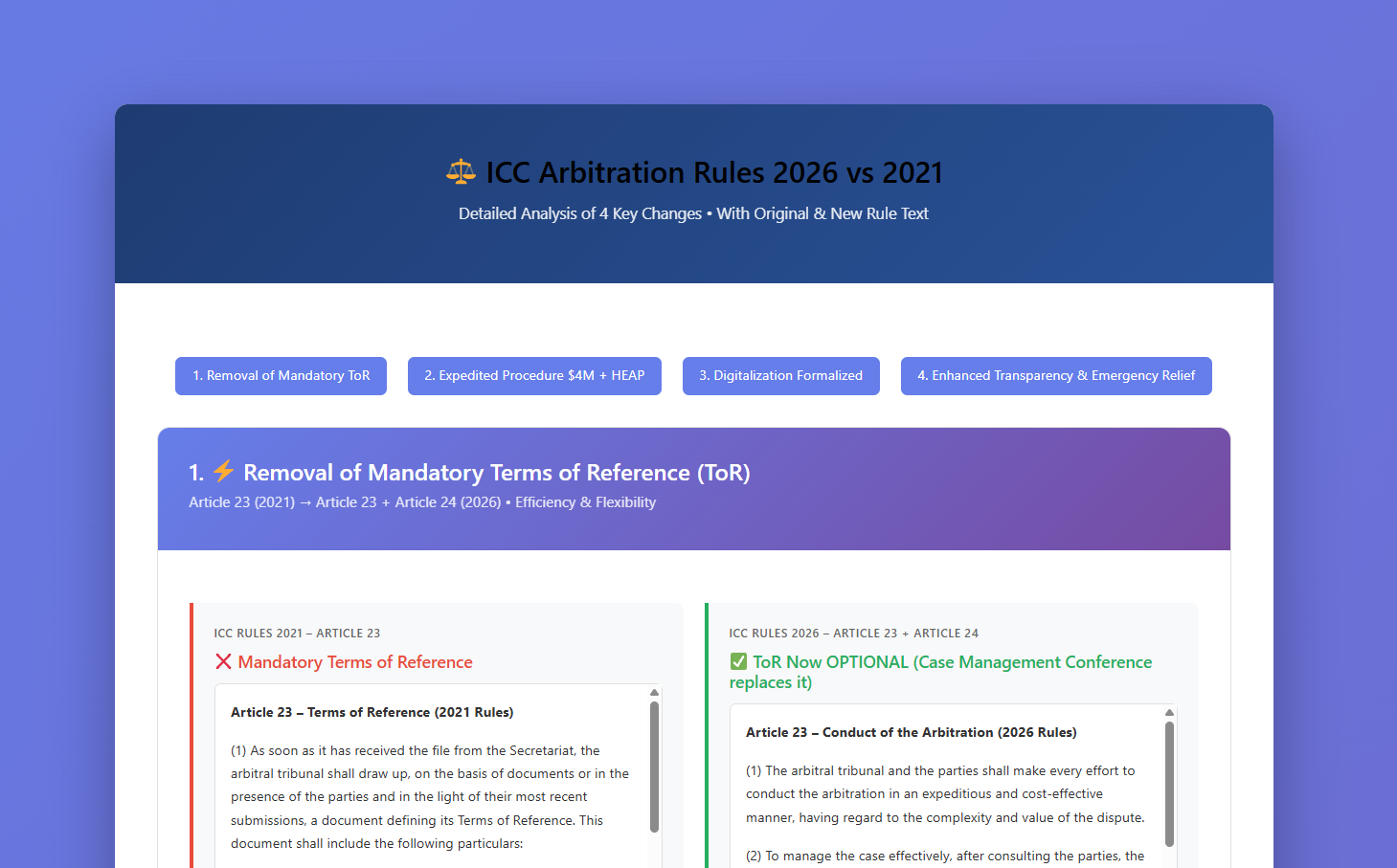
ICC Arbitration Rules 2026 VS 2021
ICC Arbitration Rules 2026 vs 2021 – 4 Key Changes Analysis ⚖ ICC Arbitration Rules 2026 vs 2021 Detailed Analysis of 4 Key Changes • With Original & New Rule Text 1. Removal of Mandatory ToR 2. Expedited Procedure $4M + HEAP 3. Digitalization Formalized 4. Enhanced Transparency & Emergency Relief 1. ⚡ Removal of Mandatory Terms of Reference (ToR) Article 23 (2021) → Article 23 + Article 24 (2026) • Efficiency & Flexibility ICC Rules 2021 – Article 23 ❌ Mandatory Terms of Reference Article 23 – Terms of Reference (2021 Rules) (1) As soon as it has received the file from the Secretariat, the arbitral tribunal shall draw up, on the basis of documents or in the presence of the parties and in the light of their most recent submissions, a document defining its Terms of Reference. This document shall include the following particulars: (a) the names in full, description, address and other contact details of each of the parties and of any person(s) representing a party in the arbitration; (b) the addresses to which notifications and communications arising in the course of the arbitration may be made; (c) a summary of the parties’ respective claims and of the relief sought by each party, together with the amounts of any quantified claims and, to the extent possible, an estimate of the monetary value of any other claims; (d) unless the arbitral tribunal considers it inappropriate, a list of issues to be determined; (e) the names in full, address and other contact details of each of the arbitrators; (f) the place of the arbitration; and (g) particulars of the applicable procedural rules and, if such is the case, reference to the power conferred upon the arbitral tribunal to act as amiable compositeur or to decide ex aequo et bono. (2) The Terms of Reference shall be signed by the parties and the arbitral tribunal. Within 30 days from the date on which the file has been transmitted to it, the arbitral tribunal shall transmit to the Court the Terms of Reference signed by it and by the parties. The Court may extend this time limit pursuant to a reasoned request from the arbitral tribunal or on its own initiative, if it decides it is necessary to do so. (3) If any of the parties refuses to take part in the drawing up of the Terms of Reference or to sign the same, they shall be submitted to the Court for approval. When the Terms of Reference have been signed in accordance with Article 23(2) or approved by the Court, the arbitration shall proceed. (4) After the Terms of Reference have been signed or approved by the Court, no party shall make new claims which fall outside the limits of the Terms of Reference unless it has been authorized to do so by the arbitral tribunal, which shall consider the nature of such new claims, the stage of the arbitration and other relevant circumstances. → ToR was MANDATORY for all cases. Tribunal HAD to draft it within 30 days of receiving the file. ICC Rules 2026 – Article 23 + Article 24 ✅ ToR Now OPTIONAL (Case Management Conference replaces it) Article 23 – Conduct of the Arbitration (2026 Rules) (1) The arbitral tribunal and the parties shall make every effort to conduct the arbitration in an expeditious and cost-effective manner, having regard to the complexity and value of the dispute. (2) To manage the case effectively, after consulting the parties, the arbitral tribunal shall adopt such procedural measures as it considers appropriate, provided that they are not contrary to any agreement of the parties. Such measures may include one or more of the case management techniques described in the guidance notes issued by the Secretariat, taking into account the work of the Commission on Arbitration and ADR. (3) At the request of any party, the arbitral tribunal may make orders concerning the confidentiality of the arbitration proceedings or of any other matters in connection with the arbitration and may take measures to protect trade secrets and confidential information. (4) In all cases, the arbitral tribunal shall act fairly and impartially and ensure that each party has a reasonable opportunity to present its case. (5) The parties undertake to comply with any order made by the arbitral tribunal. → Note: Article 23 NO LONGER mentions “Terms of Reference”. The ToR is now OPTIONAL. Article 24 – Case Management Conference; Procedural Timetable (2026 Rules) (1) Within 30 days from receiving the file from the Secretariat, the arbitral tribunal shall hold an initial CMC to consult the parties on procedural measures that may be adopted pursuant to Article 23(2). (2) During the initial CMC, or as soon as possible thereafter, the arbitral tribunal shall establish the procedural timetable that it intends to follow for the efficient conduct of the arbitration. (3) To ensure continued effective case management, the arbitral tribunal, after consulting the parties, may adopt further procedural measures or modify the procedural timetable. (4) The arbitral tribunal may conduct further CMCs, as it may deem appropriate to facilitate the efficient conduct of the proceeding. (5) In the absence of an agreement of the parties, the arbitral tribunal shall determine the means by which any CMC will be conducted. CMCs may be conducted in person, in hybrid form or by videoconference, teleconference or other form of electronic communication. → The CMC (Case Management Conference) now replaces the mandatory ToR as the key procedural framing step. 📊 Detailed Analysis What changed: The 2021 Rules mandated that the arbitral tribunal “shall draw up” a Terms of Reference document (Article 23). This was a hallmark of ICC arbitration — a formal document signed by both parties and the tribunal, defining the scope of dispute, listing issues, and setting claims. Why it was problematic: In practice, the ToR became a formalis tic and time-consuming step. Tribunals often repeated what was already in the Request and Answer. And it added more days to the timetable for
Aluminum Wire and Cable From the People’s Republic of China: Rescission of Antidumping Duty Administrative Review; 2023-2024
Commerce Rescinds Antidumping Duty Review on Aluminum Wire and Cable from China Estimated reading time: 2–5 minutes Commerce Rescinds Antidumping Duty Review on Aluminum Wire and Cable from China The U.S. Department of Commerce (Commerce) has announced that it is stopping the review of the antidumping duty on aluminum wire and cable coming from the People’s Republic of China. The review was meant for the period from December 1, 2023, to November 30, 2024. What is an Antidumping Duty? An antidumping duty is a special tax the U.S. puts on products from other countries. It helps to make sure local companies can compete fairly. If a foreign company sells a product in the U.S. for less than it costs at home, it is called “dumping.” This can hurt U.S. businesses. Why Did Commerce Rescind the Review? The Department of Commerce began the review because Tanghenam Electric Wire & Cable Co., Ltd. (Tanghenam) asked for it. They are a company in China that makes aluminum wire and cable. The review found that there were no entries of aluminum wire and cable from Tanghenam during the review period. Process and Timeline The review was initiated on January 27, 2025, based on a request from Tanghenam. On September 9, 2025, a memo was released to show that there were no entries of the product during the time of review. Commerce then planned to cancel the review on December 11, 2025, due to this lack of entries. There were some delays because of the government shutdown and other issues, which made deadlines longer. Deadlines were extended by 47 days due to a government shutdown and another 21 days because of technical issues. Commerce extended the deadline for preliminary results by another 110 days on February 9, 2026. The final decision was set for May 28, 2026. Rescission Decision Commerce uses a special rule that lets them stop a review if there are no entries of the product during the review time. Since there were no entries of aluminum wire and cable from Tanghenam, Commerce decided to stop the review. Next Steps Since the review is canceled, the cash deposit rates for antidumping duties will stay the same as before. Customs and Border Protection (CBP) will be told not to change how they assess duties on these products. Important Notifications The notice also reminds everyone involved that they have to return or destroy any private or protected information they used for this review. They have to send a written note to confirm this. Not doing so could lead to penalties. This decision and the reasons for it are available publicly, and the Commerce Department welcomes interested parties to review the related materials for in-depth understanding. Legal Disclaimer This article includes content collected from the Federal Register (federalregister.gov). The content is not an official government publication. This article is for informational purposes only and does not constitute legal advice. For case-specific consultation, please contact us. Read our full Legal Disclaimer, which also includes information on translation accuracy.
Aluminum Wire and Cable From the People’s Republic of China: Rescission of Countervailing Duty Administrative Review; 2023
U.S. Department of Commerce Rescinds Review on Aluminum Wire and Cable from China Estimated reading time: 1–3 minutes On June 4, 2026, the U.S. Department of Commerce announced its decision to rescind the administrative review of the countervailing duty order on aluminum wire and cable imported from the People’s Republic of China. The review period was from January 1, 2023, to December 31, 2023. The Department of Commerce, specifically the International Trade Administration, was responsible for this decision. They determined there were no reviewable entries of aluminum wire and cable from China during this time. Originally, a request for an administrative review was made for Tanghenam Electric Wire & Cable Co., Ltd. This request led to the initiation of the review process in January 2025. However, the Department found that there were no shipments or entries to review. This conclusion came after analyzing data from U.S. Customs and Border Protection. This decision means that there will be no change in current cash deposit requirements. The cash deposit rate will remain as it is, based on previously set rates. Commerce will instruct Customs to assess duties on any entries deemed appropriate. This assessment will not occur until a minimum of 35 days after the rescission notice is published. This rescission is aligned with Commerce’s regulations, ensuring that only merchandise with suspended entries are reviewed. This decision will be followed by no changes to cash deposits for future entries. This announcement serves as a reminder to parties involved in the process about their ongoing obligations under Administrative Protective Orders. Parties must return or destroy any proprietary information obtained in this review process. The rescission aligns with section 751 of relevant U.S. law, ensuring compliance with legal and procedural guidelines. Legal Disclaimer This article includes content collected from the Federal Register (federalregister.gov). The content is not an official government publication. This article is for informational purposes only and does not constitute legal advice. For case-specific consultation, please contact us. Read our full Legal Disclaimer, which also includes information on translation accuracy.
Chlorinated Isocyanurates From Spain: Final Results of Antidumping Duty Administrative Review; 2023-2024
U.S. Department of Commerce Finds No Dumping in Review of Chlorinated Isocyanurates from Spain Estimated reading time: 2–5 minutes The U.S. Department of Commerce has published its final decision regarding the sale of chlorinated isocyanurates, also known as chlorinated isos, from Spain. The decision covers the period from June 1, 2023, to May 31, 2024. The finding is that these products were not sold in the United States at prices less than their normal value during this time. Chlorinated isos are chemicals that come from another substance called cyanuric acid. The company from Spain involved in this review was Ercros S.A. The Department of Commerce found that Ercros did not sell its products at unfairly low prices. As a result, the company was given a weighted-average dumping margin of 0.00 percent. This means there is no penalty or additional duty due to dumping. The Department of Commerce reviews cases like this one according to rules from the Tariff Act of 1930. This process ensures that products from other countries are not being sold at unfairly low prices that can harm U.S. companies. The decision to not change the preliminary results comes after asking for comments, but receiving none. Thus, there was no need for a separate decision document. For products entering the U.S. from Spain now, the cash deposit rate for Ercros will be 0 percent because of the zero dumping margin. The Department of Commerce has specific rules about handling these cases. U.S. Customs and Border Protection will handle all entries on or after the announcement date according to these rules. For any previous cases without an assigned rate, the all-others rate will be 24.83 percent. This rate will stay until further announcements. The Department reminds all parties involved about the correct procedure for returning or destroying any proprietary information. They emphasize the importance of following these guidelines to avoid penalties. This decision was issued by Christopher Abbott, the Deputy Assistant Secretary for Policy and Negotiations. He was also performing duties of the Assistant Secretary for Enforcement and Compliance. This announcement was made on June 1, 2026, and published in the Federal Register. Legal Disclaimer This article includes content collected from the Federal Register (federalregister.gov). The content is not an official government publication. This article is for informational purposes only and does not constitute legal advice. For case-specific consultation, please contact us. Read our full Legal Disclaimer, which also includes information on translation accuracy.
Certain Corrosion Inhibitors From the People’s Republic of China: Preliminary Results of the Antidumping Duty Administrative Review; 2024-2025
Preliminary Findings on Corrosion Inhibitors from China by the U.S. Department of Commerce Estimated reading time: 5–10 minutes The U.S. Department of Commerce has announced its preliminary findings regarding certain corrosion inhibitors from the People’s Republic of China. This announcement, made on June 4, 2026, indicates that Chinese producers/exporters sold these inhibitors in the U.S. at less than their normal value. Background Information The review, which spans from March 1, 2024, to February 28, 2025, follows a decision to investigate 10 Chinese companies. The main focus was on two key companies: Anhui Trust Chem Co., Ltd. and Nantong Botao Chemical Co., Ltd. These companies were picked as the mandatory respondents for this review. Methodology Used To determine the sale prices, the Department of Commerce used specific methods outlined in the U.S. trade laws. Because China is considered a non-market economy, the normal value of these products was evaluated differently, using section 773(c) of the Tariff Act of 1930. Findings of the Review The preliminary findings showed that Anhui Trust Chem Co., Ltd. and Nantong Botao Chemical Co., Ltd. had dumping margins of 61.51% and 86.96%, respectively. Other companies involved in this review, Gold Chemical Limited and Kanghua Chemical Co., Ltd., were assigned a dumping margin of 73.75%. Separate Rates Determination The investigation also identified several companies eligible for a separate rate, distinct from those under the general Chinese entity rate. This includes the two main companies investigated and two other companies that were not individually examined but still eligible for a separate status. China-Wide Entity Six companies reviewed failed to claim separate status and are thus part of the China-wide entity. Consequently, these companies are subject to a 241.02% duty rate as determined by the department’s policy. Future Steps and Public Involvement The U.S. Department of Commerce will provide a chance for interested parties to comment on these preliminary results. They have set a timeline for public comments and planned a verification process for information used in the final results. Next Actions for Importers Importers of the affected products must comply with filing requirements concerning antidumping and/or countervailing duties. This will involve filing a certificate regarding the reimbursement of duties before entry liquidation. In summary, the preliminary results indicate significant dumping margins for corrosion inhibitors from China sold in the U.S. The Department intends to proceed with verification and review public comments before finalizing the results. Legal Disclaimer This article includes content collected from the Federal Register (federalregister.gov). The content is not an official government publication. This article is for informational purposes only and does not constitute legal advice. For case-specific consultation, please contact us. Read our full Legal Disclaimer, which also includes information on translation accuracy.
Lattice Boom Crawler Cranes From Japan: Final Affirmative Determination of Sales at Less Than Fair Value
U.S. Department of Commerce Finds Japanese Cranes Sold for Less Than Fair Value Estimated reading time: 1–7 minutes The U.S. Department of Commerce recently made a final decision on the sale of lattice boom crawler cranes from Japan. They found these cranes are being sold in the United States for less than they should be. This is called selling at “less than fair value” or LTFV. The Department of Commerce looked at crane sales from Japan from April 1, 2024, to March 31, 2025. The investigation results were first shared on January 16, 2026. Back then, Commerce said they believed Japanese cranes were indeed being sold below fair value. In their final decision, the Department confirmed that two Japanese companies were involved. These companies are Kobelco Construction Machinery Co., Ltd. and Sumitomo Heavy Industries Construction Cranes Co., Ltd. Kobelco was found to have a dumping margin of 12.36%, and Sumitomo had a margin of 20.00%. Other companies will have a margin of 16.18%. This means these companies were marking down prices too low in America, which can harm U.S. businesses selling cranes. So, to fix this, the Department will require extra fees, known as dumping duties, on these cranes when they are brought into the U.S. These extra fees will match the dumping margins found. Before this final decision, the Department checked documents and visited the company’s sites. They made sure all facts were correct. The changes made after the first findings were small. These changes were shared in a special document, the Issues and Decision Memorandum. Now, the Department will tell the International Trade Commission about their final decision. The Commission will then decide if these low-price sales are hurting U.S. businesses. If they agree there’s harm, U.S. Customs will start collecting these extra fees. If not, the case will be closed, and no extra fees will be added. All companies must follow rules about handling private information given during this investigation. This ensures that company secrets stay safe. This decision is important because it helps keep fair trade between countries. It makes sure that companies in the U.S. can compete fairly with those from other countries. Legal Disclaimer This article includes content collected from the Federal Register (federalregister.gov). The content is not an official government publication. This article is for informational purposes only and does not constitute legal advice. For case-specific consultation, please contact us. Read our full Legal Disclaimer, which also includes information on translation accuracy.
Certain Freight Rail Couplers and Parts Thereof From Mexico: Final Results of Antidumping Duty Administrative Review; 2023-2024
U.S. Department of Commerce Issues Final Results on Freight Rail Couplers from Mexico Estimated reading time: 3–5 minutes The U.S. Department of Commerce has released its final results on the antidumping duty review concerning freight rail couplers from Mexico. This review is for the period from May 3, 2023, to October 31, 2024. It found that these products were sold in the United States at prices lower than their normal value. Commerce started this review because they wanted to check if these products were being sold at unfair prices in the U.S. The agency uses laws from the Tariff Act of 1930 to conduct these reviews. The products being reviewed are called “freight rail couplers,” which are parts used in trains. Commerce found that the products from the Amsted Rail Company and its subsidiary, ASF-K de Mexico, had a dumping margin of 6.50%. The Commerce report mentions that there were no changes from the preliminary findings published earlier. They will instruct the U.S. Customs and Border Protection (CBP) to apply duties on an ad valorem basis. This means duties will be assessed based on the value of the products, rather than a per-unit fee. The business or company involved may need to pay additional duties. If a company has zero or very low sales margins, they might not pay any duties. Commerce will give detailed instructions to CBP on how to handle these duties within 41 days. Commerce will also update cash deposit rates for future shipments. The rates differ based on whether the company was involved in previous reviews or if they are new to this case. For other producers or exporters, the rate remains at 48.10%, which was set in a past investigation. Importers must also submit a certificate showing if they were reimbursed for any duties, before completed entries are processed for liquidation. Failure to submit this could lead to double duty assessments. Finally, companies under the administrative protective order (APO) must handle all sensitive business details according to Commerce’s rules. Any mishandling of such information will lead to legal consequences. This update ensures fair trading and market practices in the rail industry, while protecting U.S. manufacturers and workers. Legal Disclaimer This article includes content collected from the Federal Register (federalregister.gov). The content is not an official government publication. This article is for informational purposes only and does not constitute legal advice. For case-specific consultation, please contact us. Read our full Legal Disclaimer, which also includes information on translation accuracy.
Large Diameter Welded Pipe From the Republic of Türkiye: Preliminary Results and Rescission, in Part, of Countervailing Duty Administrative Review; 2024
Commerce Department’s Preliminary Findings on Welded Pipe Subsidies from Türkiye Estimated reading time: 3–5 minutes Commerce Department’s Preliminary Findings on Welded Pipe Subsidies from Türkiye The U.S. Department of Commerce has announced its preliminary results on a review concerning large diameter welded pipes (LDWP) imported from the Republic of Türkiye. The findings reveal that HDM Çelik Boru Sanayi Ve Ticaret A.S. (HDM Çelik), a notable producer and exporter from Türkiye, received countervailable subsidies during the period from January 1, 2024, to December 31, 2024. Background and Review Process The review began on June 25, 2025, following requests for an administrative review in line with 19 CFR 351.221(c)(1)(i). HDM Çelik was selected as the mandatory respondent on July 14, 2025. However, due to a government shutdown starting November 14, 2025, the deadlines for administrative proceedings were delayed by 47 days. An additional delay of 21 days occurred due to a backlog from the shutdown. The timeline was also extended on March 13, 2026, resulting in a final due date for preliminary results on May 29, 2026. Scope of Review The review centers on LDWP from Türkiye, assessing whether these products received unfair government subsidies. These subsidies, defined by financial contributions that benefit the recipient in a specific manner, fall under scrutiny to ensure fair trade practices. Partial Rescission Decision In part of the review, it was decided to rescind the administrative review for 11 companies. This decision is based on the absence of suspended entries of subject merchandise from these companies during the period of review (POR). The companies affected by this rescission will have their entries assessed at the rate established at the time of entry, as dictated by 19 CFR 351.212(c)(1)(i). Subsidy Rates and Methodology For HDM Çelik, the preliminary subsidy rate is set at 3.37 percent ad valorem. This rate considers various subsidy programs in which financial contributions benefit and specify how they are allocated to companies. The methodology used adheres to the legal framework aimed at identifying specific financial assistance benefiting the recipient. Next Steps and Public Participation The Commerce Department plans to disclose its full calculations for these preliminary results soon after the announcement. There will be an opportunity for interested parties to comment on these findings, with case briefs due following the issuance of the last verification report. Parties are encouraged to submit their comments with structured tables of content and authorities. Additionally, requests for a hearing should be submitted at least 30 days after this notice’s publication, including details of participants and discussion issues. Finality and Future Instructions The final results of this review are expected within 120 days from the notice publication, pending any timeline extensions. The findings will impact the cash deposit instructions for future imports from Türkiye. Conclusion The preliminary results signal ongoing diligence by the U.S. Department of Commerce in assessing international trade practices and ensuring fair economic competition. The focus remains on transparent and lawful assessments that uphold trade agreements and standards. Legal Disclaimer This article includes content collected from the Federal Register (federalregister.gov). The content is not an official government publication. This article is for informational purposes only and does not constitute legal advice. For case-specific consultation, please contact us. Read our full Legal Disclaimer, which also includes information on translation accuracy.
Prestressed Concrete Steel Wire Strand From Brazil, India, Japan, Mexico, the Republic of Korea, and Thailand: Continuation of Antidumping Duty and Countervailing Duty Orders
Antidumping Duties on Steel Wire Strand Continue Estimated reading time: 1–5 minutes The U.S. Department of Commerce will continue antidumping duties on prestressed concrete steel wire strand. Countries affected are Brazil, India, Japan, Mexico, South Korea, and Thailand. The Commerce Department, along with the U.S. International Trade Commission (ITC), decided these duties should stay. The reason is to stop companies in these countries from selling at very low prices in the U.S. The duties began on January 28, 2004, for most countries and February 4, 2004, for India. These duties are to balance out any unfair subsidies that companies might get from their governments. The decision to continue these duties came after reviews in 2025. The reviews showed that without the duties, dumping and subsidies would probably continue. Prestressed concrete steel wire strand is a special type of steel used in building. The duties make sure companies in America can compete fairly with those in the other countries. The rates of duties will stay the same as before. This decision was officially made on June 2, 2026. The duties help protect jobs and industries in the United States. The next review to decide if these duties should continue will happen before the fifth anniversary of this decision. All companies must follow rules about how to handle information about these duties. This is important to make sure everything stays fair and private. This ongoing action ensures that American businesses dealing with these products are not unfairly harmed by international trading practices. Legal Disclaimer This article includes content collected from the Federal Register (federalregister.gov). The content is not an official government publication. This article is for informational purposes only and does not constitute legal advice. For case-specific consultation, please contact us. Read our full Legal Disclaimer, which also includes information on translation accuracy.
Notice of Receipt of Complaint; Solicitation of Comments Relating to the Public Interest
U.S. International Trade Commission Receives New Complaint Estimated reading time: 1–7 minutes The U.S. International Trade Commission (USITC) has received a new complaint. This complaint is about “Certain Vehicle Space Guards”. It is labeled as DN 3912. The Commission wants to hear from the public. They are asking for comments about the public’s interest. These comments should be about any issues raised by the complaint. Who to Contact for More Information If you need more information, you can contact Lisa R. Barton. She is the Secretary to the Commission. You can call her at (202) 205-2000. You can also visit the Commission’s internet server at www.usitc.gov. To see the public version of the complaint, go to https://edis.usitc.gov. Details About the Complaint The complaint was filed by Jonathan Black Kotyk on June 1, 2026. The complaint says there are violations of section 337 of the Tariff Act of 1930. It states that some companies are breaking the law by importing, selling for importation, and selling certain vehicle space guards. These actions happen after the items are brought into the U.S. Who Are the Respondents? The complaint names several respondents: Drop Stop, LLC, from Los Angeles, CA The Container Store, from Coppell, TX Walmart, Inc., from Bentonville, AR 232 Technologies Inc., from Brooklyn, NY Sporty’s (Sportman’s Market Inc.), from Batavia, OH What Does the Complaint Ask For? The complainant wants the Commission to take action. He wants a general exclusion order and a limited exclusion order. He also wants cease and desist orders. During the 60-day Presidential review period, he wants a bond imposed on the respondents’ supposed infringing articles. Call for Public Comments The Commission is inviting comments from the public. They want to know about any public interest issues related to this complaint. Comments are needed about how the requested orders might affect: Public health and welfare in the U.S. Competitive conditions in the U.S. economy Production of similar articles in the U.S. U.S. consumers Submissions should be filed electronically. They must be made through the Commission’s Electronic Document Information System (EDIS). You can access EDIS at https://edis.usitc.gov. The deadline to submit comments is eight days after this notice is published in the Federal Register. Confidential Submissions If you want to submit something confidential, request confidential treatment. Explain why the Commission should grant this. You can find more instructions in the Handbook for Electronic Filing Procedures. The Commission will treat confidential documents accordingly. By Order of the Commission This notice was issued on June 1, 2026, by Lisa Barton, Secretary to the Commission, and filed under the number [FR Doc. 2026-11196]. Legal Disclaimer This article includes content collected from the Federal Register (federalregister.gov). The content is not an official government publication. This article is for informational purposes only and does not constitute legal advice. For case-specific consultation, please contact us. Read our full Legal Disclaimer, which also includes information on translation accuracy.
Certain Energy Drinks and Labeling and Packaging Thereof; Notice of Institution of Investigation
U.S. International Trade Commission Starts Investigation on Energy Drinks Estimated reading time: 1–7 minutes The U.S. International Trade Commission (USITC) has opened an investigation into certain energy drinks. This investigation began after Monster Energy Company from Corona, California filed a complaint. The complaint was filed on April 17, 2026. A supplemental complaint was submitted on May 21, 2026. Monster Energy says there are violations of section 337 of the Tariff Act of 1930. The complaint is about energy drinks and their labeling and packaging that are being imported into the United States. These drinks allegedly infringe on Monster Energy’s trademarks. The trademarks involved are: U.S. Trademark Registration No. 6,760,278; U.S. Trademark Registration No. 6,451,182; U.S. Trademark Registration No. 2,903,214; and U.S. Trademark Registration No. 3,434,821. The USITC is checking if these products were sold for importation or sold in the U.S. after importation. They also want to know if there is an industry in the U.S. that is affected by these imports. Monster Energy wants the Commission to issue orders to stop the products from being imported and sold. The Commission decided on June 1, 2026, to start the investigation. They want to find out if the energy drinks are imported illegally due to trademark infringement. The investigation will look at drinks made for sale outside the United States but sold here with trademarks owned by Monster Energy. The complaint named several companies as respondents. These companies might be breaking the law by importing and selling the drinks. Some of these companies are Gig Wholesale Corp., The Elegant Inc., and Hamilton Trading Corp., among others. The Office of Unfair Import Investigations will be involved. They are part of the USITC. The companies named in the complaint must respond. They have 20 days to reply to the Commission’s notice. If they do not reply, they might lose their chance to argue against the complaint. The Commission might issue exclusion or cease and desist orders if they find the companies violated the law. This investigation is important for ensuring fair trade practices in the U.S. market. It aims to protect industries in the U.S. from unfair competition. Legal Disclaimer This article includes content collected from the Federal Register (federalregister.gov). The content is not an official government publication. This article is for informational purposes only and does not constitute legal advice. For case-specific consultation, please contact us. Read our full Legal Disclaimer, which also includes information on translation accuracy.
Commerce Department, International Trade Administration Briefing 2026-06-04
Commerce Department, International Trade Administration Briefing 2026-06-04 Estimated reading time: 5 minutes 1. Prestressed Concrete Steel Wire Strand From Brazil, India, Japan, Mexico, the Republic of Korea, and Thailand: Continuation of Antidumping Duty and Countervailing Duty Orders Link: https://www.federalregister.gov/documents/2026/06/04/2026-11266/prestressed-concrete-steel-wire-strand-from-brazil-india-japan-mexico-the-republic-of-korea-and Sub: Commerce Department, International Trade Administration Content: As a result of the determinations by the U.S. Department of Commerce (Commerce) and the U.S. International Trade Commission (ITC) finding that revocation of the antidumping duty (AD) orders on prestressed concrete steel wire strand (PC strand) from Brazil, India, Japan, Mexico, the Republic of Korea (Korea), and Thailand and the countervailing duty (CVD) order on PC strand from India would likely lead to the continuation or recurrence of dumping, countervailable subsidies, and material injury to an industry in the United States, Commerce is publishing a notice of continuation of these AD and CVD orders. 2. Certain Oil Country Tubular Goods From Austria: Postponement of Preliminary Determination in the Countervailing Duty Investigation Link: https://www.federalregister.gov/documents/2026/06/04/2026-11265/certain-oil-country-tubular-goods-from-austria-postponement-of-preliminary-determination-in-the Sub: Commerce Department, International Trade Administration 3. Large Diameter Welded Pipe From the Republic of Türkiye: Preliminary Results and Rescission, in Part, of Countervailing Duty Administrative Review; 2024 Link: https://www.federalregister.gov/documents/2026/06/04/2026-11264/large-diameter-welded-pipe-from-the-republic-of-trkiye-preliminary-results-and-rescission-in-part-of Sub: Commerce Department, International Trade Administration Content: The U.S. Department of Commerce (Commerce) preliminarily determines that countervailable subsidies were provided to HDM [Ccedil]elik Boru Sanayi Ve Ticaret A.S. (HDM [Ccedil]elik), a producer/exporter of large diameter welded pipe (LDWP) from the Republic of T[uuml]rkiye (T[uuml]rkiye) during the period of review (POR) January 1, 2024, through December 31, 2024. In addition, Commerce is rescinding this review, in part, with respect to 11 companies. Interested parties are invited to comment on these preliminary results. 4. Certain Freight Rail Couplers and Parts Thereof From Mexico: Final Results of Antidumping Duty Administrative Review; 2023-2024 Link: https://www.federalregister.gov/documents/2026/06/04/2026-11263/certain-freight-rail-couplers-and-parts-thereof-from-mexico-final-results-of-antidumping-duty Sub: Commerce Department, International Trade Administration Content: The U.S. Department of Commerce (Commerce) determines that certain freight rail couplers and parts thereof (freight rail couplers) from Mexico were sold in the United States at less than normal value during the period of review (POR), May 3, 2023, through October 31, 2024. 5. Lattice Boom Crawler Cranes From Japan: Final Affirmative Determination of Sales at Less Than Fair Value Link: https://www.federalregister.gov/documents/2026/06/04/2026-11262/lattice-boom-crawler-cranes-from-japan-final-affirmative-determination-of-sales-at-less-than-fair Sub: Commerce Department, International Trade Administration Content: The U.S. Department of Commerce (Commerce) determines that lattice boom crawler cranes (cranes) from Japan are being, or likely to be, sold in the United States at less than fair value (LTFV). The period of investigation is April 1, 2024, through March 31, 2025. 6. Certain Corrosion Inhibitors From the People’s Republic of China: Preliminary Results of the Antidumping Duty Administrative Review; 2024-2025 Link: https://www.federalregister.gov/documents/2026/06/04/2026-11261/certain-corrosion-inhibitors-from-the-peoples-republic-of-china-preliminary-results-of-the Sub: Commerce Department, International Trade Administration Content: The U.S. Department of Commerce (Commerce) preliminarily determines that producers/exporters subject to this review made sales of subject merchandise at less than normal value (NV) during the period of review (POR) March 1, 2024, through February 28, 2025. Interested parties are invited to comment on these preliminary results of review. 7. Chlorinated Isocyanurates From Spain: Final Results of Antidumping Duty Administrative Review; 2023-2024 Link: https://www.federalregister.gov/documents/2026/06/04/2026-11260/chlorinated-isocyanurates-from-spain-final-results-of-antidumping-duty-administrative-review Sub: Commerce Department, International Trade Administration Content: The U.S. Department of Commerce (Commerce) determines that sales of chlorinated isocyanurates (chlorinated isos) from Spain were not sold in the United States at less than normal value during the period of review (POR), June 1, 2023, through May 31, 2024. 8. Aluminum Wire and Cable From the People’s Republic of China: Rescission of Countervailing Duty Administrative Review; 2023 Link: https://www.federalregister.gov/documents/2026/06/04/2026-11259/aluminum-wire-and-cable-from-the-peoples-republic-of-china-rescission-of-countervailing-duty Sub: Commerce Department, International Trade Administration Content: The U.S. Department of Commerce (Commerce) is rescinding the administrative review of the countervailing duty (CVD) order on aluminum wire and cable from the People’s Republic of China (China). The period of review (POR) is January 1, 2023, through December 31, 2023. 9. Aluminum Wire and Cable From the People’s Republic of China: Rescission of Antidumping Duty Administrative Review; 2023-2024 Link: https://www.federalregister.gov/documents/2026/06/04/2026-11258/aluminum-wire-and-cable-from-the-peoples-republic-of-china-rescission-of-antidumping-duty Sub: Commerce Department, International Trade Administration Content: The U.S. Department of Commerce (Commerce) is rescinding the administrative review of the antidumping duty (AD) order on aluminum wire and cable from the People’s Republic of China (China). The period of review (POR) is December 1, 2023, through November 30 2024. Legal Disclaimer This article includes content collected from the Federal Register (federalregister.gov). The content is not an official government publication. This article is for informational purposes only and does not constitute legal advice. For case-specific consultation, please contact us. Read our full Legal Disclaimer, which also includes information on translation accuracy.
International Trade Commission Briefing 2026-06-04
International Trade Commission Briefing 2026-06-04 Estimated reading time: 5 minutes 1. Certain Energy Drinks and Labeling and Packaging Thereof; Notice of Institution of Investigation Link: https://www.federalregister.gov/documents/2026/06/04/2026-11201/certain-energy-drinks-and-labeling-and-packaging-thereof-notice-of-institution-of-investigation Sub: International Trade Commission Content: Notice is hereby given that a complaint was filed with the U.S. International Trade Commission on April 17, 2026, under section 337 of the Tariff Act of 1930, as amended, on behalf of Monster Energy Company of Corona, California. A supplement to the complaint was filed on May 21, 2026. The complaint, as supplemented, alleges violations of section 337 based upon the importation into the United States, the sale for importation, and the sale within the United States after importation of certain energy drinks and labeling and packaging thereof by reason of the infringement of one or more of U.S. Trademark Registration No. 6,760,278 (“the ‘278 mark”); U.S. Trademark Registration No 6,451,182 (“the ‘182 mark”); U.S. Trademark Registration No. 2,903,214 (“the ‘214 mark”); and U.S. Trademark Registration No. 3,434,821 (“the ‘821 mark”). The complaint further alleges that an industry in the United States exists as required by the applicable Federal Statute. The complainant requests that the Commission institute an investigation and, after the investigation, issue a general exclusion order, or in the alternative a limited exclusion order, and cease and desist orders. 2. Notice of Receipt of Complaint; Solicitation of Comments Relating to the Public Interest Link: https://www.federalregister.gov/documents/2026/06/04/2026-11196/notice-of-receipt-of-complaint-solicitation-of-comments-relating-to-the-public-interest Sub: International Trade Commission Content: Notice is hereby given that the U.S. International Trade Commission has received a complaint entitled Certain Vehicle Space Guards, DN 3912; the Commission is soliciting comments on any public interest issues raised by the complaint or complainant’s filing pursuant to the Commission’s Rules of Practice and Procedure. Legal Disclaimer This article includes content collected from the Federal Register (federalregister.gov). The content is not an official government publication. This article is for informational purposes only and does not constitute legal advice. For case-specific consultation, please contact us. Read our full Legal Disclaimer, which also includes information on translation accuracy.
Circular Welded Carbon-Quality Steel Pipe From the United Arab Emirates: Preliminary Results of Antidumping Duty Administrative Review; 2023-2024
Preliminary Results Published for Antidumping Review of Steel Pipe from the UAE Estimated reading time: 3–5 minutes Date: 2026-06-03 The U.S. Department of Commerce has preliminarily determined that some steel pipe producers and exporters from the United Arab Emirates (UAE) sold their products in the United States at less than normal value. The preliminary results cover the period from December 1, 2023, through November 30, 2024. The review focuses on circular welded carbon-quality steel pipe, a specific type of steel pipe used in various applications. The review was initiated in January 2025 due to requests for a closer look at trade practices. The companies specifically examined are Conares Metal Supply Limited and Universal Tube and Pipe Industries FZE, along with its related entities THL Tube and Pipe Industries LLC and KHK Scaffolding and Formwork LLC. Determination Process The U.S. Department of Commerce used several methods to calculate whether the companies sold their products at unfairly low prices. These methods include examining export prices and constructed export prices. The goal is to determine if such prices are less than the normal value, which would affect fair competition. Preliminary results show that the companies have different dumping margins. A dumping margin indicates how much the export price is less than the normal value. Major companies in the review like Conares and Universal have dumping margins that are not zero, meaning they were selling at less than normal value. Rates and Procedures Conares Metal Supply Limited: Preliminary dumping margin is 3.15%. Universal Tube and Pipe Industries FZE and Related Entities: Preliminary dumping margin is 6.16%. Other Companies Not Individually Examined: These companies have been assigned a weighted average dumping margin of 5.50%. For companies not individually examined, their rates are based on the overall results of the reviewed companies. After these preliminary findings, the Commerce Department will accept more comments, allowing interested parties to submit their opinions. The opportunity to submit written comments will last for 21 days from the notice’s publication date. Rebuttals or responses to these comments are allowed for five days after the initial comment period. If requested, the Department will hold a hearing allowing further discussion. Such requests must be submitted within 30 days of this announcement. Upon completion of all final reviews and issuance of results, cash deposit requirements will be updated, affecting future shipments and indicating future compliance requirements. These results provide important insights into how international trade laws are monitored and enforced. The findings and the comments received during this period will help inform the final decision, ensuring fair international trade practices. Legal Disclaimer This article includes content collected from the Federal Register (federalregister.gov). The content is not an official government publication. This article is for informational purposes only and does not constitute legal advice. For case-specific consultation, please contact us. Read our full Legal Disclaimer, which also includes information on translation accuracy.
Certain Large Vertical Shaft Engines Between 225cc and 999cc, and Parts Thereof from The People’s Republic of China: Final Results of the Expedited First Sunset Review of the Countervailing Duty Order
U.S. Department of Commerce Keeps Extra Taxes on Chinese Engines Estimated reading time: 2–4 minutes On June 3, 2026, the U.S. Department of Commerce made an important decision. They decided to keep extra taxes, called countervailing duties, on certain engines from China. These engines are large, vertical shaft engines. They range from 225cc to 999cc in size. The Department thinks that removing these duties would lead to Chinese companies continuing to receive unfair help from their government. This kind of help is known as a subsidy. Subsidies can make products cheaper, making it hard for other countries to compete. The decision is based on a review that started on February 2, 2026. The review checked if these subsidies would continue without the duties in place. The main companies in the U.S. that care about this decision are Briggs & Stratton, LLC and Discovery Energy, LLC. These companies gave their thoughts to the Department of Commerce by March 4, 2026. The Government of China and other Chinese companies did not respond with their thoughts. The review found rates for subsidies that would likely continue. For Loncin Motor Co., the rate is 18.96 percent. For Chongqing Zongshen General Power Machine Co., the rate is 20.38 percent. All other companies would have a rate of 19.85 percent. This decision means the U.S. will keep the extra taxes on these engines. This helps protect American companies from unfair competition. The decision was announced by Scot Fullerton, Acting Deputy Assistant Secretary for Antidumping and Countervailing Duty Operations. The Department of Commerce’s review shows how important it is to check on foreign subsidies. They want to make sure trade with other countries is fair for everyone. Legal Disclaimer This article includes content collected from the Federal Register (federalregister.gov). The content is not an official government publication. This article is for informational purposes only and does not constitute legal advice. For case-specific consultation, please contact us. Read our full Legal Disclaimer, which also includes information on translation accuracy.
Prestressed Concrete Steel Wire Strand From Malaysia: Final Results of Antidumping Duty Administrative Review; 2023-2024
U.S. Commerce Department Issues Final Results on Malaysia Steel Wire Strand Review Estimated reading time: 5–6 minutes Date: 2026-06-03 The U.S. Department of Commerce announced the final results of an important review involving prestressed concrete steel wire strand imported from Malaysia. This review focused on determining if Malaysian companies sold this wire strand in the United States at unfairly low prices. The companies reviewed were Kiswire Sdn. Bhd., Southern PC Steel Sdn. Bhd., and Wei Dat Steel Wire Sdn. Bhd. The period reviewed was from June 1, 2023, to May 31, 2024. The Commerce Department found that these companies did not sell the wire strand below its normal value during this time. This means they sold it at fair prices in the U.S. market. The review’s findings are officially effective as of June 3, 2026. The agency involved is the International Trade Administration, a part of the Department of Commerce. Contact persons for more details are Monica Gillis and Peter Shaw from the AD/CVD Operations office. They can be reached at (202) 482-6384 or (202) 482-0697 for inquiries. Earlier on October 3, 2025, a preliminary result was published. This preliminary finding was delayed due to a government shutdown that tolled deadlines by 47 days. Further delays resulted in an additional tolling of 21 days. However, Commerce verified responses from Kiswire and Wei Dat through verification sessions in March 2026. The review specifically assessed if goods from these companies were sold at prices lower than normal value. It was conducted under section 751(a)(1)(B) of the Tariff Act of 1930. For the companies not individually examined, such as Southern PC Steel, the Act suggests a reasonable calculation method. The result is a zero percent margin for them as well. Based on these results, all reviewed companies – Kiswire, Wei Dat, and Southern PC Steel, have a dumping margin of 0.00 percent for the period. This means no extra antidumping duties are required on their products for this review period. The Commerce Department will disclose full calculation details following this review. Usually, this happens within five days of the announcement. The customs and border authority, CBP, will assess the covered entries of wire strand without imposing additional antidumping duties, following the finalized results. For future imports of the wire strand from Malaysia, the cash deposit rates will now align with these findings. The special zero rate applies to the named companies. For others not reviewed, the previous rates from earlier investigations still apply. This process involves significant documentation and the handling of proprietary information. Importers are reminded of their duty to submit respective certificates before liquidation to avoid double duties. This review helps ensure fair trade practices and confirms that the selling practices of Malaysian wire strand imports align with U.S. trade laws. Legal Disclaimer This article includes content collected from the Federal Register (federalregister.gov). The content is not an official government publication. This article is for informational purposes only and does not constitute legal advice. For case-specific consultation, please contact us. Read our full Legal Disclaimer, which also includes information on translation accuracy.
Raw Honey From Brazil: Final Results of Antidumping Duty Administrative Review, 2023-2024
U.S. Department of Commerce Finalizes Antidumping Duties on Raw Honey from Brazil Estimated reading time: 2–5 minutes Background and Review Details The U.S. Department of Commerce has released the final results of its administrative review on raw honey imported from Brazil. This review, conducted by the International Trade Administration of the Department of Commerce, determined that raw honey from Brazil was sold in the U.S. at prices below normal value. The period of review was from June 1, 2023, to May 31, 2024. The review involved 14 producers and exporters of raw honey from Brazil. Among them were Melbras Importadora E Exportadora Agroindustrial Ltda. and Minamel Agroindústria Ltda., which acted as mandatory respondents in the investigation. The preliminary results were published on September 30, 2025, and public comments were invited. However, due to a federal government shutdown later that year, the Commerce extended deadlines for the review several times. The final results were scheduled and released by May 29, 2026. The review was conducted according to U.S. law, specifically Section 751 of the Tariff Act of 1930. Commerce based this review on its findings, which involved public comments and extensive data analysis. The final decisions were detailed in the Issues and Decision Memorandum made available to registered users and directly accessible online. Scope and Examination of Imports The product under review included raw honey as defined in the original antidumping duty orders. The review continued to investigate other shipments from Brazil, especially those involving companies not individually examined in this review. Final Results and Antidumping Margins Based on the review, the weighted-average dumping margins for the examined companies were determined. Melbras Importadora faced a 4.48% dumping margin, while Minamel Agroindústria was subject to a 10.48% margin. For companies not individually reviewed, an average margin of 7.48% was applied. Disclosure and Compliance Instructions The Department of Commerce intends to disclose detailed findings and calculations from this review. Companies are required to comply with all instructions regarding antidumping assessments and cash deposits due after these final results. Notably, a reminder was issued to importers about filing certificates concerning the reimbursement of antidumping duties. Cash Deposit Requirements Effective immediately, all U.S. entries of raw honey from Brazil will have updated cash deposit requirements matching the review’s final results. These requirements will remain in place until further notifications are given by the Department of Commerce. Conclusion and Further Notifications This announcement echoes the compliance terms set by U.S. trade laws for imported raw honey. Importers and other stakeholders must remain aware of the updated duties and follow federal regulations to ensure proper execution of trade practices. The review and subsequent announcements are essential to maintain fair trade and protect domestic markets from unfair pricing methods used by some international exporters. Legal Disclaimer This article includes content collected from the Federal Register (federalregister.gov). The content is not an official government publication. This article is for informational purposes only and does not constitute legal advice. For case-specific consultation, please contact us. Read our full Legal Disclaimer, which also includes information on translation accuracy.
Certain Uncoated Paper From Portugal: Preliminary Results of Antidumping Duty Administrative Review; 2024-2025
U.S. Department of Commerce Finds Unfair Paper Sales from Portugal Estimated reading time: 3–5 minutes The U.S. Department of Commerce recently announced preliminary findings about paper sales from Portugal. This decision involves uncoated paper. The period under review was from March 1, 2024, to February 28, 2025. The review investigates if Portuguese companies sold paper in the U.S. at unfairly low prices. The focus was on The Navigator Company, S.A., a major producer. The company faced scrutiny over its pricing practices. The Department found that Navigator had sold paper at prices lower than normal value. They calculated a dumping margin of 2.70%. A dumping margin shows how much a company’s sale price undershoots a fair market price. The findings came from a process involving many calculations and rules. The Department looked at export prices and the normal values in Portugal. They used specific methods outlined in U.S. law. This announcement opens a window for further comments. Each party in the review can share their thoughts on this preliminary result. They have 21 days from the announcement to file their case briefs. Rebuttal comments can be filed five days after that. There is also a chance for a hearing. Interested parties must request this within 30 days of the announcement. They must include the names of participants and the issues they want to discuss. The findings lead to certain actions by the U.S. Customs and Border Protection. If the dumping margin is above de minimis (0.50%), they will assess duties. If Navigator’s margin is zero or very low, there will be no duties. The Commerce Department has made instructions for customs. They want to ensure all regulations are followed properly. The next steps depend on any final decisions after this review. These measures aim to ensure fair trade practices. The U.S. is protecting its market from unfair pricing practices. The process involves detailed reviews and public participation before any final decisions. Legal Disclaimer This article includes content collected from the Federal Register (federalregister.gov). The content is not an official government publication. This article is for informational purposes only and does not constitute legal advice. For case-specific consultation, please contact us. Read our full Legal Disclaimer, which also includes information on translation accuracy.
Commerce Department, International Trade Administration Briefing 2026-06-03
Commerce Department, International Trade Administration Briefing 2026-06-03 Estimated reading time: 5 minutes 1. Certain Uncoated Paper From Portugal: Preliminary Results of Antidumping Duty Administrative Review; 2024-2025 Link: https://www.federalregister.gov/documents/2026/06/03/2026-11122/certain-uncoated-paper-from-portugal-preliminary-results-of-antidumping-duty-administrative-review Sub: Commerce Department, International Trade Administration Content: The U.S. Department of Commerce (Commerce) preliminarily determines that producers/exporters subject to this review made sales of subject merchandise at less than normal value (NV) during the period of review (POR), March 1, 2024, through February 28, 2025. Interested parties are invited to comment on these preliminary results of review. 2. Raw Honey From Brazil: Final Results of Antidumping Duty Administrative Review, 2023-2024 Link: https://www.federalregister.gov/documents/2026/06/03/2026-11121/raw-honey-from-brazil-final-results-of-antidumping-duty-administrative-review-2023-2024 Sub: Commerce Department, International Trade Administration Content: The U.S. Department of Commerce (Commerce) determines that raw honey from Brazil was sold in the United States at prices below normal value. The period of review (POR) is June 1, 2023, through May 31, 2024. 3. Prestressed Concrete Steel Wire Strand From Malaysia: Final Results of Antidumping Duty Administrative Review; 2023-2024 Link: https://www.federalregister.gov/documents/2026/06/03/2026-11120/prestressed-concrete-steel-wire-strand-from-malaysia-final-results-of-antidumping-duty Sub: Commerce Department, International Trade Administration Content: The U.S. Department of Commerce (Commerce) determines that Kiswire Sdn. Bhd. (Kiswire), Southern PC Steel Sdn. Bhd (Southern PC Steel), and Wei Dat Steel Wire Sdn. Bhd. (Wei Dat) did not make sales of prestressed concrete steel wire strand (PC strand) from Malaysia in the United States at prices below normal value (NV) during the period of review. The period of review (POR) is June 1, 2023, through May 31, 2024. 4. Certain Large Vertical Shaft Engines Between 225cc and 999cc, and Parts Thereof from The People’s Republic of China: Final Results of the Expedited First Sunset Review of the Countervailing Duty Order Link: https://www.federalregister.gov/documents/2026/06/03/2026-11119/certain-large-vertical-shaft-engines-between-225cc-and-999cc-and-parts-thereof-from-the-peoples Sub: Commerce Department, International Trade Administration Content: The U.S. Department of Commerce (Commerce) finds that revocation of the countervailing duty (CVD) order on certain large vertical shaft engines between 225cc and 999cc, and parts thereof (vertical shaft engines) from the People's Republic of China (China) would be likely to lead to continuation or recurrence of countervailable subsidies at the levels indicated in the "Final Results of Sunset Review" section of this notice. 5. Circular Welded Carbon-Quality Steel Pipe From the United Arab Emirates: Preliminary Results of Antidumping Duty Administrative Review; 2023-2024 Link: https://www.federalregister.gov/documents/2026/06/03/2026-11118/circular-welded-carbon-quality-steel-pipe-from-the-united-arab-emirates-preliminary-results-of Sub: Commerce Department, International Trade Administration Content: The U.S. Department of Commerce (Commerce) preliminarily determines that producers/exporters subject to this review made sales of subject merchandise at less than normal value (NV) during the period of review (POR), December 1, 2023, through November 30, 2024. Interested parties are invited to comment on these preliminary results of review. Legal Disclaimer This article includes content collected from the Federal Register (federalregister.gov). The content is not an official government publication. This article is for informational purposes only and does not constitute legal advice. For case-specific consultation, please contact us. Read our full Legal Disclaimer, which also includes information on translation accuracy.
Initiation of Antidumping and Countervailing Duty Administrative Reviews
Commerce Department Starts New Trade Reviews Estimated reading time: 3–5 minutes The United States Department of Commerce has begun new administrative reviews. These are for antidumping and countervailing duty orders. These are important because they help ensure that products imported to the U.S. are fairly priced. The reviews started on June 2, 2026. The Commerce Department received requests for reviews concerning various products. Many of these products have April anniversary dates. What Products Are Being Reviewed? Common Alloy Aluminum Sheet: This product is used in buildings and transportation. Companies in countries like Bahrain, Brazil, Croatia, and several more are being reviewed. Carbon and Alloy Steel Threaded Rod: Used in construction, items from companies in India and China are under review. 1,1,1,2-Tetrafluoroethane (R-134a): This chemical is used in refrigeration. Companies in China are being checked. Activated Carbon: This product cleans air and water. Companies in China are under review. Wooden Cabinets and Vanities: Used in homes, these products from China are being looked at. And many more products and companies from countries like Egypt, Germany, India, Indonesia, Italy, Oman, South Africa, Spain, Taiwan, Türkiye, and Slovenia. Why Are These Reviews Important? These reviews help to check if foreign companies are selling their products too cheaply in the U.S. This is called “dumping”. Products sold this way can hurt U.S. businesses. The reviews make sure companies are charging fair prices. What Will Happen Next? Once the reviews are done, the Commerce Department will decide if any actions are needed. They may impose extra duties on some products if they find problems. This process helps keep trade fair and protects American companies. It is important for companies who want to keep their separate tax rates to fill out certain forms. They need to do this 14 days after the notice came out. Companies that are part of these reviews need to keep track of their sales carefully. The Commerce Department will finish these reviews by April 30, 2027. This gives them time to make sure everything is fair and accurate. What Should Interested Parties Do? If anyone is interested in these reviews, they should apply for access to information. They need to follow the rules given by the Commerce Department. There are specific ways to share information and facts. This ensures that the reviews are transparent. Commerce will not be able to share information unless a party asks for it in the right way. As the reviews continue, the Commerce Department remains focused on maintaining fair trade for all involved. These actions ensure a level-playing field in the market. Stay informed as this process progresses and further decisions are made. Legal Disclaimer This article includes content collected from the Federal Register (federalregister.gov). The content is not an official government publication. This article is for informational purposes only and does not constitute legal advice. For case-specific consultation, please contact us. Read our full Legal Disclaimer, which also includes information on translation accuracy.
Certain Activated Carbon From the People’s Republic of China: Amended Final Results of Antidumping Duty Administrative Review; 2023-2024
U.S. Department of Commerce Amends Results of Antidumping Duty Review on Activated Carbon from China Estimated reading time: 3–4 minutes Background: The U.S. Department of Commerce has announced changes to the results of its review of antidumping duties on certain activated carbon from China. This review looked at imports from April 1, 2023, to March 31, 2024. On April 23, 2026, the Commerce Department released the original results. However, errors were found by several companies involved. These companies included Calgon Carbon Corporation and Norit Americas, Inc., along with Datong Juqiang Activated Carbon Co., Ltd. and Ningxia Huahui Environmental Technology Co., Ltd. The errors were seen as ‘ministerial,’ meaning they were mistakes like math errors or incorrect copying. The law says these kinds of mistakes can be fixed. Specific Errors Corrected: The errors affected how some costs were calculated. For Datong Juqiang Activated Carbon Co., Ltd., mistakes included how a by-product was excluded and the costs of electricity and packing were added up. For Ningxia Huahui Environmental Technology Co., Ltd., errors included using incorrect export numbers and mislabeled units of measure. Correcting these errors changed the dumping margin for Ningxia Huahui from $0.56 per kilogram to $0.04 per kilogram. This change also affected other non-selected companies, setting their new rate at $0.04 per kilogram. Amended Results: After corrections, the estimated dumping margins are: Datong Juqiang Activated Carbon Co., Ltd.: $0.00 per kilogram. Ningxia Huahui Environmental Technology Co., Ltd.: $0.04 per kilogram. Cash Deposit Requirements: With these new results, new cash deposit requirements will take effect. Companies must deposit an amount equal to their dumping margin for any future shipments. For example, Datong Juqiang will deposit $0.00 per kilogram, and Ningxia Huahui will deposit $0.04 per kilogram. Conclusion: These changes ensure that the duties applied are based on accurate information. The Department of Commerce will give specific instructions on how to handle affected imports to U.S. Customs and Border Protection. This decision aims to protect U.S. businesses by ensuring a fair trade environment with China in the activated carbon market. Legal Disclaimer This article includes content collected from the Federal Register (federalregister.gov). The content is not an official government publication. This article is for informational purposes only and does not constitute legal advice. For case-specific consultation, please contact us. Read our full Legal Disclaimer, which also includes information on translation accuracy.
Notice of Receipt of Complaint; Solicitation of Comments Relating to the Public Interest
U.S. International Trade Commission Receives New Complaint Estimated reading time: 1–7 minutes The U.S. International Trade Commission (USITC) has received a new complaint. This complaint is about systems, devices, software, chemicals, and supplies used to study proteins. The complaint is filed by Seer, Inc. and The Brigham and Women’s Hospital, Inc. The USITC is asking for comments from the public. They want to know if the complaint would affect the public interest. This includes public health and welfare, the U.S. economy, and consumers. The complaint is against Nanomics Biotechnology Co., Ltd. of China. The complaint says they violated section 337 of the Tariff Act of 1930. They want the USITC to stop some imports and sales of these products. The USITC is also interested in knowing how these products are used in the U.S. They want to know if any similar products are made in the U.S. and if they can replace these items. The USITC will accept comments for eight days after the notice is published in the Federal Register. They will also allow further comments if a decision is made. The USITC wants all comments to be five pages or less. They must be sent electronically through the USITC’s Electronic Document Information System. The USITC will accept no paper filings. Anyone with questions can contact Lisa R. Barton, Secretary to the Commission. If anyone wants their document to be confidential, they must ask the Commission for confidential treatment. This news is important because it affects imports, businesses, and possibly the economy. The USITC uses section 337 of the Tariff Act to handle these cases. This notice is a reminder of how trade laws protect U.S. interests. For more information, visit the USITC’s website or contact their office. Legal Disclaimer This article includes content collected from the Federal Register (federalregister.gov). The content is not an official government publication. This article is for informational purposes only and does not constitute legal advice. For case-specific consultation, please contact us. Read our full Legal Disclaimer, which also includes information on translation accuracy.
Commerce Department, International Trade Administration Briefing 2026-06-02
Commerce Department, International Trade Administration Briefing 2026-06-02 Estimated reading time: 5 minutes 1. N-Cyclohexylbenzothiazole-2-Sulfenamide from the People’s Republic of China: Initiation of Countervailing Duty Investigation Link: https://www.federalregister.gov/documents/2026/06/02/2026-11001/n-cyclohexylbenzothiazole-2-sulfenamide-from-the-peoples-republic-of-china-initiation-of Sub: Commerce Department, International Trade Administration 2. N-Cyclohexylbenzothiazole-2-Sulfenamide From the People’s Republic of China: Initiation of Less-Than-Fair-Value Investigation Link: https://www.federalregister.gov/documents/2026/06/02/2026-11000/n-cyclohexylbenzothiazole-2-sulfenamide-from-the-peoples-republic-of-china-initiation-of Sub: Commerce Department, International Trade Administration 3. Agency Information Collection Activities; Submission to the Office of Management and Budget (OMB) for Review and Approval; Comment Request; Applications for Inclusion on the Lists of Arbitrators Under the Data Privacy Framework Program Link: https://www.federalregister.gov/documents/2026/06/02/2026-10983/agency-information-collection-activities-submission-to-the-office-of-management-and-budget-omb-for Sub: Commerce Department, International Trade Administration 4. Certain Activated Carbon From the People’s Republic of China: Amended Final Results of Antidumping Duty Administrative Review; 2023-2024 Link: https://www.federalregister.gov/documents/2026/06/02/2026-10940/certain-activated-carbon-from-the-peoples-republic-of-china-amended-final-results-of-antidumping Sub: Commerce Department, International Trade Administration Content: The U.S. Department of Commerce (Commerce) is amending its final results of the administrative review of the antidumping duty (AD) order on certain activated carbon from the People's Republic of China (China) to correct ministerial errors. The period of review (POR), April 1, 2023, through March 31, 2024. 5. Initiation of Antidumping and Countervailing Duty Administrative Reviews Link: https://www.federalregister.gov/documents/2026/06/02/2026-10939/initiation-of-antidumping-and-countervailing-duty-administrative-reviews Sub: Commerce Department, International Trade Administration Content: The U.S. Department of Commerce (Commerce) has received requests to conduct administrative reviews of various antidumping duty (AD) and countervailing duty (CVD) orders with April anniversary dates. In accordance with Commerce's regulations, we are initiating those administrative reviews. 6. Antidumping or Countervailing Duty Order, Finding, or Suspended Investigation; Opportunity To Request Administrative Review and Join Annual Inquiry Service List; Note Regarding Format of Review Requests Link: https://www.federalregister.gov/documents/2026/06/02/2026-10938/antidumping-or-countervailing-duty-order-finding-or-suspended-investigation-opportunity-to-request Sub: Commerce Department, International Trade Administration Legal Disclaimer This article includes content collected from the Federal Register (federalregister.gov). The content is not an official government publication. This article is for informational purposes only and does not constitute legal advice. For case-specific consultation, please contact us. Read our full Legal Disclaimer, which also includes information on translation accuracy.
International Trade Commission Briefing 2026-06-02
International Trade Commission Briefing 2026-06-02 Estimated reading time: 5 minutes 1. Prestressed Concrete Steel Wire Strand From Brazil, India, Japan, Mexico, South Korea, and Thailand Link: https://www.federalregister.gov/documents/2026/06/02/2026-11007/prestressed-concrete-steel-wire-strand-from-brazil-india-japan-mexico-south-korea-and-thailand Sub: International Trade Commission 2. Notice of Receipt of Complaint; Solicitation of Comments Relating to the Public Interest Link: https://www.federalregister.gov/documents/2026/06/02/2026-10997/notice-of-receipt-of-complaint-solicitation-of-comments-relating-to-the-public-interest Sub: International Trade Commission Content: Notice is hereby given that the U.S. International Trade Commission has received a complaint entitled Certain Systems, Devices, Software, Compositions, Chemicals, and Laboratory Supplies for Studying Proteins, DN 3911; the Commission is soliciting comments on any public interest issues raised by the complaint or complainant's filing pursuant to the Commission's Rules of Practice and Procedure. Legal Disclaimer This article includes content collected from the Federal Register (federalregister.gov). The content is not an official government publication. This article is for informational purposes only and does not constitute legal advice. For case-specific consultation, please contact us. Read our full Legal Disclaimer, which also includes information on translation accuracy.
United States-Mexico-Canada Agreement (USMCA), Article 10.12: Binational Panel Review: Notice of Request for Panel Review
United States-Mexico-Canada Agreement Panel Review Request Filed Estimated reading time: 3–5 minutes A new development has taken place under the United States-Mexico-Canada Agreement (USMCA). A Request for Panel Review was filed on May 4, 2026. This involves Certain oil country tubular goods from the United States. The request was submitted to the Canadian Section of the USMCA Secretariat. The request was filed on behalf of Maverick Tube Corporation. The case has been given the number CDA-USA-2026-10.12-01. The panel review is about a final result from the Canadian Border Services Agency. This result was published in the Canada Gazette on April 4, 2026. USMCA Article 10.12 allows countries to settle disputes about trade remedy determinations. These determinations come from the United States, Canada, or Mexico. When a panel review is requested, a Binational Panel is formed. This panel reviews the determination and gives a binding decision. The USMCA has specific Rules for Article 10.12 reviews. These rules were agreed upon by the three countries. The filing of requests must follow Rule 40. Details about these rules can be found on the official USMCA Secretariat website. There are steps for parties interested in the panel review: A Complaint must be filed no later than 30 days after the first Request for Panel Review. This means the Complaint deadline is June 3, 2026. Anyone who wants to participate in the review must file a Notice of Appearance. This must be done no later than 45 days after the first Request for Panel Review. The deadline for this is June 18, 2026. The panel review will focus on errors of fact or law. It can also include challenges to the jurisdiction of the authority. The focus will be on errors and defenses raised in the panel review. Further information can be obtained by contacting Vidya Desai. She is the United States Secretary of the USMCA Secretariat. This development marks an important step in resolving trade disputes under USMCA rules. Legal Disclaimer This article includes content collected from the Federal Register (federalregister.gov). The content is not an official government publication. This article is for informational purposes only and does not constitute legal advice. For case-specific consultation, please contact us. Read our full Legal Disclaimer, which also includes information on translation accuracy.
Utility Scale Wind Towers From the Republic of Korea: Final Results of Antidumping Duty Administrative Review; 2023-2024
U.S. Department of Commerce Finds Korean Wind Towers Dumped Estimated reading time: 3–5 minutes The U.S. Department of Commerce has announced the final results of its review concerning utility scale wind towers from the Republic of Korea. The review determined that these wind towers, produced by Dongkuk S&C Co., Ltd. from Korea, were sold in the United States at below their normal value during the period from August 1, 2023, to July 31, 2024. Dumping Margin Dongkuk S&C Co., Ltd. has been assigned a weighted-average dumping margin of 4.99%. This means that the Department of Commerce found that the company sold its wind towers in the U.S. at prices that were 4.99% less than their fair value. Background The Department had made a preliminary determination earlier in January 2026, which it has now finalized. Interested parties were invited to comment on these preliminary results. Dongkuk S&C was the sole producer or exporter reviewed in this period. Scope of the Order The order covers utility scale wind towers from Korea, which are subject to U.S. antidumping laws. These laws are intended to protect U.S. businesses from foreign companies selling goods at unfairly low prices. Assessment and Cash Deposits Customs and Border Protection (CBP) will assess additional duties on imports at the determined dumping margin. The Department also confirmed that there would be no changes to the preliminary margin calculation. It outlined that CBP would liquidate entries of Dongkuk’s wind towers at these rates unless they had no knowledge of the items’ destination being the U.S. The new cash deposit rate for future imports will be set at Dongkuk’s determined margin of 4.99%, effective from the date of publication of these findings. For others, different historical rates or a rate of 5.41% will apply. Legal and Administrative Details Commerce’s determination is part of its routine enforcement under the Tariff Act of 1930. Companies involved in importing must comply with these requirements or face penalties. The information used in this determination can be accessed on the Department’s electronic systems by registered users. For more details or further information, Anne Entz from AD/CVD Operations, Office IX, Enforcement and Compliance, International Trade Administration, can be contacted at the Department of Commerce. The U.S. government continues to monitor and enforce trade laws to ensure fair competition and protect domestic industries from practices like dumping. Legal Disclaimer This article includes content collected from the Federal Register (federalregister.gov). The content is not an official government publication. This article is for informational purposes only and does not constitute legal advice. For case-specific consultation, please contact us. Read our full Legal Disclaimer, which also includes information on translation accuracy.
Certain New Pneumatic Off-the-Road Tires From India: Preliminary Results and Rescission, in Part, of Antidumping Duty Administrative Review; 2024-2025
Commerce Preliminarily Finds Dumping of Off-the-Road Tires from India, Begins Review Process Estimated reading time: 5–8 minutes Commerce Preliminarily Finds Dumping of Off-the-Road Tires from India, Begins Review Process The U.S. Department of Commerce has announced its preliminary findings regarding the import of certain new pneumatic off-the-road tires (OTR tires) from India. According to the Department, producers and exporters in India sold some of these tires in the United States at unfairly low prices, violating trading rules. The review period spans from March 1, 2024, to February 28, 2025. Companies Under Review Commerce selected two companies for detailed examination: ATC Tires Private Ltd., which includes ATC Tires AP Private Limited, and Mahansaria Tyres Private Limited (MTPL). These companies are referred to as the mandatory respondents. Government Shutdown Impact and Timing Adjustments Due to a lapse in U.S. federal funding and a government shutdown, the review process faced delays. Commerce extended deadlines twice to account for these interruptions. Initially, deadlines were moved back 47 days, then an additional 21 days were added, delaying the preliminary results to May 26, 2026. Scope of Review The review focuses on OTR tires from India and seeks to determine if they were sold in U.S. markets at less than the normal value. Normal value is the price at which goods are sold in the exporter’s home market. If exported products are sold for less, it’s considered dumping. Methodology and Preliminary Findings Commerce is conducting the review under specific U.S. trade rules. Both export price and normal value are determined according to legal guidelines. Commerce calculates the margin of unfair pricing to decide on possible penalties. The Department found that the two scrutinized companies had dumping margins of 2.01% for ATC and 1.07% for MTPL during the review period. For other companies not individually reviewed, a margin of 1.87% was established. Next Steps for Public Participation The decision is open for public comment. Interested parties have the opportunity to file their views in writing. Comments should be filed within seven days after the last verification report related to this review. Rescission for Certain Companies The Department has also decided to rescind the review for 25 companies, concluding there were no entries of interest during the review period. These companies will have their antidumping duties assessed based on their previous rates. Cash Deposit Requirements After the review, new cash deposit rates are set for the companies based on their calculated margins. These rates will be applied to all future shipments from June 1, 2026, onward. Conclusion The Department of Commerce’s preliminary determination and ongoing review process aim to ensure fair trading practices in the importation of OTR tires from India. This step reflects broader efforts to maintain competitive market conditions in the U.S. tire industry. The final decision is pending further investigations and will ultimately direct the trade measures applied to these imports. Legal Disclaimer This article includes content collected from the Federal Register (federalregister.gov). The content is not an official government publication. This article is for informational purposes only and does not constitute legal advice. For case-specific consultation, please contact us. Read our full Legal Disclaimer, which also includes information on translation accuracy.
Diffusion-Annealed, Nickel-Plated Flat-Rolled Steel Products From Japan: Notice of Court Decision Not in Harmony With the Results of Antidumping Administrative Review; Notice of Amended Final Results
U.S. Court Ruling Changes Antidumping Measures for Japanese Steel Estimated reading time: 2–4 minutes The U.S. Court of International Trade (CIT) made a significant decision on May 22, 2026, concerning steel products from Japan. The case involves the company Toyo Kohan Co., Ltd. The CIT ruled in favor of Toyo Kohan by upholding the Department of Commerce’s revised findings about antidumping duties on specific steel products. The products in question are diffusion-annealed, nickel-plated flat-rolled steel products from Japan. The review covers sales from May 1, 2022, to April 30, 2023. The Department of Commerce originally calculated a dumping margin of 4.44 percent. Toyo Kohan did not agree with this result and appealed the decision. The CIT found issues with how Commerce evaluated the U.S. sales data. It asked Commerce to review how it determines the “date of sale” and to perform a different analysis for price differences, aligning with suggestions from the Federal Circuit’s Marmen decision. Following the CIT’s guidance, Commerce revised its evaluation. It slightly increased the dumping margin for Toyo Kohan from 4.44 percent to 4.58 percent. The CIT’s latest ruling is a definitive judgment, meaning it does not support the original Commerce’s results. This means Commerce had to amend its previous decision with this updated dumping rate. However, Toyo Kohan’s cash deposit rate will not change because newer results exist from subsequent reviews. Furthermore, the CIT has blocked the liquidation of Toyo Kohan’s entries during the review period. Whether the CIT’s decision stands or if it is challenged in higher courts will affect how duties are assessed. For now, antidumping duties will follow the amended margin if there are no further appeals. The decision brought by the CIT marks a crucial moment for international trade relations and duties on Japanese steel products. This ruling is essential for companies involved in the steel import business, as it influences how duties and prices are configured. The Department of Commerce’s updates in response to CIT’s decision reflect the ongoing regulatory adjustments and international trade’s legal framework’s complexity. Legal Disclaimer This article includes content collected from the Federal Register (federalregister.gov). The content is not an official government publication. This article is for informational purposes only and does not constitute legal advice. For case-specific consultation, please contact us. Read our full Legal Disclaimer, which also includes information on translation accuracy.
Initiation of Five-Year (Sunset) Reviews
Department of Commerce Begins Five-Year Sunset Reviews Estimated reading time: 3–5 minutes Department of Commerce Begins Five-Year Sunset Reviews The International Trade Administration, a part of the Department of Commerce, has begun the process of five-year reviews, also known as Sunset Reviews. These reviews look at antidumping (AD) and countervailing duty (CVD) orders. They also check on suspended investigations of certain products. This step is in line with the Tariff Act of 1930. Purpose and Background The aim of these reviews is to see if the existing duties are still needed to stop unfair trading activities. Procedures for these Sunset Reviews are outlined in past notices from 1998 and 2005. In 2012, a final adjustment was made to guide how Commerce conducts these reviews. Products Under Review Many products from different countries are under review. Some of them include: Cut-to-Length Steel Plate from China and Russia. Melamine from China. Potassium Phosphate Salts from China. Walk-Behind Lawn Mowers from China and Vietnam. Methionine from France, Japan, and Spain. Passenger Vehicle and Light Truck Tires from Korea, Taiwan, Thailand, and Vietnam. Each product has a specified case number for identification and is assigned a Commerce contact for inquiries. Important Dates and Contacts These reviews become applicable from May 29, 2026. If you need more information, you can contact officials from the AD/CVD Operations, based at the U.S. Department of Commerce, Washington, DC. Filing Information The Commerce Department encourages interested parties to visit its website for more details about the process. They have set specific rules for submissions that include electronic filing. Participation Parties wanting to participate in the reviews must submit necessary documentation, including a letter of appearance. This helps in being listed as an interested party. Conclusion The initiation of these reviews is a critical process that ensures fair trading practices. It allows the Department of Commerce to evaluate whether trade duties are still needed. The department encourages participation to maintain a fair trade environment. Legal Disclaimer This article includes content collected from the Federal Register (federalregister.gov). The content is not an official government publication. This article is for informational purposes only and does not constitute legal advice. For case-specific consultation, please contact us. Read our full Legal Disclaimer, which also includes information on translation accuracy.
Certain Coated Confectionery Products and Components Thereof; Notice of Institution of Investigation
Investigation Launched on Coated Confectionery Products Importation Estimated reading time: 3–5 minutes Investigation Launched on Coated Confectionery Products Importation The U.S. International Trade Commission (USITC) has initiated an investigation concerning certain coated confectionery products. This investigation follows a filed complaint under section 337 of the Tariff Act of 1930. The complaint was made by Promotion in Motion, Inc., based in Park Ridge, New Jersey. This step was taken after a supplement to the complaint was submitted on May 6, 2026. Complaint Details The complaint suggests that there are violations regarding the importation and sale of coated confectionery products in the United States. The violations are related to alleged infringements on two U.S. patents. These are the ‘267 patent and the ‘640 patent. The complaint claims that these products are being imported, sold for importation, and sold in the U.S. after importation. It argues that these actions infringe on certain patent claims. Subject of Investigation The products in question are described as “coated fruit snack products” that contain probiotics. These products include fruit centers, coatings, and encapsulated probiotics. The complaint also asserts that an industry around these products is either established or emerging in the U.S. Entities Involved Promotion in Motion, Inc., the filer of the complaint, is located at One PIM Plaza, Park Ridge, NJ 07656. Several entities are named as respondents in the investigation: Cibo Vita, Inc., 12 Vreeland Avenue, Totowa, NJ 07512 Cibo Vita Founders, Inc., 1209 Orange St., Wilmington, DE 19801 New Cibo Vita, LLC, 1209 Orange St., Wilmington, DE 19801 AnaBio Technologies, LTD, 11 Herbert Street, Dublin 2, Ireland Next Steps and Responses Respondents to the complaint must file a response within 20 days. This is to adhere to the Commission’s Rules of Practice and Procedure. Responses are vital for consideration and may impact the outcome of the investigation. Failing to respond might waive the right to contest the allegations and could lead to exclusion orders or cease and desist orders. The investigation will proceed under the supervision of the Chief Administrative Law Judge at USITC. However, the Office of Unfair Import Investigations will not participate in this case. The public can access non-confidential information on the Commission’s electronic docket (EDIS). The inquiry aims to determine if there is a breach regarding the importation and sale of the products outlined. The determination will help decide if further actions like exclusion or cease and desist orders are necessary. Issued by the Commission The notice of investigation was issued on May 27, 2026. Lisa Barton, the Secretary to the Commission, finalized the order for the investigation on this date. For more information, the public can visit the USITC website or contact relevant offices. Legal Disclaimer This article includes content collected from the Federal Register (federalregister.gov). The content is not an official government publication. This article is for informational purposes only and does not constitute legal advice. For case-specific consultation, please contact us. Read our full Legal Disclaimer, which also includes information on translation accuracy.
Certain TOPCon Solar Cells, Modules, Panels, Components Thereof, and Products Containing Same; Commission Determination Not To Review an Initial Determination Granting a Motion To Intervene
U.S. International Trade Commission Allows BYD America LLC to Join Solar Cells Investigation Estimated reading time: 3–5 minutes The U.S. International Trade Commission (ITC) has decided not to review a decision, which is called an Initial Determination. This decision was made by an Administrative Law Judge who allowed the non-party, BYD America LLC, to join an ongoing investigation. This investigation is about certain types of solar products called TOPCon solar cells and their parts. The investigation started on March 30, 2026. It is based on a complaint made by First Solar, Inc. from Phoenix, Arizona. This company accused other companies of breaking U.S. trade laws. They said these companies imported and sold TOPCon solar cells and related products in the U.S. This allegedly violated certain U.S. patent laws. This specific patent, known as the ‘074 patent, is at the heart of the issue. First Solar claims that the patent was infringed upon. The company also says that an industry in the U.S. is in the process of being formed or is already formed around this technology. Many companies have been named in this investigation. These companies are located in various countries, including the United States, Germany, Canada, China, Thailand, India, Jordan, Korea, Vietnam, Malaysia, and Japan. The Office of Unfair Import Investigations is also involved in the investigation. BYD America LLC wanted to become part of this case as a respondent. BYD asked to join the case through a motion on April 14, 2026. A motion is like a formal request. Some companies that are already part of this investigation said they do not oppose BYD’s request. First Solar also said they do not oppose it. After reviewing these requests, the Administrative Law Judge approved BYD’s request on April 27, 2026, which is called Order No. 7. Since no one disagreed with this approval, the ITC decided on May 27, 2026, not to review it any further. This decision means BYD America LLC can officially take part in the investigation. The ITC’s decision is supported by laws outlined in Section 337 of the Tariff Act of 1930 and additional rules the ITC follows. This entire process showcases the legal and regulatory steps involved in dealing with patent and trade violations involving international companies and U.S. industries. Legal Disclaimer This article includes content collected from the Federal Register (federalregister.gov). The content is not an official government publication. This article is for informational purposes only and does not constitute legal advice. For case-specific consultation, please contact us. Read our full Legal Disclaimer, which also includes information on translation accuracy.
Melamine From China; Institution of Five-Year Reviews
U.S. International Trade Commission Reviews Melamine Duties on China Estimated reading time: 3–5 minutes The United States International Trade Commission (USITC) announced the start of a review concerning melamine imports from China. The announcement was made in the Federal Register, Volume 91, Number 104, published on June 1, 2026. The investigation, identified as Nos. 701-TA-526 and 731-TA-1262, is a five-year review. The goal is to decide if lifting duties on melamine from China would harm U.S. producers. Background In 2015, the U.S. Department of Commerce placed duties on melamine from China. This was to counter unfair trading practices. The purpose was to protect U.S. industries from unfair pricing. These duties were renewed in 2021. The USITC now reviews these duties again. Important Dates June 1, 2026: The review process begins. July 1, 2026: Deadline for responses from interested parties. August 10, 2026: Deadline for comments on the responses. Definitions Subject Merchandise: Melamine products under review. Subject Country: China. Domestic Like Product: U.S.-made products similar to the Chinese melamine. Domestic Industry: U.S. producers of products like melamine. Participation People or companies wanting to participate must file an entry of appearance by June 22, 2026. They must say how they are interested in the case. This could be as U.S. producers, importers, or other stakeholders. Additional Information The USITC will analyze responses to decide if the review will be full or expedited. Parties submitting information must certify it as accurate. Submission Guidelines Responses must be filed by 5:15 p.m. on the due date. Submissions must meet specific criteria related to accuracy and completeness. Importance The review determines if ending duties on melamine from China would lead to harm for U.S. producers. This decision can impact prices and availability of these goods in American markets. Public Service and Ethics A public service list will have names and addresses of all participants. Former USITC employees may participate under certain conditions. Confidential Information Business proprietary information will be protected under specific rules. Only authorized parties may access it. Further Clarifications For further details, interested individuals can contact the Commission. The official USITC website can provide additional resources. Conclusion The USITC’s review is key in deciding the continuation of trade duties for melamine imported from China. This affects prices, imports, and U.S. industries involved. Interested parties must meet deadlines and submit required documents to be part of the process. Legal Disclaimer This article includes content collected from the Federal Register (federalregister.gov). The content is not an official government publication. This article is for informational purposes only and does not constitute legal advice. For case-specific consultation, please contact us. Read our full Legal Disclaimer, which also includes information on translation accuracy.
Potassium Phosphate Salts From China; Institution of Five-Year Reviews
US International Trade Commission Begins Review of Potassium Phosphate Salts Import Orders Estimated reading time: 5 minutes The United States International Trade Commission (USITC) has announced a new review process involving potassium phosphate salts. This process is to check if changing certain import rules will hurt US companies that make these salts. The USITC is looking at two main laws: the countervailing and antidumping duty orders. These laws were first put into place on July 22, 2010, to control salts coming from China. The latest check of these rules started on June 1, 2026. The rules right now place extra costs on Chinese-made potassium phosphate salts. This makes buying American salts more attractive to US customers. The review will decide if these extra costs should stay or go. People and companies interested in this process must send their opinions by July 1, 2026. They can also comment on the quality of other responses by August 10, 2026. The USITC is defining key terms to help this process. “Subject Merchandise” includes the salts in question from China. The “Subject Country” is China, and the “Domestic Like Product” is similar US-made products. USITC is asking important questions to interested parties. They want to know the impact if these import rules change. They also want to know who makes and buys these salts in the US and other countries. The goal is to make sure that American producers are not hurt by foreign imports taking a big share of the market. Interested parties must submit key data: production numbers, import details, and any changes in market demand. All the information collected ensures the USITC makes the best decision to help American businesses. The review will also include any noticeable market shifts since 2019. Public and private entities can give input if they have facts about these changes. US laws back this review, ensuring fair rules and healthy businesses inside the US. Views from all sides help shape the final decisions to keep the playing field level for US companies. Legal Disclaimer This article includes content collected from the Federal Register (federalregister.gov). The content is not an official government publication. This article is for informational purposes only and does not constitute legal advice. For case-specific consultation, please contact us. Read our full Legal Disclaimer, which also includes information on translation accuracy.

