
Fan Zhang Granted Full Registration as Registered Foreign Lawyer at the Singapore International Commercial Court
Expanding cross-border dispute resolution capabilities across the Asia-Pacific legal market under Section 36P of the Legal Profession Act 1966
In the Asia-Pacific commercial dispute resolution landscape, a new door has opened. On July 6, 2026, Fan Zhang was granted full registration as a Registered Foreign Lawyer, Singapore International Commercial Court (SIC/RFL 23/2026), under Section 36P of the Singapore Legal Profession Act 1966. This registration, effective through July 5, 2027, authorizes her to appear in proceedings of offshore cases before the SICC and relevant appeals in the Court of Appeal.
This is not merely another credential. It is a strategic capability that extends the reach of Fan Zhang’s cross-border practice into one of the world’s most dynamic jurisdictions for international commercial litigation — a court that has already issued 249 written judgments and is purpose-built for the resolution of high-value, cross-border disputes.
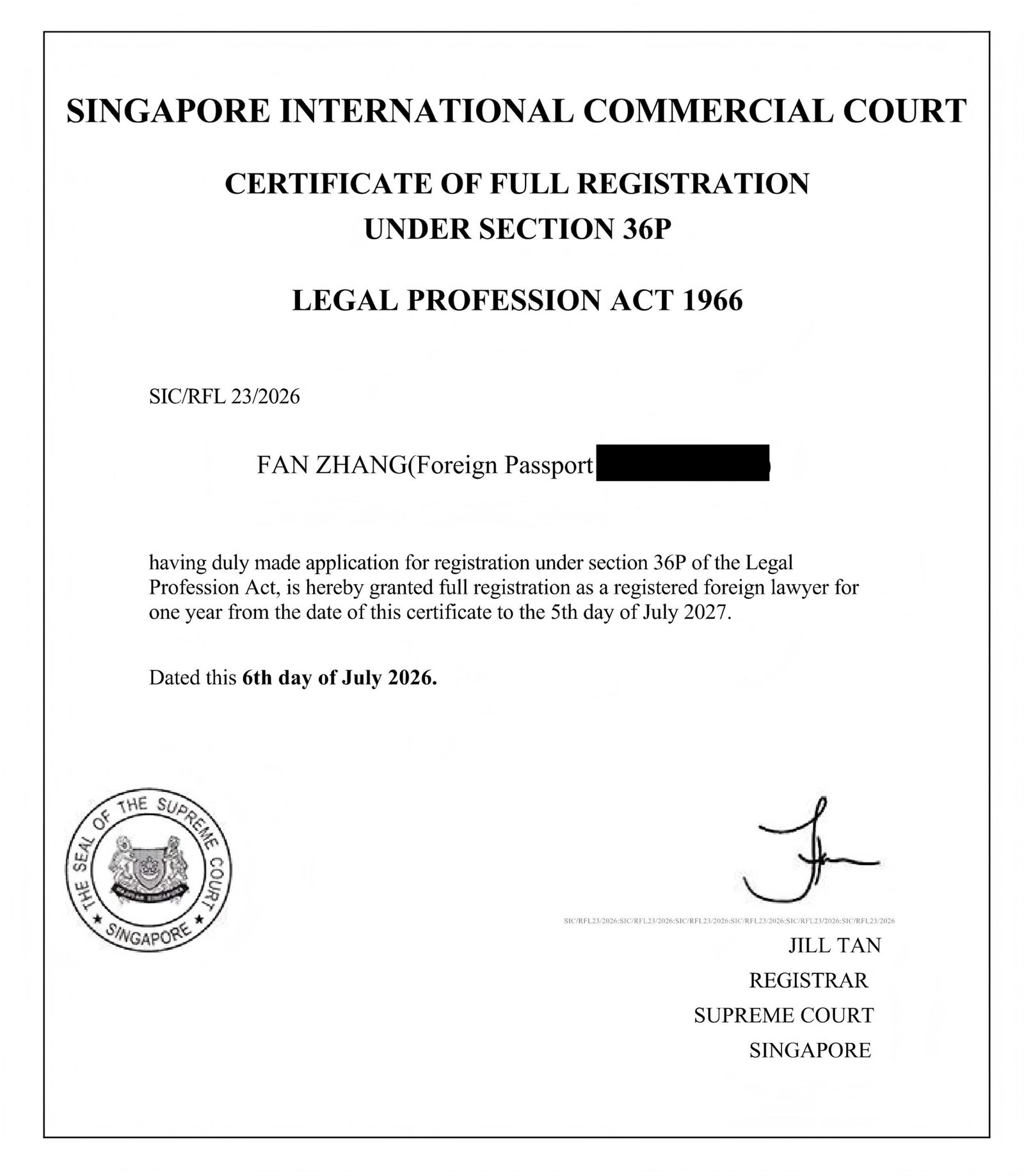
Certificate of Full Registration under Section 36P of the Legal Profession Act 1966 — Singapore International Commercial Court, Supreme Court of Singapore
What Is the Singapore International Commercial Court?
The Singapore International Commercial Court (SICC) is a division of the General Division of the High Court of Singapore. Unlike conventional arbitration, the SICC offers the procedural flexibility and international expertise that global businesses expect, combined with the enforceability of a national court judgment. The SICC model clauses for jurisdiction submission are available on the Singapore Judiciary website.
Key institutional features define the SICC’s unique position:
Court of Record
SICC judgments are enforceable as judgments of the High Court of Singapore, carrying the full weight of a sovereign judicial decision.
Hague Convention Framework
The Hague Convention on Choice of Court Agreements, ratified by Singapore in 2016, enhances cross-border enforceability of SICC judgments in contracting states.
Bilateral Enforcement
Under the Reciprocal Enforcement of Foreign Judgments Act 1959, SICC judgments benefit from established bilateral enforcement arrangements with multiple jurisdictions.
International Composition
Foreign judges and lawyers may participate in SICC proceedings, creating a genuinely international bench while preserving Singapore’s judicial standards.
Procedural Rules
The SICC Rules 2021 govern proceedings commenced on or after April 1, 2022, offering a modern, streamlined framework designed for complex commercial disputes.
Proven Track Record
With 249 written judgments issued to date, the SICC has established a substantial and growing body of jurisprudence in international commercial disputes.
Why This Matters for Cross-Border Disputes
For parties engaged in high-stakes international commerce, the choice of dispute resolution forum is a strategic decision with long-term consequences. The SICC addresses a critical gap in the market: it delivers the enforceability of a court judgment with the international character of arbitration.
Consider the enforceability architecture. An arbitration award under the New York Convention is enforceable in over 170 states — but the process requires separate recognition proceedings in each jurisdiction. A SICC judgment, by contrast, benefits from the Hague Convention framework (for choice-of-court agreements) and bilateral reciprocal enforcement arrangements, creating multiple, complementary pathways to execution. For parties with assets in Asia-Pacific jurisdictions, this dual enforcement architecture can be decisive.
Moreover, the SICC offers something arbitration typically cannot: appeals. SICC decisions are subject to appeal to the Singapore Court of Appeal, providing a structured appellate mechanism that ensures legal consistency and predictability — qualities that sophisticated commercial parties increasingly value in long-term contractual relationships.
The SICC is not simply an alternative to arbitration. It is a third path — one that preserves the enforceability of court judgments while embracing the internationalization that defines modern commerce.
A Tri-Jurisdictional Capability: United States, Singapore, and China
Fan Zhang’s SICC registration complements her cross-border practice. She is now credentialed to practice before:
SICC — Singapore
Registered Foreign Lawyer (SIC/RFL 23/2026) for international commercial litigation and Court of Appeal proceedings of offshore cases.
U.S. Federal Courts
California State Bar, CIT, Federal Circuit, Ninth Circuit, and two U.S. District Courts.
China — PRC Practice
Multi positions at JINGSH Law Firm, with deep expertise in Chinese corporate law, cross-border litigation and M&A, and regulatory compliance.
This tri-jurisdictional capability — United States, Singapore, and China — is rare. For disputes involving parties, assets, or contractual connections across these three major economies, it provides a single point of legal coordination that would otherwise require engagement of multiple, uncoordinated counsel in different jurisdictions.
Combined with her credentials as a ACCA-qualified professional and her background in international trade and finance together with technology, this registration enables a genuinely integrated approach to disputes that span legal, financial, and regulatory dimensions.
Considering the SICC for Your Cross-Border Dispute?
Experience your coordinated, tri-jurisdictional representation in international commercial disputes.
Contact for SICC Consultation
