
The “Regulations of the State Council of China on Outward Investment” (hereinafter referred to as the “Regulations”) will take effect on July 1, 2026. Article 22 has emerged as a critical focal point for the international arbitration community. This article sets a clear “Compliance Redline” for Chinese parties providing evidence in overseas proceedings.
What is Article 22? #
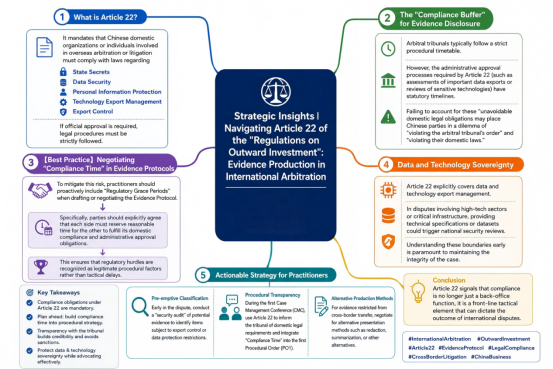
It mandates that Chinese domestic organizations or individuals involved in overseas arbitration or litigation must comply with laws regarding State Secrets, Data Security, Personal Information Protection, Technology Export Management, and Export Control when providing evidence. If official approval is required, legal procedures must be strictly followed.
Deep Dive: Strategic Implications for Arbitration: #
1. The “Compliance Buffer” for Evidence Disclosure #
Arbitral tribunals typically follow a strict procedural timetable. However, the administrative approval processes required by Article 22 (such as assessments of important data exports or reviews of sensitive technologies) have statutory timelines. Failing to account for these “unavoidable” domestic legal obligations may place Chinese parties in a dilemma of “violating the arbitral tribunal’s order” and “violating their domestic laws.”
2. 【Best Practice】Negotiating “Compliance Time” in Evidence Protocols #
To mitigate this risk, practitioners should proactively include”Regulatory Grace Periods” when drafting or negotiating the Evidence Protocol. Specifically, parties should explicitly agree that each side must reserve reasonable time for the other to fulfill its domestic compliance and administrative approval obligations. This ensures that regulatory hurdles are recognized as legitimate procedural factors rather than tactical delays.
3. Data and Technology Sovereignty #
Article 22 explicitly covers data and technology export management. In disputes involving high-tech sectors or critical infrastructure, providing technical specifications or datasets could trigger national security reviews. Understanding these boundaries early is paramount to maintaining the integrity of the case.
Actionable Strategy for Practitioners: #
Pre-emptive Classification: Early in the dispute, conduct a “security audit” of potential evidence to identify items subject to export control or data protection restrictions.
Procedural Transparency: During the first Case Management Conference (CMC), use Article 22 to inform the tribunal of domestic legal requirements and integrate “Compliance Time” into the first Procedural Order (PO1).
Alternative Production Methods: For evidence restricted from cross-border transfer, negotiate for alternative presentation methods such as redaction, summarization, or other alternatives.
Conclusion: #
Article 22 signals that compliance is no longer just a back-office function, it is afront-line tactical element that can dictate the outcome of international disputes.
#InternationalArbitration #OutwardInvestment #Article22 #EvidenceProtocol #LegalCompliance #CrossBorderLitigation #ChinaBusiness
This article is for informational purposes only and does not constitute legal advice. For case-specific consultation, please contact us. Read our full Legal Disclaimer, which also includes information on translation accuracy.


